Have you ever been so sure about something, only to realize later that you were completely wrong?
Nearly a thousand years ago, a man named Al-Ghazali was the most famous teacher in the world. He lived during the Islamic Golden Age, a time when libraries were like palaces and ideas were more valuable than gold. But at the height of his success, he began to wonder if anything he knew was actually true.
Imagine walking through the streets of Baghdad in the year 1091. The city is a circle, protected by massive walls, and at its center is a library called the House of Wisdom.
This was a world of logic and debate. Scientists were measuring the stars, doctors were writing medical textbooks, and philosophers were translating the works of the ancient Greeks.
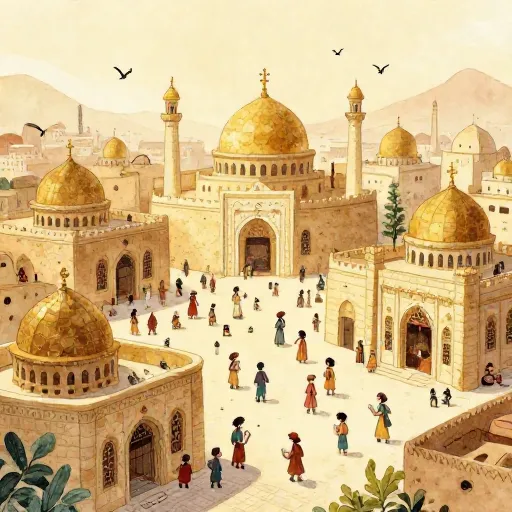
Imagine a city where the air smells of cinnamon and parchment paper. Baghdad was the largest city on Earth, filled with parks, markets, and over 100 bookshops. In the grand libraries, scholars from different religions sat together to solve math problems and translate ancient scrolls.
At the center of all this excitement was Al-Ghazali. He was the head of the Nizamiyya, the most famous school in the world.
He was so brilliant that people called him the Proof of Islam. When he walked through the halls, hundreds of students stopped to listen.

Finn says:
"If he was already the most famous teacher, why did he feel like he didn't know anything? I'd be happy just knowing how to pass my spelling test!"
But Al-Ghazali had a secret. Even though he could win any argument, he felt like he was standing on shaky ground.
He began to ask himself a difficult question: How do I know that my senses aren't lying to me? It is a question that sounds simple, but once you start thinking about it, it becomes very big.

Next time you are in a car or a train, look at the moon. It looks like it is following you, doesn't it? But you know it is actually far away in space. Your eyes see one thing, but your mind knows another. This is the exact feeling that started Al-Ghazali's big adventure.
He looked at a shadow on the ground. To his eyes, the shadow seemed to be standing still.
But he knew that the sun was moving across the sky and the shadow was actually moving, inch by inch. If his eyes were wrong about the shadow, what else were they wrong about?
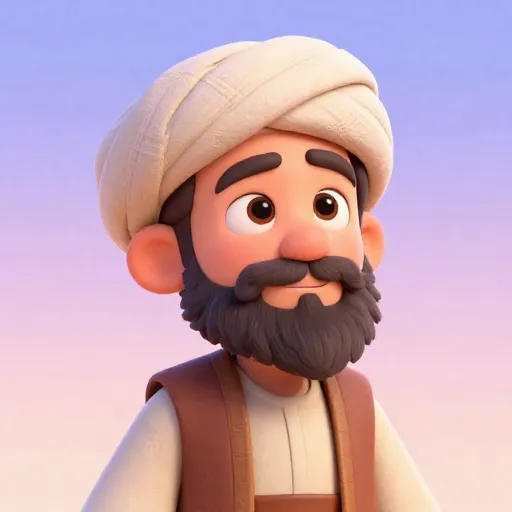
The senses said, 'It is impossible for us to be wrong.' But then Reason appeared and said, 'You are wrong.'
This doubt grew until Al-Ghazali felt like he was lost in a fog. He looked at the stars and thought about how small they looked, even though he knew they were massive.
He realized that our reason, the part of our brain that solves puzzles, often has to correct what our eyes see. But then he wondered: what if something else needs to correct our reason?

Al-Ghazali's 'crisis of doubt' happened 500 years before the famous French philosopher René Descartes. Descartes is famous for saying 'I think, therefore I am,' but Al-Ghazali was asking almost the exact same questions centuries earlier in a tower in Damascus!
Things got so intense that Al-Ghazali literally lost his voice. He would stand in front of his class, ready to give a lecture, and no words would come out.
Doctors came to see him, but they couldn't find anything wrong with his throat. His problem wasn't in his body: it was in his mind.

Mira says:
"His voice stopped because his brain was asking too many questions at once. It's like when your computer freezes because you opened too many tabs."
To find the answer, Al-Ghazali did something that shocked everyone. He gave away his expensive clothes, left his famous job, and walked out of Baghdad.
He became a Sufi, a person who believes that truth is found through the heart rather than just through books. For eleven years, he traveled and lived a simple life.
The best way to find the truth is to study hard, read every book you can find, and use logic to solve every problem like a puzzle.
The best way to find the truth is to be still, listen to your heart, and experience the world directly instead of just reading about it.
During this time, he practiced meditation. He believed that the heart is like a mirror.
If a mirror is covered in dust, it cannot reflect the light of the sun. Al-Ghazali thought that our hearts get dusty with worries, pride, and distractions.

The heart is like a mirror, and the things we do are like the polish that makes it shine.
When we clean the mirror of the heart, Al-Ghazali believed we can see a different kind of truth. He called this Certainty.
It is not the kind of certainty you get from solving a math problem. It is the kind of certainty you feel when you know someone loves you, or when you feel at peace in nature.
Mira says:
"I like the idea of the heart being a mirror. It means that the truth is already there, we just have to keep ourselves clear enough to see it."
Eventually, Al-Ghazali began to write again. He wrote a book called The Incoherence of the Philosophers, where he argued with people who thought logic could explain everything.
He didn't think logic was bad, but he thought it had limits. He compared it to a set of scales: great for weighing gold, but not for weighing the ocean.
Al-Ghazali was a huge fan of fables. He often used stories about animals, like a donkey carrying books or a moth drawn to a flame, to explain complicated ideas to his students so they would remember them forever.
Al-Ghazali's ideas changed the way people in the Islamic world thought about God and the world. He brought together the head and the heart.
He showed that you could be a scientist and a person of faith at the same time. He believed that the inner world was just as vast and important as the outer world.
Through the Ages
Today, Al-Ghazali is remembered as one of the most important thinkers in history. His journey from the classroom to the desert reminds us that it is okay to be unsure.
Sometimes, losing your way is the only way to find out where you really stand. It takes courage to admit you don't have all the answers.

The thirst for the truth of things was my habit from my early years.
Even now, philosophers look back at his work when they want to understand what it means to truly "know" something. He reminds us that the mind is a wonderful tool, but the heart is a powerful compass.
Something to Think About
If you couldn't trust your eyes or your ears for one day, how would you decide what is real?
There isn't a single correct answer to this. Some people think we use our feelings, some think we use our memories, and some think we just have to trust that the world is there. What do you think?
Questions About Philosophy
Did Al-Ghazali hate science?
What is a Sufi?
Why did he stop talking?
The Unfinished Journey
Al-Ghazali's story doesn't end with a perfect set of rules. It ends with a reminder that the world is much bigger than what we see in front of us. Whether you are looking through a microscope or sitting quietly in your room, there is always more to discover about the 'inner light' he spent his life searching for.
