Have you ever looked at a seashell, a beetle, or a star and wondered why it is exactly the way it is?
Over 2,300 years ago, a man named Aristotle spent his entire life asking those exact questions. In Ancient Greece, he became one of the most famous thinkers in history by creating a new way to study philosophy, science, and how to be a good person.
Imagine walking through a dusty, sun-drenched garden in Athens. You are surrounded by people talking, laughing, and arguing about the meaning of life.
In the center of it all is a man with a sharp gaze and a curious smile. He is not looking up at the clouds or dreaming of invisible worlds. Instead, he is crouching down to look at a honeybee on a flower.
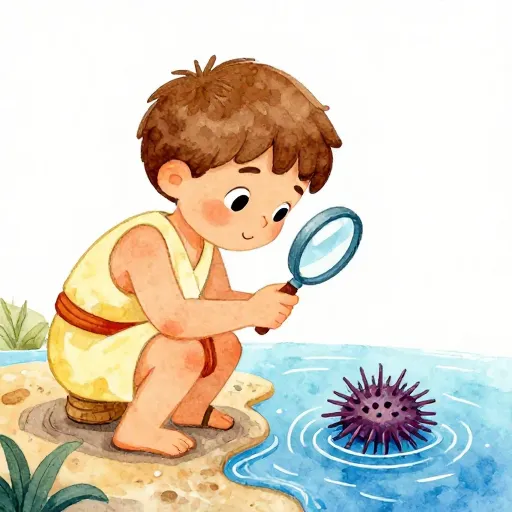
Imagine you are six years old, crouching in a tide pool on the Greek coast. While other kids are playing tag, you are watching a sea urchin. You notice how it moves, how many spikes it has, and what it eats. This habit of 'looking closely' is how Aristotle became the world's first true scientist.
Aristotle was born in a small town called Stagira. His father was a doctor for a king, which meant Aristotle grew up around medicine and biology.
From a young age, he learned that if you want to understand how a body works, you have to look at it closely. You have to touch, measure, and observe the real world around you.
The Student and the Teacher
When he was seventeen, Aristotle traveled to the great city of Athens. He joined the most famous school in the world: the Academy.
His teacher was Plato, another legendary philosopher. For twenty years, they worked together, but they did not always see the world the same way.
All men by nature desire to know.
Plato believed that the "real" world was a place of perfect ideas that we can only see in our minds. For example, Plato thought there was a perfect "Idea of a Chair" somewhere in the universe, and every chair we sit on is just a blurry copy of it.
Aristotle disagreed. He thought that if you want to know what a chair is, you should look at the chairs right in front of you.
The truth is 'up there' in a world of perfect ideas. To find it, we must use our minds to look past the physical world.
The truth is 'down here' in the things we can see and touch. To find it, we must study nature as it actually is.
This was the beginning of Empiricism. This is the big idea that we gain knowledge by using our five senses: sight, touch, smell, hearing, and taste.
Aristotle believed the world was not a distraction from the truth. He believed the world was the truth.

Finn says:
"If Plato was right and the 'real' world is in our heads, does that mean my dog is just a blurry copy of a perfect Idea of a Dog? I think I like the real dog better!"
The Walking School
After Plato died, Aristotle eventually started his own school called the Lyceum. It was very different from schools today.
Instead of sitting at desks, Aristotle and his students walked together under covered porches called peripatos. This is why his followers were called the Peripatetics, which basically means "the walkers."

Aristotle’s school, the Lyceum, had the first great library in history. He collected hundreds of scrolls, but he also collected 'data.' He once asked his students to help him study every single political system in the known world to find out which one worked best!
They walked and talked about everything. Aristotle wanted to organize all the knowledge in the human mind.
He wrote books on the weather, the way animals breathe, how government should work, and even the way poetry makes us feel. He was like a human encyclopedia before encyclopedias were even invented.
Finding the Middle Path
Aristotle didn't just care about how bugs lived or how stars moved. He cared deeply about how humans should live, a subject called Ethics.
He wanted to know: what is the secret to a happy life? He used a special word for this kind of deep, meaningful happiness: Eudaimonia.

For the things we have to learn before we can do them, we learn by doing them.
To reach this happiness, Aristotle came up with a famous tool called the Golden Mean. He believed that being a good person meant finding the perfect balance between two extremes.
Think about being brave. If you have too much bravery, you are reckless and do silly, dangerous things. If you have too little, you are a coward who is afraid of everything.
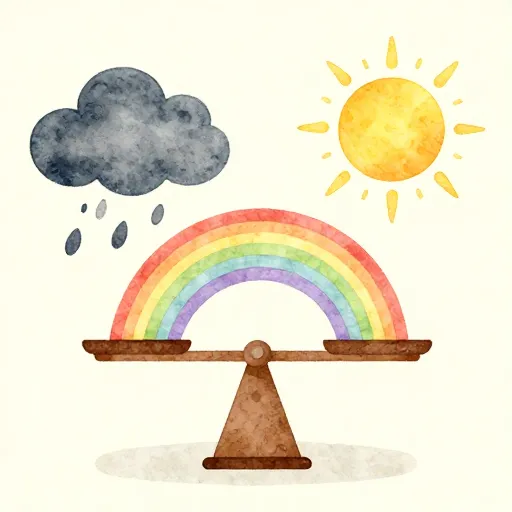
Pick a character trait, like 'Honesty.' Can you find the Golden Mean? What does it look like to have 'too much' honesty (where you might be mean or hurtful)? What does it look like to have 'too little' (lying)? What is the perfect balance in the middle?
The Golden Mean is the sweet spot right in the middle. It is being brave at the right time, for the right reason, and in the right way.

Mira says:
"The Golden Mean makes so much sense. It's like finding the perfect temperature for cocoa: not too hot to burn you, but not too cold to be boring. It's the 'just right' middle."
The Art of Clear Thinking
One of Aristotle's greatest gifts to the world was Logic. He wanted to create a system so people could tell the difference between a good argument and a bad one.
He invented something called the Syllogism. This is a three-step way of proving that something is true.
- Start with a big truth: All humans need to breathe.
- Add a specific fact: Mira is a human.
- Find the conclusion: Therefore, Mira needs to breathe.
By following these steps, Aristotle showed that we can use our brains to discover new truths without having to guess. This became the foundation for almost all modern science.
The Four Causes
Aristotle was obsessed with why things happen. He believed that to truly know something, you had to understand its "Four Causes."
Imagine you are looking at a beautiful marble statue of a lion. Aristotle would ask four questions to explain it:
- The Material Cause: What is it made of? (In this case, marble.)
- The Formal Cause: What is its shape or design? (The shape of a lion.)
- The Efficient Cause: Who made it? (The sculptor with their tools.)
- The Final Cause: What is its purpose? (To decorate a temple or honor a king.)
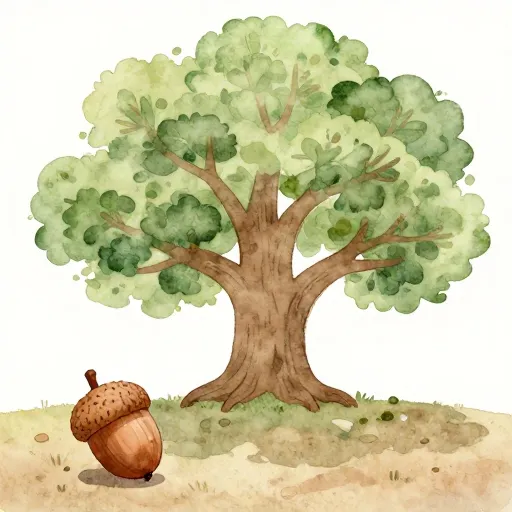
Think about an acorn. Its 'Final Cause' is to become an oak tree. Aristotle believed that humans have a purpose too. Our purpose is to use our unique ability to think and reason to live a life of virtue and happiness.
Aristotle believed that everything in nature, from a rain cloud to a human heart, had a "Final Cause" or a purpose. He thought the world was a place where everything was trying to become the best version of itself.
The Teacher of Kings
Aristotle's fame grew so much that the King of Macedonia asked him to do a very special job. He wanted Aristotle to tutor his young son, Alexander.
Aristotle taught the boy about philosophy, medicine, and the great stories of Homer. That boy grew up to be Alexander the Great, one of the most famous conquerors in history.
Finn says:
"I wonder if Alexander the Great ever got in trouble for not doing his philosophy homework? It must be weird to have the smartest man in the world as your teacher."
Even though Alexander was busy conquering lands, he stayed in touch with his teacher. Legend says he even sent Aristotle samples of strange plants and animals from the far-off places he visited.
Aristotle's Ideas Through the Ages
Why Aristotle Matters Today
Aristotle died a long time ago, but his way of looking at the world changed everything. He taught us that the world is a giant puzzle waiting to be solved.
He didn't want us to just accept what people told us. He wanted us to look at the evidence, use our logic, and find the balance in our own lives.

Friendship is a single soul dwelling in two bodies.
When you see a scientist today observing a cell under a microscope, they are following in Aristotle's footsteps. When you stop yourself from being too angry or too shy, you are practicing his Golden Mean.
He showed us that wonder is the beginning of all wisdom. By looking closely at the smallest things, we can begin to understand the biggest ideas in the universe.
Something to Think About
If you were to start your own school today, would you walk while you learned? What would you and your friends choose to observe first?
Aristotle believed there was no limit to what we could learn if we just paid attention. There are no right or wrong answers here, just the start of your own investigation.
Questions About Philosophy
Did Aristotle really know everything?
Why did he tutor Alexander the Great?
What is his most important book?
Keep Looking Closer
The next time you find a strange rock or wonder why a friend is acting a certain way, remember Aristotle. He believed that the world is a wonderful, logical place, and that your own curiosity is the best tool you have to explore it. You don't need a lab to be a philosopher, you just need to keep your eyes open and your mind moving.