Have you ever done something wrong just because you knew you weren't supposed to do it?
Around 1,600 years ago, a man named Augustine sat down to write the world's first true autobiography. He didn't just write about his adventures: he wrote about his feelings, his mistakes, and his endless questions about truth and time.
Imagine standing on the edge of the Mediterranean Sea in the year 380. The sun is hot, the sand is golden, and the air smells like salt and olives. This was the world of Augustine, a brilliant student from North Africa who couldn't stop wondering about why the world is the way it is.
He grew up in a town called Thagaste, in what we now call Algeria. Back then, it was part of the massive Roman Empire. Augustine was a Berber, a member of the local people who had lived there for thousands of years, but he spoke and wrote in Latin.
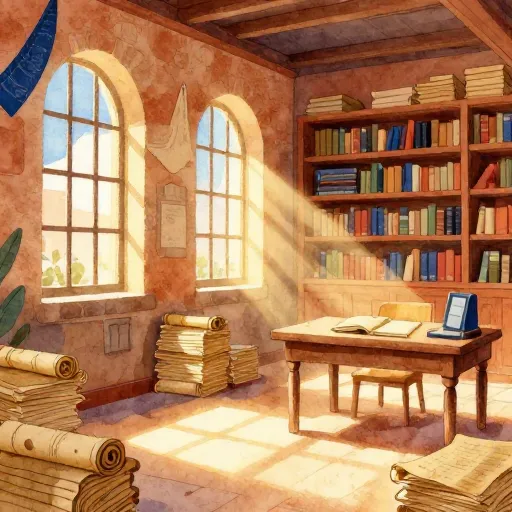
Imagine the library in Hippo. It is filled with thousands of scrolls made of papyrus. Outside, the Mediterranean sun is bright, but inside it is cool and quiet. Augustine is sitting at a wooden desk, dipping a reed pen into black ink, writing down thoughts that people will still be reading 1,600 years later.
His parents noticed early on that he was incredibly smart. They saved every penny they had to send him to the best schools. They wanted him to become a famous teacher of rhetoric, which is the art of speaking so well that you can convince anyone of anything.
Augustine was very good at it. He traveled to big, noisy cities like Carthage, Rome, and Milan. He loved fame, he loved winning arguments, and he loved having fun with his friends. Yet, even when he had everything he thought he wanted, he felt like something was missing.

Mira says:
"Augustine reminds me of a puzzle enthusiast. He had all these pieces of his life: fame, friends, books: but he kept feeling like the most important piece was still hiding under the sofa."
The Mystery of the Pears
One of the most famous stories Augustine ever told was about a pear tree. When he was about sixteen, he and a gang of friends went out in the middle of the night. They found a neighbor’s tree that was heavy with fruit.
They didn't steal the pears because they were hungry. In fact, Augustine said the pears weren't even very tasty, and he had better ones at home. They shook the tree, gathered the fruit, and then threw it all to some pigs.

Augustine's 'Confessions' was the first book in history where someone looked back at their childhood and tried to understand their own psychology. Before him, most people only wrote about the 'big' things like wars or kings. Augustine thought the small things, like stealing a pear, were just as important.
This tiny event haunted him for the rest of his life. Why did he do it? If the pears weren't good, and he didn't need them, why was it so fun to take them? He realized that he did it simply because it was forbidden.
He began to think that humans have a strange 'restlessness' inside them. We often choose things that don't make us happy, or things that are unkind, just to see what it feels like to be in control. This led him to ask a massive question: Where does 'badness' even come from?
Our hearts are restless until they find rest in You.
A Hole in the Light
For a long time, Augustine followed a group called the Manichaeans. They believed that the world was a literal battlefield between a Good God of Light and a Bad God of Darkness. To them, 'Evil' was a real, physical thing that lived in the world.
But as Augustine studied more philosophy, especially the ideas of Plato, he started to disagree. He came up with a mind-bending idea. He suggested that evil is not a 'thing' at all. Instead, it is the absence of good.
Evil is a real, powerful force or a 'Dark God' that fights against the Light. It is like a black paint that someone splashed onto a white wall.
Evil isn't a substance at all. It is just the 'privation' (the lack) of good. It is more like a hole in the wall than a splash of paint.
Think about a hole in your favorite t-shirt. You can see the hole, and the hole might be a problem, but can you go to the store and buy a bag of 'holes'? No, because a hole is just a place where the fabric is missing.
Augustine argued that everything in the universe is naturally good. When we see something 'bad' or 'evil,' we are actually seeing a place where goodness has been moved or forgotten. It is like a shadow: a shadow isn't a dark blanket thrown on the ground, it's just a spot where the light is being blocked.

Finn says:
"So if evil is like a shadow, does that mean we shouldn't be afraid of it? You can't be hurt by a shadow, but it still makes the room feel different, doesn't it?"
The Mystery of Time
Augustine didn't just worry about goodness: he also worried about the clock. He spent a huge part of his life trying to figure out what time actually is. This is a question that still makes scientists and philosophers scratch their heads today.
He noticed something very strange. The 'past' doesn't exist anymore, because it is gone. The 'future' doesn't exist yet, because it hasn't happened. And the 'present' is so short that by the time you think about it, it has already become the past.

Try to catch the 'Now.' Sit quietly for ten seconds. Every time you think 'this is the present,' that moment has already moved into the past! Augustine realized that our minds are like a bridge that connects what we remember to what we hope for.
If none of those parts of time 'exist' in the world, where are they? Augustine’s answer was that time exists in our consciousness. Our minds create time by remembering what happened and expecting what will happen next.
He believed that God, however, lives in eternity. To Augustine, eternity isn't just a really long time. It is a place completely outside of time, where everything that ever happened and ever will happen is seen all at once, like a giant map spread out on a table.
What then is time? Provided that no one asks me, I know: if I want to explain it to an inquirer, I do not know.
The Two Cities
While Augustine was busy thinking about time and light, the world around him was falling apart. In the year 410, the city of Rome was attacked and captured by a group called the Visigoths. For people living then, this was like the end of the world.
Everyone was terrified. Many people blamed the new religion, Christianity, for making the Empire weak. Augustine decided to write a massive book called The City of God to help people understand what was happening to their history.
Mira says:
"It's like having two different apps open on your phone at once. One is for your own games, and the other is a group chat where you help your friends. We're always switching between them."
He said that everyone in the world is living in two different 'cities' at the same time. These aren't cities with walls and gates, but cities in our hearts. He called them the City of Man and the City of God.
- The City of Man is built on 'love of self.' It is about power, wanting to be better than others, and keeping things for yourself.
- The City of God is built on 'love of others.' It is about being kind, seeking truth, and working for the good of everyone.
Augustine argued that earthly empires, like Rome, will always eventually crumble because they are built on the City of Man. But the City of God is eternal because love and truth don't have an expiration date. He told people not to be afraid of the changing world, but to focus on which 'city' they were building with their choices.

Augustine is the 'Patron Saint of Printers.' This is funny because the printing press wasn't even invented until 1,000 years after he died! People gave him this title because he wrote so many books (over five million words!) that he kept the early copyists very busy.
Living through the End
Augustine ended his life in the city of Hippo, where he had become a leader (a bishop). Even as he grew old, he didn't stop writing. He spent his final days with his friends, talking about ideas and helping his neighbors.
As he lay dying, a group of invaders called the Vandals were actually surrounding his city. He could hear the sounds of war outside his window. Yet, he remained calm, focused on the books in his library and the people who needed him.

Love, and do what thou wilt.
Augustine Through the Ages
His ideas changed the way people in Europe thought for over a thousand years. He was one of the first people to say that our 'inner world' - our thoughts and memories - is just as important as the 'outer world' of trees and stones. He taught us that it is okay to be restless and full of questions, because searching for answers is how we grow.
Something to Think About
If you could talk to the Augustine of the future, what would you ask him about time?
There are no right or wrong answers here. Thinking about time is like looking into a very deep well: the more you look, the more you see.
Questions About Philosophy
Was Augustine a real person?
What is 'Original Sin'?
Why is he called 'Augustine of Hippo'?
Keep Wandering
Augustine taught us that being 'restless' isn't a bad thing. It's the engine that drives us to find truth. Next time you see a shadow or a hole in a sock, remember the boy from North Africa who saw a whole philosophy in the empty spaces.
