
Have you ever wondered if you can be absolutely, 100 percent sure that anything is true?
Bertrand Russell spent nearly a century asking that very question. He was a philosopher who believed that we should use logic like a flashlight to find the truth, even when the world feels messy and confusing.
Imagine a world where the adults around you seem to know everything, yet they cannot explain why. This was the world of young Bertrand Russell. He grew up in a massive, cold house in England called Pembroke Lodge during the late 1800s.
His parents were gone, and he was raised by his grandmother, a strict lady who didn't allow much fun. The house was filled with long, dark hallways and silent rooms. For a lonely boy, the world felt like a place of secrets and rules that didn't always make sense.

Imagine a boy sitting alone in a library so large the tops of the shelves are lost in the shadows. He is surrounded by thousands of books, each one a different person's attempt to explain the world. He decides right then that he won't stop until he finds the one book that is actually right.
Bertrand found his escape in the family library. He didn't just read stories, he looked for foundations. He wanted to find the one thing in the universe that was definitely, undeniably true. Most people told him to just 'have faith,' but Bertrand wanted proof.
When he was eleven, his older brother began to teach him geometry. For Bertrand, this was like a lightning bolt. Here was a world where you didn't have to guess. You could prove things using shapes and numbers.

Mathematics, rightly viewed, possesses not only truth, but supreme beauty.
The Quest for the Perfect Language
As Bertrand grew older, he realized that humans often argue because our language is fuzzy. Words can mean different things to different people. He wondered if there was a way to turn human thought into a kind of math.
He wanted to create a perfect language where every sentence could be proven right or wrong, just like 2 + 2 = 4. This field of study is called analytical philosophy. It is the art of breaking big, messy ideas down into tiny, logical pieces.

Finn says:
"If we turned our whole language into math, would that mean we'd never have misunderstandings again? Or would we just have really long homework?"
He spent years writing a massive set of books called Principia Mathematica. It was so complicated that it took him and his friend Alfred North Whitehead hundreds of pages just to prove that 1 + 1 really does equal 2.
Why spend years on something so simple? Because Russell believed that if the foundations of our thinking are weak, the whole building might fall down. He wanted to make sure the floor we were standing on was solid stone, not shifting sand.
The 'Why' Game: Russell was a master of asking 'why.' Try this with a friend: ask them a simple fact, like 'The sky is blue.' Then ask 'Why?' to whatever answer they give. See how many steps it takes before you reach something that nobody can truly prove. That 'I don't know' moment is where philosophy begins!
The Barber Who Only Shaved Himself
While Russell was trying to build this perfect system of math, he ran into a giant problem. It is now called Russell's Paradox. It is a bit like a brain teaser that breaks the rules of logic, and it bothered him for a long time.
Think about a village with only one barber. This barber has a very specific rule: he shaves all those, and those only, who do not shave themselves. It sounds simple, right? But then Russell asked the magic question: Does the barber shave himself?
If the barber shaves himself, he is a person who shaves himself. But his rule says he ONLY shaves people who don't shave themselves. So he CAN'T shave himself.
If he doesn't shave himself, then he is one of the people who doesn't shave himself. But his rule says he MUST shave everyone who doesn't shave themselves. So he MUST shave himself.
If the barber shaves himself, he is breaking his rule because he only shaves people who don't shave themselves. But if he doesn't shave himself, then he must shave himself according to the rule! This kind of loop is called a paradox.
Russell used this puzzle to show that even the most careful math can have holes in it. It was a moment of deep uncertainty. Even his 'solid stone' foundation had a crack in it, and he was brave enough to admit it.

Mira says:
"That barber paradox makes my head spin! It’s like a glitch in the Matrix. It shows that even the smartest rules can have a 'wait a minute' moment."
The Teapot in the Stars
Russell didn't just think about numbers. He thought about how we decide what to believe in everyday life. He was a famous skeptic, which means he didn't believe things just because they were popular or traditional.
To explain this, he came up with a famous story called 'Russell's Teapot.' Imagine if someone told you there was a tiny china teapot orbiting the sun, right between Earth and Mars. They say it is too small to see with any telescope.
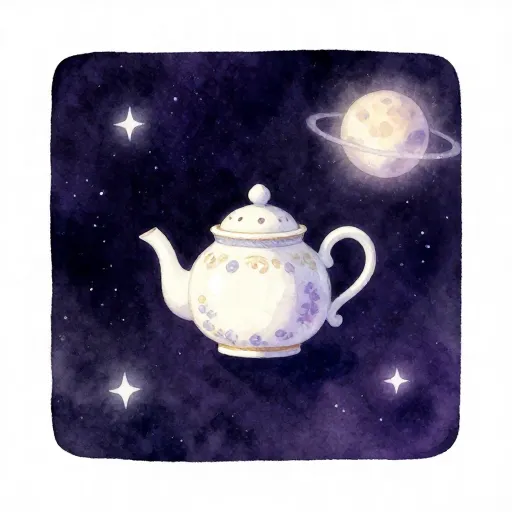
Russell's Teapot is so famous that it even shows up in pop culture! Some rock bands have used it as an album cover, and it's a common way for scientists today to explain why we shouldn't believe in things just because they can't be disproven.
If you can't see it, you can't prove it's NOT there. But does that mean you should believe it is? Russell said no. He argued that the burden of proof lies with the person making the claim, not the person who is questioning it.
This idea changed how people think about science and religion. It taught us that 'I don't know' is often a more honest answer than 'I believe it because you said so.' It invites us to be curious detectives instead of just listeners.
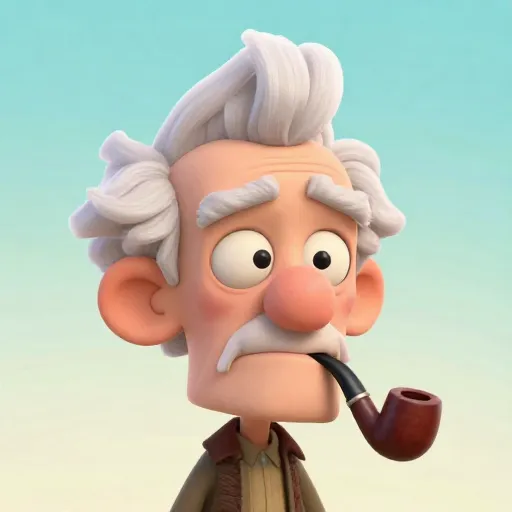
The whole problem with the world is that fools and fanatics are always so certain of themselves, and wiser people so full of doubts.
The Man Who Chose Peace
Russell lived through two World Wars. He saw that logic wasn't just for books, it was for how we treat other people. He became a famous pacifist, someone who believes that war is a terrible way to solve problems.
During World War I, he spoke out against the fighting when almost everyone else was cheering for it. He was even sent to prison for his ideas. But Russell didn't mind prison too much, he used the quiet time to read and write more books!
The Journey of Logic
He believed that most of the world's problems came from people being too certain that they were right and their enemies were wrong. He called for tolerance and kindness. He thought that if we could look at the world logically, we would see that we are all much more alike than we are different.
In his final years, he became a leader in the movement to stop nuclear weapons. He was still protesting and giving speeches when he was 90 years old! He never lost his fire for the truth or his love for the world.
Finn says:
"So Russell used logic to prove math, but then used that same logic to say we should be kinder to each other? I guess being smart and being kind aren't different things after all."
Wisdom Over Knowledge
There is a difference between knowing facts and having wisdom. Russell had plenty of both, but he valued wisdom more. To him, wisdom was the ability to hold your own ideas gently, knowing you might be wrong one day.
He once said that the trouble with the world is that the stupid are cocksure while the intelligent are full of doubt. He wanted us to be comfortable with that doubt. He wanted us to see the world as a place of wonder, where every answer leads to a better question.
Bertrand Russell won the Nobel Prize in Literature in 1950. Even though he wrote about 'dry' subjects like math and logic, he did it with so much wit, clarity, and beauty that the world decided it was great art.
As you walk through your day, you can practice being a little bit like Russell. When someone tells you something is 'obvious,' ask them why. When you find a puzzle that seems to have no answer, don't get frustrated: get interested.
Russell's life reminds us that being smart isn't about having all the answers. It is about having the courage to keep looking, even when the path is foggy and the destination is far away.
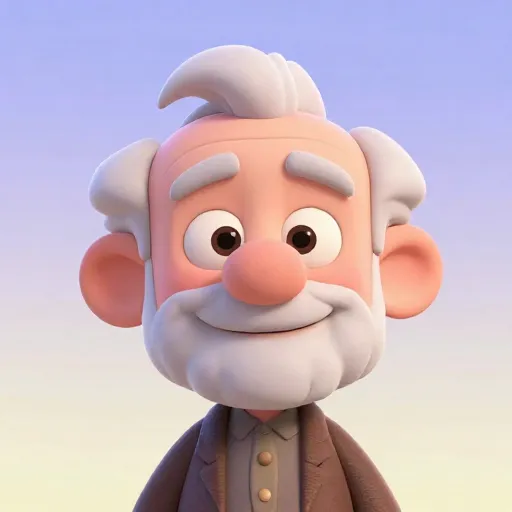
Love is wise, hatred is foolish.
Something to Think About
If you could find the answer to just one 'Why' in the entire universe, which one would you choose?
There are no right or wrong answers here. Some people want to know why the universe exists, while others want to know why we feel love. What is your big question?
Questions About Philosophy
Did Bertrand Russell actually prove that 1+1=2?
Was Bertrand Russell a scientist?
Why is the teapot story so important?
Keep Hunting for the Light
Bertrand Russell's life was a long, beautiful search for clarity. He showed us that logic isn't just a classroom subject: it is a way to be free. By questioning what we are told and looking for real proof, we become masters of our own minds. Whether you are looking at a math problem or a world event, remember to bring your flashlight.