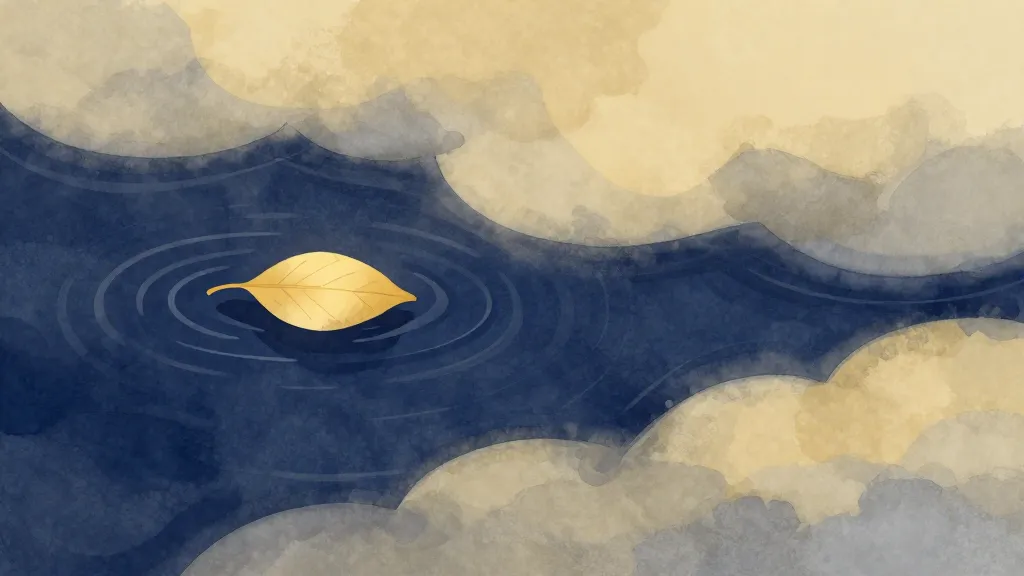
Have you ever noticed that the 'you' who woke up this morning is just a little bit different from the 'you' sitting here right now?
Over 2,500 years ago, a prince in ancient India began to ask deep questions about why people feel sad and how they can find lasting peace. This journey led to the birth of Buddhism, a way of thinking that focuses on the mind, the nature of change, and how we are all connected to the world around us.
Imagine a world of tall Himalayan peaks, dense green jungles, and bustling kingdom gates in ancient India. This is where our story begins, around the 5th century BCE. A young man named Siddhartha Gautama lived a life of incredible luxury, surrounded by silk robes and golden plates.
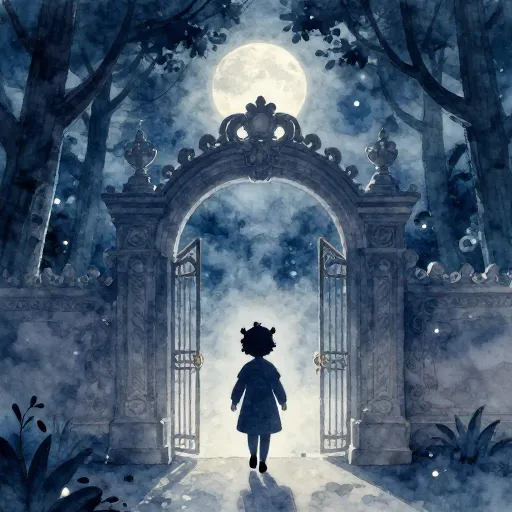
Imagine a young prince sneaking out of a palace at midnight. The moon is bright, and he is leaving behind his crown, his horse, and his soft bed. He isn't running away because he is angry: he is running away because he is curious about the truth.
Even with all that treasure, Siddhartha felt something was missing. He noticed that outside his palace walls, people got sick, they grew old, and they passed away. He started to wonder: if everything we love eventually changes or disappears, how can we ever truly be happy?
The Search for the Middle Way
Siddhartha left his palace to find the answer. For years, he lived like a hermit, eating almost nothing and trying to find wisdom through extreme hardship. But he soon realized that being totally empty was just as distracting as being totally full.

Finn says:
"So if the Middle Way is like a guitar string, does that mean I should only eat 'medium' amounts of pizza? What if it's really good pizza?"
He decided to take a different path, which he called the Middle Way. It is the idea that the best way to live is not to have too much or too little. It is like tuning a guitar string: if it is too tight, it snaps: if it is too loose, it won't play a note.
Find a rubber band. Stretch it until it is almost ready to snap: that is the 'too tight' life of stress. Let it go so it is totally floppy: that is the 'too loose' life of being bored. Now, hold it just firm enough to snap it gently. That balance is the Middle Way!
After finding this balance, he sat down under a giant fig tree, now known as the Bodhi Tree. He vowed not to get up until he understood the truth about life. As the sun rose the next morning, he felt a massive shift in his mind: he became the Buddha, which means 'the enlightened one' or 'the one who woke up.'
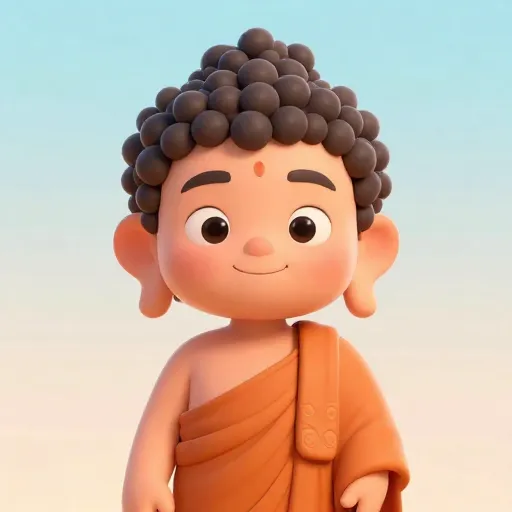
The mind is everything. What you think you become.
The Idea of Impermanence
One of the biggest 'Big Ideas' the Buddha shared is something called Impermanence. This is the observation that nothing in the entire universe stays the same forever. Think about a cloud in the sky: it looks solid, but it is actually moving and shifting into new shapes every second.

The original Bodhi Tree where the Buddha sat is gone, but its 'grandchildren' are still alive! People took cuttings of the tree and planted them in other places. One of them in Sri Lanka is over 2,200 years old, making it one of the oldest trees in the world planted by humans.
Our feelings are like this, too. When you feel a burst of anger or a wave of joy, it feels like it might last forever. But Buddhist philosophy teaches us that these feelings are just like weather passing through the sky of our minds.
If you look closely at a river, you will see that you can never step into the same water twice. The river is always flowing, and you are always changing, too.

Mira says:
"Wait, if the river is always different water, and my cells are always being replaced, who is the 'me' that stays the same? That's a little bit spooky and a little bit cool."
The Great Web of Connection
If everything is changing and moving, how do things stay together? The Buddha taught about Interconnectedness, the idea that nothing exists all by itself. We often think of ourselves as separate islands, but we are more like waves in the same ocean.
Some people think Buddhism says that life is only full of suffering and sadness, so we should try to escape it.
Others argue that Buddhism says life is actually a wonderful mystery, and we just need to stop 'clinging' to things so we can enjoy the ride.
To understand this, look at a piece of paper. To have that paper, you need a tree. To have the tree, you need rain, soil, sunshine, and a person to plant the seed. Without the sun, the paper couldn't exist: so, in a way, the sun is 'inside' the paper.

If you are a poet, you will see clearly that there is a cloud floating in this sheet of paper.
This way of looking at the world changes how we treat people and nature. If we are all part of the same big web, then being kind to someone else is actually a way of being kind to ourselves. Many Buddhists call this Compassion, which is the wish for everyone to be free from struggle.
The Art of Waking Up
So, how do we actually use these ideas? The main tool in Buddhist philosophy is Mindfulness. This simply means paying 100% attention to what is happening right now, without wishing it were different.
Try the 'Mindful Snack' challenge. Take one raisin or a slice of apple. Before you eat it, look at its texture. Smell it. Then, chew it as slowly as you can, noticing every single flavor. Does it taste different when you give it all your attention?
When we practice mindfulness, we stop worrying about what happened yesterday or what might happen tomorrow. We focus on the feeling of our breath, the sound of the wind, or the taste of an apple. We learn to be 'awake' to our own lives.

Just as a mother would protect her only child at the risk of her own life, even so, cultivate a boundless heart towards all beings.
Living with the Wheel
Buddhist thinkers often talk about life as a wheel. Sometimes the wheel is at the top (things are going great!) and sometimes it is at the bottom (things are tough). They call the feeling of the wheel being 'stuck' or 'out of balance' Dukkha.
Finn says:
"I wonder if being mindful makes time go slower. Like, if I'm really focused on my homework, does it feel like it takes a million years, or does it just feel... interesting?"
Usually, we try to make the good times stay forever and we try to push the bad times away as fast as possible. But the Buddha suggested that this constant pushing and pulling is what makes us tired. Instead, he taught that we can learn to stay calm while the wheel turns.
Buddhism Through the Ages
The Many Paths of Buddhism
Over thousands of years, these ideas traveled from India to China, Japan, Tibet, and eventually the whole world. Different groups, or schools, formed to study these ideas in different ways.
- Theravada focuses on the original teachings and personal wisdom.
- Mahayana emphasizes the idea that we should help everyone else get 'un-stuck' before we do.
- Zen uses riddles and sitting in silence to see the world clearly.
No matter the school, the goal is the same: to find a deep sense of Peace that doesn't depend on everything going perfectly. It is a peace that comes from understanding that change is okay, and we are never truly alone.
Something to Think About
If you knew that everything you have right now - your favorite toy, your best friend, even your own mood - was going to change eventually, how would you treat this moment?
There isn't a right or wrong answer to this. Some people feel a bit sad thinking about change, while others feel excited that something new is always coming. How does it feel to you?
Questions About Philosophy
Is Buddhism a religion or a philosophy?
Do Buddhists believe in a God?
Why do some Buddha statues look different?
The Adventure of the Mind
Buddhist philosophy doesn't ask you to believe in magic or distant worlds. It asks you to look closely at the world right in front of you. By understanding that everything flows, and that we are all part of that flow, we can find a kind of quiet strength that stays with us, even when the wind blows.
