If you give the same map to ten different explorers, they might all choose a different path to reach the mountain peak.
After the Buddha died, his followers began to wonder how to keep his teachings alive. They formed different schools of thought, each focusing on a different way to understand the Dharma and reach a state of peace called Nirvana.
Imagine you are standing in a dusty grove in Northern India, about 2,400 years ago. The air is warm, and the only sound is the rhythmic chanting of monks under a massive banyan tree.
For many years, a teacher known as the Buddha had traveled across these lands, sharing his thoughts on how to be kind, wise, and peaceful. But now, the teacher is gone.
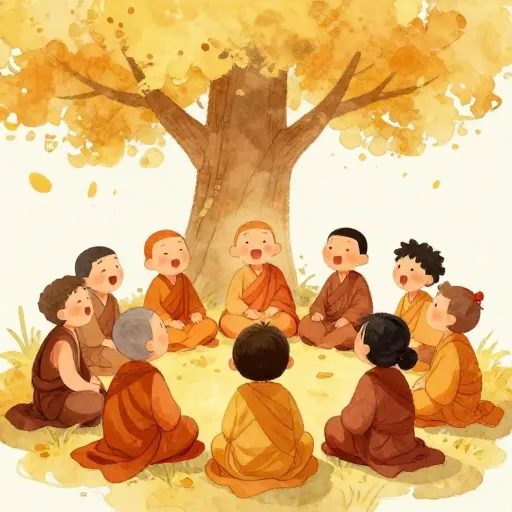
Imagine a giant hall filled with five hundred people. One person stands up and recites a long story about kindness. Then, all five hundred people repeat it back perfectly. This is how the first 'books' of Buddhism were kept in the minds of the students.
His students faced a giant question: How do we remember everything he said? There were no books yet, and no one had a smartphone to record his voice.
They had to rely on their memories. Groups of monks would gather to chant the teachings together, checking each other’s work to make sure not a single word was lost.

Finn says:
"Wait, if they didn't write anything down for hundreds of years, how do they know they didn't accidentally play a giant game of Telephone and change the message?"
As the centuries passed, the community of followers, called the Sangha, grew larger and larger. They moved into different countries, over high mountains, and across wide oceans.
As they traveled, they started to emphasize different parts of the Buddha's message. Some focused on strict rules, while others focused on wild stories and deep compassion.
The Way of the Elders
The oldest branch still thriving today is called Theravada. The name literally means the School of the Elders, and its followers try to stay as close as possible to the original instructions the Buddha gave.
In Theravada philosophy, the focus is often on the individual’s journey. Imagine you are learning to swim: someone can tell you how to kick and breathe, but you are the one who has to do the work in the water.
Try walking across the room very, very slowly. Notice exactly how your heel touches the floor, how your weight shifts, and how your toes lift up. This kind of 'mindful walking' is a big part of how Theravada students practice paying attention to the present moment.
Theravada thinkers believe that by following the rules and practicing meditation, a person can become an Arhat. This is someone who has cleared away all the clutter in their mind and found perfect peace.
They rely on a collection of writings called the Pali Canon. These are the oldest recorded teachings, written down on palm leaves in Sri Lanka about 2,000 years ago.
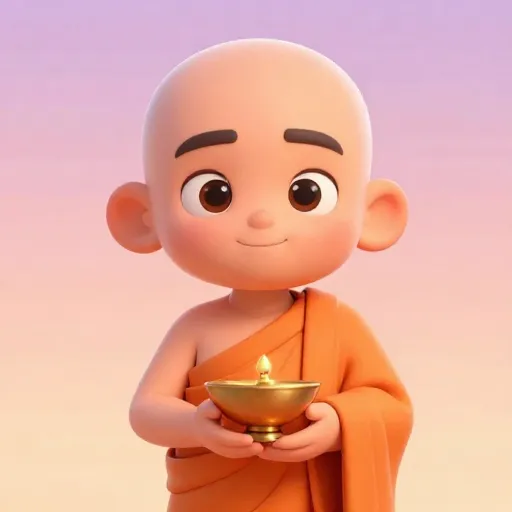
The king said: 'Is there any being who is reborn?' Nagasena said: 'No, but a name and form is reborn. It is like a lamp that lights another lamp.'
The Great Vehicle
About 500 years after the Buddha, a new way of thinking began to emerge. It was called Mahayana, which means the Great Vehicle.
If Theravada is like a small boat meant for one person to cross a river, Mahayana is like a giant ferry boat. The goal isn't just to get yourself to the other side: it is to bring everyone else along with you.

Mira says:
"I like the idea of the Great Vehicle. It's like when you find a really cool secret in a video game and you immediately want to tell all your friends so they can see it too."
Mahayana philosophers introduced a beautiful idea called the Bodhisattva. This is someone who is so wise and kind that they could reach Nirvana right now, but they choose to stay behind.
They decide to keep being reborn in the world until every single bug, bird, and person is free from sadness. It is a philosophy built on the idea that we are all connected.
The goal is to focus on your own mind, follow the rules perfectly, and reach peace so you can show others it is possible.
The goal is to put everyone else first, even if it takes a million lifetimes, because no one can be truly happy until everyone is happy.
Because they wanted to help everyone, Mahayana schools spread quickly through China, Japan, Korea, and Vietnam. They wrote new books called Sutras that used poetry and magic to explain complicated ideas.
One of their biggest ideas is Sunyata, or Emptiness. This doesn't mean that things don't exist: it means that nothing exists all by itself.

May I be a guard for those who need protection, a guide for those on the path, a boat, a raft, a bridge for those who wish to cross the flood.
The Diamond Path
High up in the snowy Himalayan mountains of Tibet, another school developed called Vajrayana. This name means the Diamond Path or the Lightning Bolt Path.
Vajrayana thinkers believe that life is short, so we should try to find wisdom as fast as possible. They use colorful tools to help their minds focus.
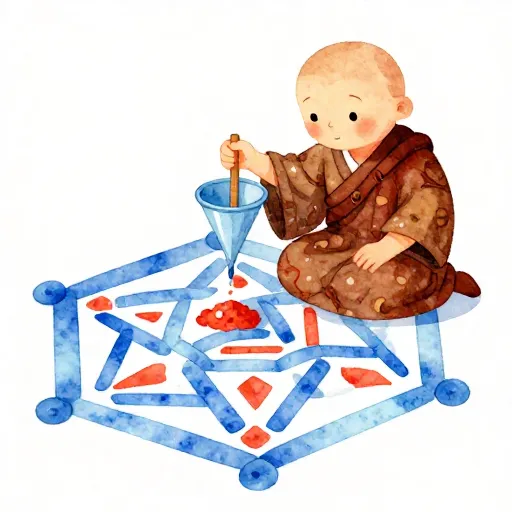
In Tibetan Buddhism, monks spend days making beautiful paintings out of colored sand. Once they are finished, they immediately sweep the sand away! They do this to show that nothing lasts forever and we shouldn't get too attached to things.
They create intricate sand paintings called mandalas and use special hand gestures called mudras. They believe that by using your body, your speech, and your mind all at once, you can wake up your inner wisdom instantly.
This school is famous for its teachers, called Lamas. The most well-known is the Dalai Lama, who is seen as a leader of wisdom and kindness for people all over the world.
Through the Ages
The School of Just Sitting
You might have heard of Zen, which is a school that grew out of Mahayana in China and Japan. Zen philosophy is famous for being a bit mysterious and very direct.
Zen teachers often say that words are just fingers pointing at the moon. If you spend all your time looking at the finger, you will never see the moon itself.
Finn says:
"So if words are just fingers pointing at the moon, does that mean the moon is the truth that we're all trying to see without overthinking it?"
Instead of reading lots of books, Zen students spend a lot of time in Zazen, or sitting meditation. They try to see the world exactly as it is, without all the labels we usually put on things.
Sometimes, Zen teachers give their students a Koan. This is a riddle with no logical answer, like: What is the sound of one hand clapping?

To study the Way is to study the self. To study the self is to forget the self.
The word 'Zen' actually comes from the Sanskrit word 'Dhyana,' which just means meditation. As the word traveled from India to China and then to Japan, the pronunciation changed like a long-distance game of Telephone: Dhyana became Ch'an, which became Zen.
Today, these different schools are like a large family. They might live in different houses and speak different languages, but they all share the same roots.
They all agree that life involves some struggle, but that we can find a way to be peaceful by changing how we see the world. Whether through the Elders' rules, the Bodhisattva's kindness, or the Zen monk's silence, the goal is the same: waking up.
Something to Think About
If you were going on a long journey, would you rather have a very detailed map with strict instructions, or a group of friends to help you find the way together?
There isn't a right answer: some people find comfort in rules, and some find strength in the community. Both ways help you reach the destination.
Questions About Philosophy
Are these different schools like different religions?
Why do some monks wear orange and others wear red or black?
Can you belong to more than one school?
The Forest of Ideas
The next time you see a statue of a sitting Buddha or a colorful sand painting, remember that you are looking at just one branch of a very large tree. Each school has spent thousands of years trying to solve the same puzzle: how can we be kind to ourselves and the world at the same time? It is a puzzle that is still being solved today, and every person who asks these questions becomes a part of that long, curious history.
