If you teach a parrot to say 'I'm hungry,' does the parrot actually feel a rumbly tummy, or is it just making noises it heard before?
This simple question is at the heart of one of the most famous puzzles in philosophy. In 1980, a philosopher named John Searle created a thought experiment called the Chinese Room to explore the difference between a machine that looks smart and a person who actually has consciousness.
Imagine you are sitting in a small, quiet room. There are no windows, just a heavy wooden door with two narrow slots in it: one for mail to come in, and one for mail to go out.
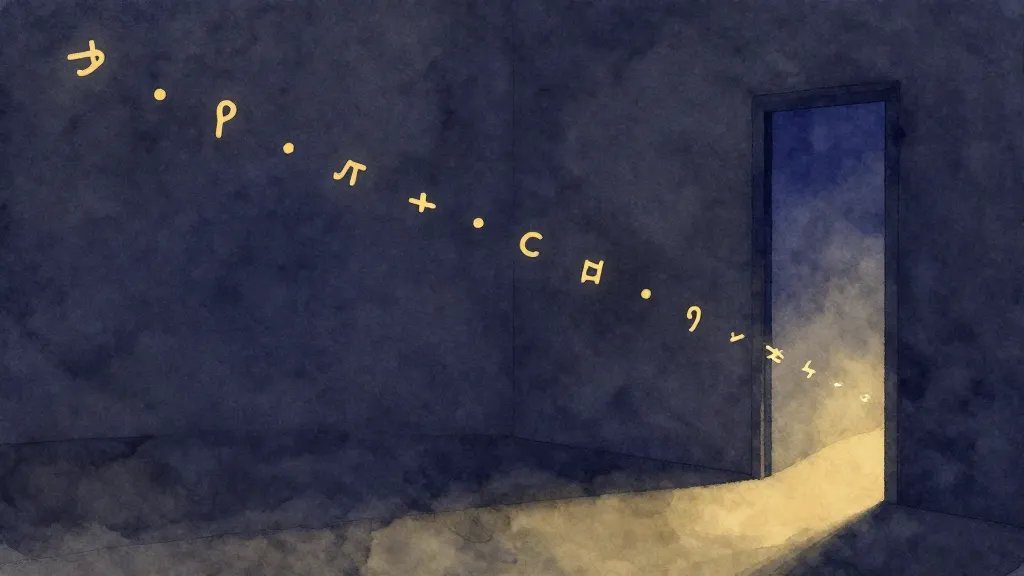
You are alone in this room, and you do not speak or read a single word of Chinese. To you, Chinese characters look like beautiful, complicated patterns of ink, but they have no more meaning than the swirls on a marble countertop.

Imagine the room is filled with thousands of drawers. Each drawer contains a single Chinese character on a card. You have to run from drawer to drawer, picking up cards and laying them out in the order the rulebook tells you. It’s a lot of work, but you still don’t know what you are 'writing'!
Inside the room with you is a massive, dusty book. This book is full of instructions written in English, which you understand perfectly.
The instructions are very specific: "If you see a piece of paper with the symbol shaped like a house, find the paper with the symbol shaped like a wavy line and push it through the exit slot."
The Secret Messenger
Outside the room, a person who actually speaks Chinese writes a question on a slip of paper. They slide it through the entry slot.
You pick up the paper, look at the symbols, and flip through your giant rulebook. You find the matching patterns and follow the instructions exactly as they are written.

The computer has a syntax, but no semantics.
You pick a response from a stack of papers and slide it back out the door. Outside, the person reads your reply and smiles.
To them, you seem like a brilliant conversation partner who understands Chinese perfectly. But inside the room, you are just matching shapes without any idea of what is being said.
Symbols versus Meaning
John Searle used this story to talk about Artificial Intelligence, or AI. He wanted to show that computers are just like the person in that room.
A computer uses a set of rules called an algorithm to process information. It takes in syntax, which is the arrangement of symbols or code, but it doesn't have semantics, which is the actual meaning behind those symbols.
Finn says:
"Wait, so if I follow a recipe to make a cake, but I don't know what 'flour' or 'sugar' is, am I like the person in the room? The cake still tastes good, but I'm just following instructions!"
Think about when you play a video game. The computer knows that if you press the 'jump' button, the character on the screen must move up.
But does the computer know what a 'jump' feels like? Does it know why the character needs to reach the platform, or does it just follow the 'If-Then' rule you programmed into it?
Ask a parent or friend to be your 'Computer.' Give them a piece of paper with a code: A=Draw a circle, B=Draw a square, C=Draw a line. Then, give them a 'program' like: 'A, C, B.' They must follow it without knowing what they are drawing. Did they 'understand' they were drawing a stick-figure face?
The Ghost in the Machine
Before John Searle came up with his room, another famous thinker named Alan Turing had a different idea. He created something called the Turing Test in 1950.
Turing believed that if a machine could have a conversation so well that you couldn't tell if it was a human or a computer, then we should say the machine is "thinking."

A computer would deserve to be called intelligent if it could deceive a human into believing that it was human.
Searle disagreed with Turing's test. He thought that "faking it" wasn't the same thing as "being it."
He argued that even if a computer could perfectly mimic a human brain, it would still just be a collection of switches and wires. It wouldn't have an inner life, or a sense of subjective experience, which is the feeling of being "me."
The Big Debate: The Systems Reply
When Searle published his idea, other philosophers were quick to argue back. One of the most famous counter-arguments is called the Systems Reply.
These thinkers agreed that the person in the room doesn't understand Chinese. However, they argued that the entire system - the person, the room, the rulebook, and the papers - together does understand Chinese.
Understanding is something only living, conscious minds can do. Machines are just pretending.
Understanding is just a complex way of processing information. If a system is complex enough, it understands.
Imagine your own brain for a moment. A single brain cell, or neuron, doesn't know who you are.
It doesn't remember your birthday or know your favorite color. It just sends tiny electric signals. But when billions of those cells work together, "you" happen.

Mira says:
"I think the 'Systems Reply' makes sense. My hand doesn't know how to write a story, but my whole body does. Maybe the room is smarter than the person inside it."
Through the Ages
The question of whether machines can think has been around much longer than modern computers. Even hundreds of years ago, people wondered if mechanical toys could have souls.
The Quest for Thinking Machines
In the 1800s, a mathematician named Ada Lovelace worked on the very first designs for a general-purpose computer. She was a visionary who saw that machines could do more than just math.

The Analytical Engine has no pretensions whatever to originate anything. It can do whatever we know how to order it to perform.
Lovelace’s idea was very similar to Searle’s. She believed that machines could only do what we tell them to do. They might be able to compose music or solve puzzles, but they wouldn't have their own original thoughts or feelings.
Chatbots and the Future
Today, we use AI every day. You might talk to a smart speaker in your kitchen or use a chatbot to help with your homework.
These modern programs are much more complicated than the rulebook in Searle’s room. They use neural networks to learn from millions of examples, making them seem more human than ever before.
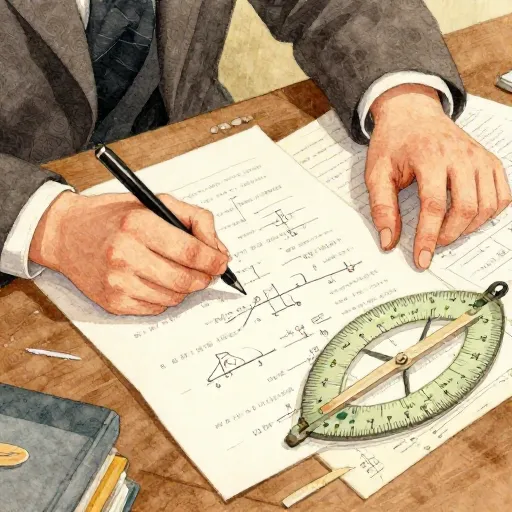
The word 'Computer' used to be a job title for people! Before we had electronic machines, 'computers' were people (often women) who sat in rooms and did long math problems by hand, following strict rules just like the man in the Chinese Room.
When a chatbot tells you a joke, is it laughing on the inside? Or is it just calculating which words usually follow each other to make a human laugh?
Searle would say that no matter how fast the computer gets, it is still just the man in the room. It is still just matching symbols and following a very long, very fast list of instructions.
Finn says:
"If a robot says it's my friend, does it matter if it doesn't 'feel' it? If it acts like a friend, isn't that enough? This is getting really weird."
The Mystery of You
This thought experiment makes us look at ourselves, too. If we are just a "system" of cells following biological rules, why does it feel so different to be us than it does to be a calculator?
Philosophers call this the Hard Problem of Consciousness. We know how the brain works physically, but we don't know why we have feelings, dreams, and a sense of wonder.
Searle’s thought experiment is a challenge to 'Strong AI.' Strong AI is the idea that a computer could one day have a mind exactly like ours. 'Weak AI' is what we have now: computers that are great at specific tasks, like playing chess or suggesting movies.
Maybe one day we will build a machine that really does understand. Or maybe there is something special about living things that code can never copy.
Something to Think About
If a robot could feel pain, but it was only because its code said 'if touched hard, say ow,' is that the same as you feeling a stubbed toe?
This is a big question with no 'correct' answer. Philosophers still argue about this today! What do you think makes a feeling 'real'?
Questions About Philosophy
Does the Chinese Room mean AI is bad?
Is there a way to prove something is conscious?
Will computers ever actually 'understand'?
The Room with the Open Door
The Chinese Room doesn't give us a final answer, but it gives us a better way to ask the question. As technology gets faster and smarter, we have to keep wondering what it is that makes us human. Is it our ability to follow rules, or the spark of meaning we find inside them? Keep looking for the meaning behind the symbols in your own life!
