
What would it be like to live with absolutely no stuff?
In the busy streets of Ancient Greece, a group of thinkers called the Cynics tried to do exactly that. They believed that most of the things we worry about, like fancy clothes or expensive toys, are actually like heavy invisible bags that weigh us down from being truly happy.
Imagine walking through a crowded market in the city of Athens over two thousand years ago. You see people arguing about money, checking their reflections in polished bronze, and rushing to important meetings.
Then, you see a man who owns nothing but a ragged cloak and a wooden staff. He doesn't look sad or stressed. In fact, he looks like the only person there who is truly awake.

Imagine a home made of clay. It isn't a house, but a giant ceramic storage jar called a 'pithos,' normally used for holding wine or oil. It's cool inside, round like a cocoon, and sits right on the edge of the city square where everyone can see it. This is where Diogenes lived, proving he didn't need a roof and walls to feel at home in the world.
This man belongs to a group of philosophers called the Cynics. They weren't interested in sitting in quiet classrooms or writing long, dusty books.
Instead, they wanted to live their ideas out loud. They believed that human beings had become confused by too many rules and too much 'stuff.'

Finn says:
"If I lived in a giant jar, where would I keep my comic books? Wait, maybe a Cynic wouldn't even want comic books because they'd rather just watch the real world happen!"
The story of this school began with a man named Antisthenes. He was a student of the famous Socrates, and he noticed something interesting about his teacher.
Socrates didn't care about wealth or being popular. He only cared about the truth. Antisthenes decided to take this idea as far as it could possibly go.

The most useful piece of learning for the uses of life is to unlearn what is untrue.
Antisthenes taught at a place called the Kynosarges, which was a gymnasium for people who weren't considered 'top-tier' citizens. Some people believe the name of the school, Cynicism, comes from this place.
However, others say the name comes from the Greek word for dog, kynikos. This is because the Cynics decided to live just like nature intended, like a friendly but honest stray dog.
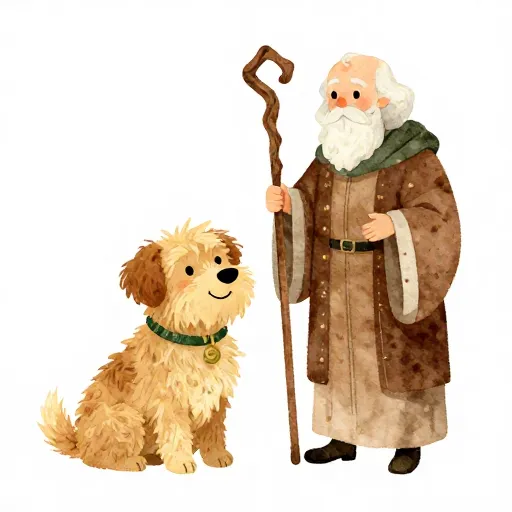
The word 'Cynic' literally means 'Dog-like.' The Greeks called them this as an insult at first, because they lived on the streets and didn't follow social rules. But the philosophers loved the name! They thought dogs were the best teachers because they are honest, they don't care about money, and they know exactly who their true friends are.
The most famous 'dog' of all was a man named Diogenes of Sinope. He is the one you might have heard of living in a giant ceramic jar in the middle of the city.
Diogenes didn't live there because he was poor or had no choice. He chose it to show everyone that a human being only needs a tiny bit of space and some fresh air to be happy.

Mira says:
"It's like when you go camping and realize you only need a backpack to be happy. The Cynics just never came back from the camping trip!"
One day, the most powerful man in the world, Alexander the Great, came to meet Diogenes. Alexander was impressed by the philosopher's reputation and wanted to give him a gift.
He stood over the philosopher, who was sunning himself on the ground, and asked: 'Is there anything I can do for you?' Diogenes didn't ask for gold or a palace.

Yes, stand out of my sun.
This interaction shocked the people watching. They couldn't understand why someone would turn down a favor from a king.
But for Diogenes, the sun was a gift from nature that was much more valuable than any gift from a human king. He wanted people to see that we often ignore the best things in life because we are busy chasing things that don't actually matter.
The 'Is it Necessary?' Test. Pick one thing you own today, like a toy or a gadget. Ask yourself: If I lost this tomorrow, would I still be 'me'? Would I still be able to be kind and think clearly? The Cynics believed that the more things you can say 'no' to, the more 'yes' you have for your own freedom.
The Cynics had a special word for the way they spoke: parrhesia. It means 'bold speech' or 'telling it like it is.'
They believed that being honest was more important than being polite. If they saw someone being greedy or fake, they would point it out right there in the street, sometimes using jokes or even barking like a dog to get attention.
Finn says:
"I heard Diogenes used to walk around with a lantern during the day. When people asked why, he said he was 'looking for a real human being.' I wonder if he ever found one?"
Another famous Cynic was Crates of Thebes. He was born into a very wealthy family and was supposed to inherit a fortune.
Instead of keeping the money, he gave it all away to the people of his city. He decided that wisdom and kindness were the only things that couldn't be taken away from him.

Wisdom and virtue are the only riches that can't be stolen.
Crates wasn't a grumpy person. He was actually known as the 'Door-Opener' because people loved him so much they would invite him into their homes to help settle family arguments.
He showed that you could be a Cynic and still be a warm, helpful part of a community. You just had to be willing to live with a very light suitcase.
You should wear the latest fashions and act politely so that people will respect you and think you are successful.
It doesn't matter what you wear. If you are a good person, you are already successful. Rules about 'fashion' are just distractions.
As time went on, the ideas of the Cynics started to change the way other people thought about the world. They influenced another famous group called the Stoics.
The Stoics took the Cynic idea of 'living simply' and turned it into a way to keep your mind calm even when life gets messy or difficult.
Through the Ages
Today, the word 'cynic' has a different meaning. We often use it to describe someone who is grumpy or expects the worst from people.
But the Ancient Cynics weren't like that. They were actually full of hope. They believed that if we could just clear away the 'clutter' of our lives, we would find a version of ourselves that is brave, free, and totally natural.

Picture a man carrying a lit lantern through a bright, sunny marketplace at noon. When people laugh and ask what he's doing, he holds the light up to their faces and says: 'I am just looking for an honest human being.' He was trying to show that even with all their fancy clothes, people were hiding who they really were.
Think about the things you own. Which ones do you actually need, and which ones are just taking up space?
Maybe the Cynics were right: perhaps the most important things we own aren't things at all, but the way we choose to see the world and treat the people in it.
Something to Think About
If you had to move into a tiny ceramic jar tomorrow and could only take three things with you, what would they be?
There is no right or wrong answer here. This is just a way to see which things in your life feel like 'you' and which ones are just 'stuff.'
Questions About Philosophy
Did the Cynics hate everything?
Were they really homeless?
Is a modern 'cynic' the same as an ancient one?
Living Lightly
The Cynics remind us that we are part of the natural world, just like the trees and the dogs they admired. We don't need to be perfect or wealthy to be 'enough.' Sometimes, the best way to find yourself is to let go of everything you thought you needed to be.
