
If you took a piece of bread and kept cutting it in half, and then in half again, and then in half again, would you ever have to stop?
Around 2,500 years ago, a man named Democritus asked this very question and came up with a revolutionary idea called philosophy. He traveled the world to find out what matter was made of, eventually deciding that everything is built from tiny, invisible building blocks.
Imagine a city called Abdera. It was a busy, sun-drenched port town on the coast of ancient Greece, filled with the smell of salty air and the sounds of merchants shouting.
Democritus lived there long ago, but he didn't spend his time selling olives or building ships. Instead, he spent his time wondering about the hidden secrets of the world.
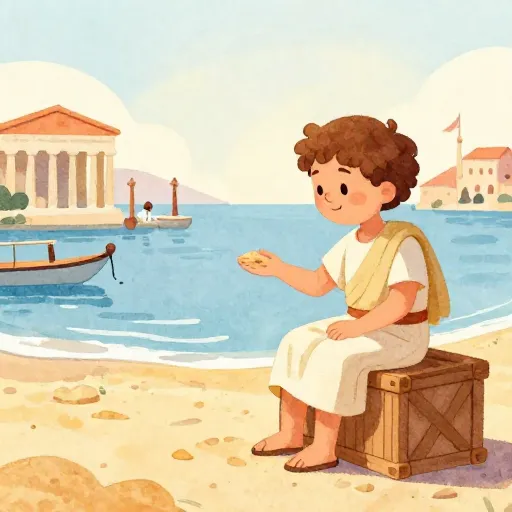
Imagine standing on a dock in Abdera. Ships with giant orange sails are arriving from Egypt, carrying papyrus and spices. You see a man sitting on a crate, not looking at the ships, but staring intensely at a handful of sand, letting the grains trickling through his fingers one by one.
He was born into a very wealthy family, but he didn't care much for gold or fancy clothes. He spent almost all his money traveling to distant lands like Egypt, Persia, and even India to talk to the smartest people he could find.
Democritus wanted to know one thing above all else: what is the world actually made of when you get right down to the bottom of it?

Finn says:
"If I had a piece of gold and I kept cutting it, would it eventually stop being gold? Or would it just be the smallest possible speck of gold in the world?"
The Idea of the Uncuttable
One day, legend says Democritus was sitting with a simple loaf of bread. He looked at the bread and realized that he could break it in two, and then break those pieces into smaller crumbs.
He began a thought experiment in his head. If he had a knife sharp enough and hands steady enough, could he keep cutting that bread forever?
The more any body is divided, the less it becomes.
Democritus decided that the answer had to be "no." He believed that eventually, you would reach a piece of matter so small that it could no longer be cut or divided any further.
He called these tiny, final pieces atoms, which in the Greek language simply means "uncuttable." This was the birth of a brand new theory about the universe.
Take a piece of paper and tear it in half. Now take one of those halves and tear it again. Keep going until the piece is so small you can't tear it with your fingers. Democritus believed that even if you had a magic tool to keep going, you would eventually hit a 'wall' where the piece simply refused to break.
Atoms and the Great Empty
Democritus didn't just think there were tiny pieces: he also thought about what was between them. He argued that for atoms to move around and join together, there had to be empty space.
He called this empty space the void. Think of it like a crowded room: you can only walk through the room because of the gaps between the people.

Mira says:
"It's like how a LEGO castle is made of bricks, but the space between the bricks is what lets you pull them apart and build something totally different!"
This was a very strange idea for people back then. Many other thinkers believed that "nothing" couldn't exist, so there couldn't be a void, but Democritus disagreed.
He pictured the universe as a giant dance of tiny particles. These atoms were always moving, bumping into each other, and hooking together to make trees, dogs, and even you.
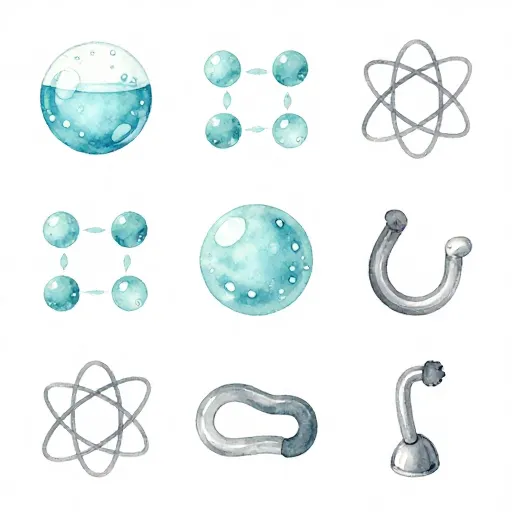
Democritus thought that atoms came in different shapes! He believed water atoms were smooth and round, which is why water flows. He thought iron atoms had hooks that kept them locked together, and salt atoms were sharp and jagged, which is why they taste prickly on your tongue.
Are Colors Real?
If everything is just a bunch of tiny, colorless atoms bumping into each other in the dark, why does the world look so bright and colorful? Democritus had a surprising answer for this.
He believed that things like "sweetness," "bitterness," and "color" weren't actually in the objects themselves. Instead, they were things our senses created when atoms hit our eyes or tongues.

By convention sweet is sweet, by convention bitter is bitter, by convention hot is hot, by convention cold is cold, by convention color is color; but in reality there are atoms and the void.
He called these sensory experiences convention. This means they are real to us because of how we are built, but they aren't the ultimate truth of the universe.
Imagine a strawberry. To us, it is red and sweet, but to the atoms that make it up, there is no color and no sugar: just shapes and movement.

Democritus was one of the first people to suggest that the Milky Way: that bright band of light in the night sky: was actually the light from millions of distant stars that were too far away to see individually. He was right about that, too!
The Laughing Philosopher
Democritus wasn't just interested in rocks and bread: he was also interested in how people could live happy lives. He was famous for being very cheerful and was often seen laughing in the streets.
People in Abdera sometimes thought he was a bit strange. They couldn't understand why he laughed so much, especially when things seemed serious.
Finn says:
"I wonder if he ever got in trouble for laughing during a serious meeting? It must be hard to be serious when you're thinking about tiny invisible balls bouncing everywhere."
He laughed because he saw how much people worried about things that didn't really matter in the long run. He believed the goal of life was a state called cheerfulness, which he described as a calm and steady mind.
He thought that if you understood that the world was just atoms doing their thing, you wouldn't get so upset when things went wrong. You could just enjoy the show.

Happiness resides not in possessions, and not in gold; happiness dwells in the soul.
A Battle of Ideas
Not everyone liked Democritus’s ideas. Another very famous philosopher, Plato, reportedly disliked him so much that he wanted to burn all of Democritus’s books!
Plato and his student Aristotle believed the world was made of four elements: Earth, Air, Fire, and Water. They thought the idea of invisible "atoms" was ridiculous.
Everything is made of tiny, indivisible particles called atoms that move through empty space.
There is no such thing as empty space. Everything is made of four continuous elements: Earth, Air, Fire, and Water.
Because Aristotle was so popular for thousands of years, most people forgot about Democritus and his atoms. His books were lost, and we only know what he said because other writers wrote about him.
It took a very long time for people to realize that the traveler from Abdera might have been right all along about the invisible world.
The Journey of the Atom
Why Democritus Still Matters
Today, we use the word "atom" all the time in science class. Even though we now know that atoms can be split into even smaller pieces like protons and electrons, the core idea remains the same.
Democritus taught us to look past what our eyes see. He showed us that the world is much deeper and more complex than it appears on the surface.
[CHARACTER_CALLOUT_4]
He also reminds us that being curious is a way of being happy. By trying to understand the physics of the world, we can find a sense of wonder that keeps us laughing and learning.
Next time you hold a handful of sand or watch a cloud drift by, try to imagine the invisible dance of the "uncuttable" pieces happening right in front of you.
Something to Think About
If you could design a new kind of atom that explained why something feels 'fuzzy' or 'sticky,' what shape would it be?
There are no wrong answers here. Democritus used his imagination to explain the world, and you can too. How do you picture the invisible parts of your favorite things?
Questions About Philosophy
Did Democritus have a microscope?
Why was he called the Laughing Philosopher?
Was he right about everything?
The Adventure of Thinking
Democritus shows us that the greatest discoveries don't always happen in a lab. Sometimes, they happen when we sit quietly, look at a piece of bread, and ask 'Why?' Keep asking questions about the things you see every day: you might just discover a secret that lasts for thousands of years.
