Have you ever woken up from a dream and for a second, just a tiny second, you weren't sure if you were still in it?
René Descartes spent his whole life asking that very question. He wanted to find a truth so solid that it was impossible to doubt, and in doing so, he changed how we think about existence and the human mind forever.
Imagine it is a freezing winter night in the year 1619. In a small, cozy room in Germany, a soldier is sitting by a warm stove.
He is not thinking about battles or horses. He is thinking about everything he has ever been taught.
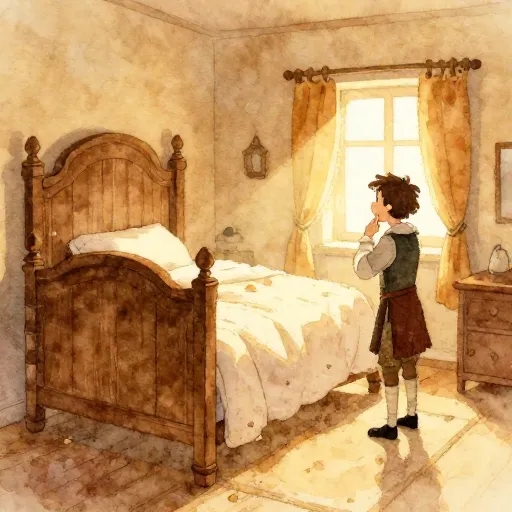
Descartes was a bit of a night owl! He loved to sleep in and often stayed in bed until noon. He said that his mind was most productive when he was resting and letting his thoughts wander.
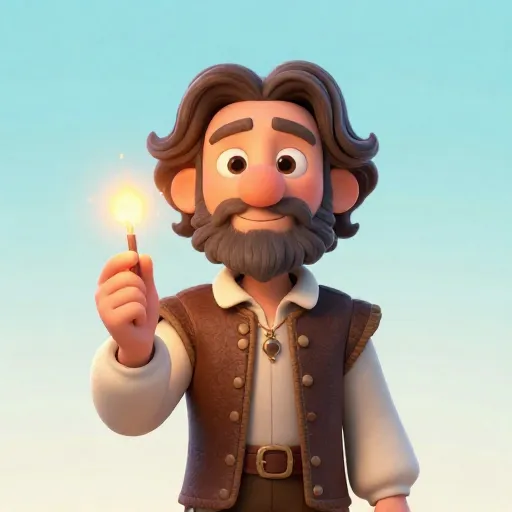
This man is René Descartes. He is about twenty-three years old, and he has a problem.
He has realized that many things he once believed to be true turned out to be false. If he was wrong about those things, could he be wrong about everything else too?
The House of Knowledge
Descartes decided to do something very brave and a little bit strange. He decided to throw away every single thought he had.
He compared his mind to a house that was built on shaky ground. If you want to build a house that will never fall down, you have to clear away the old sand and find solid rock.

Mira says:
"It is like cleaning out a toy box. You have to take everything out and look at each toy to see if it is broken before you put it back in."
He called this process Skepticism. It was not because he wanted to be grumpy or disagree with everyone.
He wanted to see if anything was left after he questioned everything. He was looking for the most stable foundation in the world.
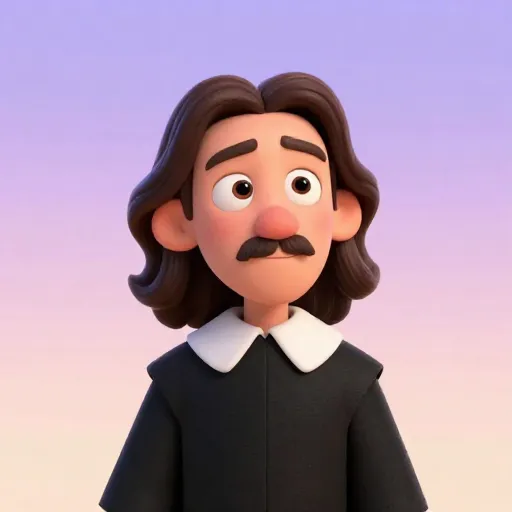
If you would be a real seeker after truth, it is necessary that at least once in your life you doubt, as far as possible, all things.
He started with his senses. You might think you can trust your eyes, but have you ever seen a straw look bent in a glass of water?
Your eyes tell you it is bent, but your hands tell you it is straight. If your senses can trick you once, Descartes thought, maybe they are tricking you all the time.
The Great Trickster
To make his doubt even stronger, Descartes imagined a "Malicious Demon." This was a thought experiment about a powerful trickster.
What if this demon was using all its energy to deceive him? What if the trees, the sky, and even his own body were just illusions made by the demon?

Imagine you are wearing a very high-tech VR headset. It's so realistic that you can feel the wind and smell the grass. If you never took the headset off, would you believe the game was the real world? This is exactly the kind of riddle Descartes loved to solve.
This sounds like the plot of a science fiction movie, doesn't it? It is the same question people ask today about Virtual Reality or computer simulations.
If you were inside a perfect video game, how would you know the walls weren't just pixels? Descartes was asking this hundreds of years before computers existed.
The Lightbulb Moment
After doubting his eyes, his ears, and even the fact that he had a body, Descartes felt like he was floating in deep water. He had nothing left to hold onto.
But then, he noticed something beautiful. Even if he was being tricked, he was still the one being tricked.
Finn says:
"So even if a giant space-robot is making me think I am eating a taco, I still exist because I am the one thinking about the taco?"
To be tricked, you have to be thinking. And if you are thinking, you must exist.
You cannot think and be nothing at the same time. This was the solid rock he was looking for.
I think, therefore I am.
He wrote this down in Latin: Cogito, ergo sum. In English, we say: "I think, therefore I am."
This was his first Certainty. It didn't matter if the world was a dream or a trick: the fact that a thought was happening proved that the thinker was real.
Try the 'Dream Check.' Right now, look at your hands. Then, look at a clock or try to read a sentence in a book. Usually, in dreams, clocks look blurry and text changes when you look away. If everything stays still, you're likely awake. But can you be 100 percent sure?
Two Worlds: Mind and Body
Descartes didn't stop there. He started to look at how different his thoughts felt compared to his physical body.
He could imagine himself without a hand or a leg, but he couldn't imagine himself without a mind. This led him to a big idea called Dualism.
- The Mind is for thinking, dreaming, and feeling. It doesn't take up space.
- The Body is like a very complicated machine made of bones and muscles. It exists in the physical world.
He believed these two things were separate but joined together. He even tried to find the exact spot in the brain where they met, like a pilot sitting in the cockpit of a plane.
We can only find the truth by using our logic and reason. Our senses (like sight and touch) are messy and often trick us.
We learn everything through experience and our senses. If we couldn't see or touch the world, our minds would be empty.
The Fly on the Ceiling
Descartes wasn't just a philosopher: he was a brilliant mathematician too. Legend says that while he was lying in bed watching a fly, he had another huge idea.
He realized he could describe the fly’s exact position on the ceiling using just two numbers. One number for how far it was from one wall, and one for how far it was from the other.
Mira says:
"It is amazing how a fly on the ceiling led to the maps we use on our phones today. Everything is connected if you look closely enough."
This is why we have Cartesian Coordinates today. Every time you look at a graph in math class with an X-axis and a Y-axis, you are using Descartes' brain.
He showed us that shapes and numbers are actually the same thing. This helped scientists describe the world using math instead of just guessing.
The Journey of the Cogito
The Legacy of the Thinker
Because Descartes put so much trust in the human mind, he is often called the Father of Modern Philosophy. He shifted the focus from what "authorities" said to what an individual person could discover through Reason.
He believed that if we are careful and break big problems into small pieces, we can solve almost anything.
Descartes' name is where we get the word 'Cartesian.' So, if you've ever used a 'Cartesian coordinate system' in math, you're literally using Descartes' name!
However, not everyone agreed with him. Some later thinkers, like David Hume, wondered if we are really just a "bundle of thoughts" rather than one solid person.
Others, like Spinoza, thought the mind and body weren't separate at all, but two sides of the same coin. This debate is still happening in science labs today.

Each problem that I solved became a rule, which served afterwards to solve other problems.
Today, when we talk about Consciousness - the mystery of what it feels like to be you - we are walking the path Descartes started.
He taught us that wondering is the beginning of wisdom. Even if we don't have all the answers, the fact that we are asking the questions is pretty amazing.
Something to Think About
If you didn't have a body, but you still had your thoughts, would you still be 'you'?
There isn't a right or wrong answer to this. Some people feel their body is a huge part of who they are, while others feel like they are just a 'visitor' inside their own head. What do you think?
Questions About Philosophy
Did Descartes really think a demon was tricking him?
Why is 'I think, therefore I am' so important?
Is Descartes still relevant today?
Keep Wandering, Keep Wondering
René Descartes showed us that being unsure isn't a bad thing: it's a starting line. When we ask 'Is this real?' or 'How do I know?', we are using the most powerful tool we have: our reason. Next time you find yourself daydreaming, remember that the very act of thinking is proof of how incredible you are.
