
What if the secret to a happy life isn't a mountain of toys or a chest of gold, but a simple piece of cheese and a good friend?
Over 2,300 years ago, a man named Epicurus started a school in Athens that changed how people thought about pleasure and fear. He didn't live in a palace: he lived in a garden, where he taught that the best way to be happy was to stop worrying about things we can't control.
Imagine walking through the busy, dusty streets of ancient Athens. You hear merchants shouting, politicians arguing, and the clatter of horse-drawn carts. But just outside the city walls, there is a gate leading to a quiet, shady spot filled with fruit trees and vegetable patches.
This was The Garden, the home and school of Epicurus. While other philosophers held their classes in grand public buildings, Epicurus chose a backyard. He invited anyone to join him: men, women, and even people who were enslaved, which was a very radical thing to do at the time.
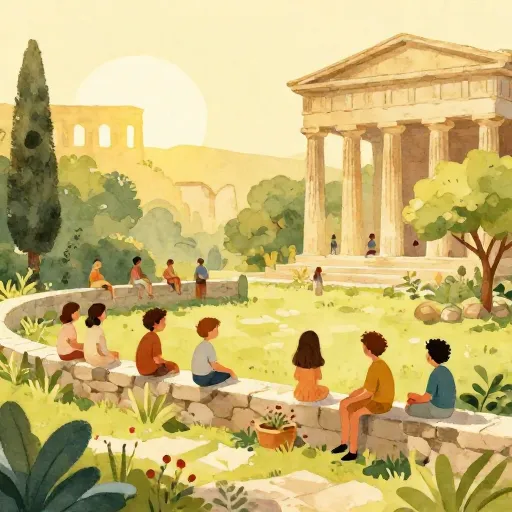
Imagine a school where there are no desks and no tests. Instead, you spend your day pulling weeds in a vegetable patch, sitting under the shade of a fig tree, and talking with people from all walks of life. The only rule is to be kind and to try to understand how the world works.
Epicurus lived during a time of great change and uncertainty. Wars were frequent, and many people felt like their lives were being tossed around by the whims of angry gods. He wanted to provide a place of calm, a way to find ataraxia, which is a Greek word for a mind that is steady and free from storm-clouds.

Mira says:
"I like the idea of a philosopher who teaches in a garden instead of a boring office. It’s like his classroom was made of leaves and sunlight."
The Great Misunderstanding
Today, if someone calls you an "epicure," they usually mean you love fancy, expensive food and high-end restaurants. But the real Epicurus would probably find that quite funny. He believed that the more things you "need" to be happy, the more ways you have to be miserable.
He famously said that he could be as happy as a king on just bread and water. If he wanted a real feast, he would ask his friends to send him a small pot of cheese. For him, pleasure wasn't about being greedy: it was about the relief of not being hungry or thirsty.
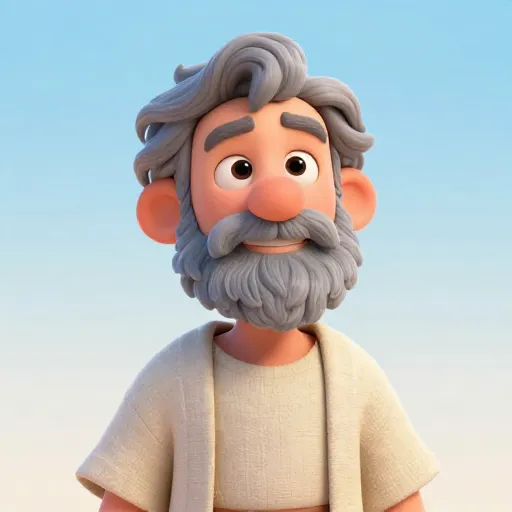
Do not spoil what you have by desiring what you have not: remember that what you now have was once among the things you only hoped for.
Epicurus realized that our brains are often very good at tricking us. We think that getting a new toy or winning a game will make us happy forever. But that feeling usually fades quickly, leaving us wanting the next thing, and the next.
He taught his students to look at their desires through a magnifying glass. He sorted them into three categories: things that are natural and necessary (like food and friends), things that are natural but not necessary (like fancy cakes), and things that are neither (like fame or being a celebrity).

Try the 'Epicurean Feast.' Find a very simple snack, like a plain cracker or a slice of apple. Before you eat it, think about how hungry you are. Eat it slowly, noticing every flavor. Epicurus believed this simple snack could be more satisfying than a huge meal if you are truly paying attention.
Everything is Made of Atoms
Epicurus wasn't just interested in feelings: he was one of the world’s first scientists. He wanted to know what the world was actually made of. He didn't believe that lightning was a grumpy god throwing bolts from a mountain.
He adopted an idea called atomism. He believed that everything in the universe: the trees, the stars, your pet cat, and even your own soul: is made of tiny, invisible building blocks called atoms. These atoms are constantly moving through an empty space called the void.

Finn says:
"So if I’m made of atoms, and my chair is made of atoms, are we basically the same thing? Just arranged in a different pattern?"
This was an incredibly brave way to think back then. By explaining the world through science and tiny particles, Epicurus helped people stop being afraid of magic or monsters. If a storm happened, it wasn't because a god was mad: it was just atoms bumping into each other in a specific way.
He even believed that these atoms sometimes "swerved" for no reason at all. This swerve was his way of explaining how we have free will. If everything was just predictable atoms falling in straight lines, we would be like robots, but the swerve meant that we are free to choose our own paths.
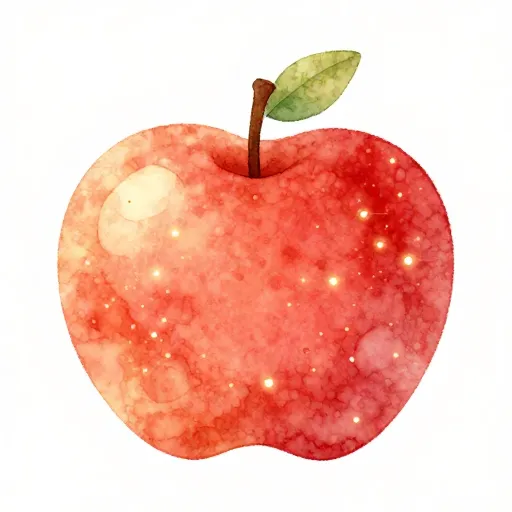
The word 'atom' comes from the Greek word 'atomos,' which means 'uncuttable.' Epicurus and his teacher Democritus believed that if you kept cutting an apple into smaller and smaller pieces, you would eventually find a tiny bit so small it couldn't be cut anymore.
The Gift of Friendship
If you asked Epicurus what the single most important thing in life was, he wouldn't say money, or health, or even wisdom. He would say friendship. To him, a friend is more than just someone to play a game with.
A friend is someone who makes you feel safe. Epicurus believed that the main reason we get anxious is because we feel alone and unprotected. Knowing that you have a group of friends who will help you if things go wrong is the ultimate "safety net" for the human mind.

Of all the things which wisdom provides to make us entirely happy, much the greatest is the possession of friendship.
In The Garden, the students didn't just study together: they lived together. They shared their meals, looked after the plants, and took care of each other when they were sick. This community was their shield against the worries of the outside world.
Focus on duty, self-control, and being brave. Happiness comes from doing the right thing, even if it's hard or painful.
Focus on peace, friendship, and avoiding pain. Happiness comes from simple pleasures and keeping your mind calm.
Facing the Big Scaries
One of the hardest things for humans to think about is the end of life. Epicurus noticed that a lot of people were unhappy because they were terrified of what happens after we die. He used his theory of atoms to help them feel better.
He argued that because we are made of atoms, when we die, those atoms simply move apart to become something else. Since our ability to feel pain depends on our atoms being joined together, once they move apart, we can't feel anything anymore. There is no pain in not existing.

Death is nothing to us. When we exist, death is not; and when death exists, we are not.
This sounds like a heavy topic, but for Epicurus, it was meant to be a huge relief. He wanted people to focus on the "now." If you aren't worried about the future or what happens after life, you can finally enjoy the sunshine on your face or the taste of an apple right this second.
Mira says:
"It’s weirdly comforting to think that when I’m not here, I won’t even know I’m not here. It makes me want to go find a really good snack right now."
The Message That Traveled
Epicurus’s ideas didn't stay in his garden. They traveled across the sea to Rome and survived for centuries. Even though his school eventually closed, his books and letters were copied and passed down through history.
Through the Ages
In the 1700s, many famous thinkers were inspired by his focus on happiness and science. Thomas Jefferson, one of the founders of the United States, once wrote: "I am an Epicurean." You can even see Epicurus’s influence in the phrase "the pursuit of happiness."
Why He Matters Today
We live in a world that is much louder and busier than ancient Athens. We are constantly told that we need more stuff, more likes on social media, and more achievements to be happy. Epicurus is like a quiet voice from the past, reminding us to slow down.
He reminds us that being happy is actually quite simple. It’s about having a body that isn't in pain, a mind that isn't full of fear, and a friend to talk to. It's about noticing the tiny swerves in life that make us who we are.
Something to Think About
If you could only keep three things to make you happy for the rest of your life, what would they be?
Epicurus would say to choose carefully: fancy things can break or be taken away, but memories and friendships stay with you. There are no right or wrong answers, only what matters most to you.

Epicurus was incredibly prolific. He wrote over 300 books on papyrus scrolls! Sadly, almost all of them were lost or destroyed over time. Most of what we know about him comes from just a few letters and a long poem written by one of his fans named Lucretius.
Questions About Philosophy
Was Epicurus just a lazy person who wanted to eat all day?
Did Epicurus believe in God?
How can atoms explain my feelings?
The Garden is Always Open
The next time you feel overwhelmed or worried about having the newest toy, remember the man in the garden with his pot of cheese. Epicurus shows us that the world is made of tiny wonders and that the greatest treasure of all is simply being at peace with your friends. You don't need a time machine to visit The Garden: you just need to appreciate the small, beautiful things right in front of you.
