
Have you ever been told to 'just follow the rules' even when the rules felt wrong?
Hannah Arendt was a woman who lived through some of the scariest moments in history. She spent her life studying how Totalitarianism happens and why it is so important for every person to keep their own Thinking alive. She believed that every time a child is born, the world gets a chance for a brand-new beginning, a concept she called Natality.
Imagine growing up in a house full of books where everyone is always debating big ideas. This was the world of Hannah Arendt in Germany during the early 1900s. She was a curious girl who loved poetry and ancient Greek stories.
But as she grew up, the world around her began to change in a frightening way. People started saying that some groups of people were better than others. They began to stop asking questions and started following a leader who wanted total control.

Hannah Arendt didn't like being called a 'philosopher.' She preferred the term 'political theorist.' She thought philosophers spent too much time thinking about abstract things alone, while she wanted to think about how people live together in the real world.
Because Hannah was Jewish, it became dangerous for her to stay in her home country. She had to leave everything behind and become a Refugee. This means she had to find safety in new places, first in France and finally in New York City.
She arrived in America with very little money and a language she didn't know yet. But she carried something very powerful with her: her ability to think for herself. She wanted to understand how people could let such terrible things happen.

Finn says:
"So, wait. If someone just follows orders without thinking, are they still 'them' anymore? Or are they just like a remote-controlled car?"
Hannah noticed that when people stop thinking, they start acting like parts of a machine. They do what they are told because it is easier than deciding what is right or wrong. She wanted to remind the world that we are not machines.
The Superpower of New Beginnings
One of Hannah’s most beautiful ideas is something she called Natality. It comes from the word for birth. She believed that every single human being is a 'new beginning' walking around on two legs.
Think about a time you started a new game or made a new friend. Before that moment, that game or that friendship didn't exist. You brought it into the world just by being you.

The new beginning inherent in birth can make itself felt in the world only because the newcomer possesses the capacity of beginning something anew, that is, of acting.
Hannah believed that because we are all born, we all have the capacity to do something unexpected. No one can predict exactly what you will say or do tomorrow. This unpredictability is what makes humans special.
In her view, we aren't just here to repeat what happened yesterday. We are here to start things. This is why she loved the idea of children and young people. They are the constant reminder that the world doesn't have to stay the same.
Think of one 'New Beginning' you could start today. It doesn't have to be big! It could be drawing a picture of a creature that doesn't exist, or making up a new rule for a game of tag. Notice how that idea didn't exist until you decided to act.
The Space Between Us
Hannah often talked about the Public Sphere. Imagine a table sitting between two people. The table connects them because they are both sitting at it, but it also keeps them separate so they have their own space.
To Hannah, the world is like that table. It is the space where we come together to talk and act. She called this Plurality. It means that even though we are all human, no two people are ever exactly the same.

Mira says:
"I like the table idea. It's like how we can both look at the same tree, but you see the bird's nest and I see the funny-shaped leaf. We need both stories to know the whole tree."
She believed that freedom isn't something you have all by yourself in a room. Freedom is something that happens when you go out into the world and interact with others. It is the act of showing the world who you are through your words and deeds.
If everyone was exactly the same, we wouldn't need to talk. We would already know what everyone else was thinking. But because we are different, we have to use our voices to build a world together.
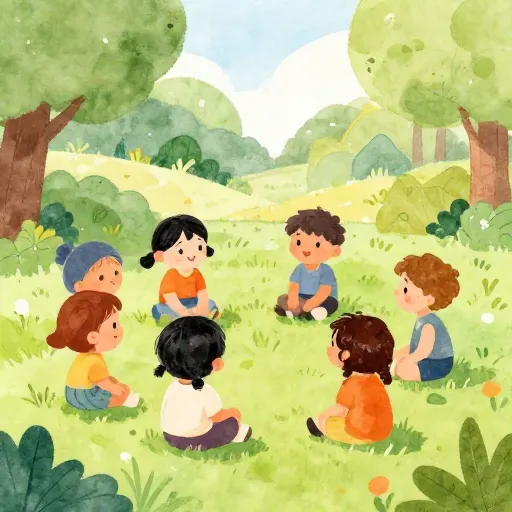
Imagine a giant playground with no rules and no adults. Some kids want to build a fort, others want to play a game of pretend, and others just want to sit and talk. To Hannah, this 'clash' of different ideas is the most beautiful thing about being human. It's where freedom lives.
The Danger of the 'Sleepy Mind'
Later in her life, Hannah went to a famous trial to watch a man who had done very bad things during the war. Many people expected him to look like a monster from a movie. But Hannah saw something much more confusing.
She saw a man who seemed very ordinary. He didn't seem to hate people or have big, angry plans. He just said he was 'following orders.' He had stopped thinking for himself entirely.

The sad truth is that most evil is done by people who never make up their minds to be good or evil.
Hannah called this the Banality of Evil. 'Banality' is a fancy word for something that is boring or common. She meant that sometimes, the most terrible things in the world happen not because people are 'monsters,' but because they are too lazy or scared to think.
She believed that thinking is like a silent conversation you have with yourself. Before you do something, you should ask, 'Could I live with myself if I did this?' If you stop having that inner conversation, you lose your way.
It is easier to just do what everyone else is doing. You don't have to worry about being wrong or standing out. You just follow the map someone else drew.
It can be lonely or scary to disagree, but it's the only way to be sure you are doing what is right. You have to draw your own map as you go.
Thinking vs. Knowing
Hannah made a big distinction between 'knowing' and 'thinking.' Knowing is about facts, like knowing that 2 + 2 = 4 or that the sky is blue. Facts are important, but they don't tell you how to live.
Thinking is different. Thinking doesn't always have a final answer. It is the way we search for the meaning of things. It is the 'why' behind the 'what.'
Finn says:
"Sometimes I think about stuff for hours and don't find an answer. I used to think I was failing, but Hannah makes it sound like the 'thinking' part is the actual goal."
When we think, we are moving. We are looking at things from different angles. Hannah believed that even if we don't find a perfect answer, the act of thinking keeps us human. It protects us from just following the crowd.
Through the Ages
Life as an Action
Hannah divided the things we do into three categories: Labor, Work, and Action. Labor is what we do to survive, like eating and cleaning. Work is what we do to build things, like making a chair or writing a book.
But Action is the most important to her. Action is when we do something in front of other people to change the world. It’s when you stand up for a friend or suggest a new way to solve a problem at school.

Storytelling reveals meaning without committing the error of defining it.
Action is risky because you never know how it will end. Once you start something, other people join in, and the idea grows in ways you can't control. Hannah thought this was the most exciting part of being alive.
She wanted us to be brave enough to act, even if we are afraid. She believed that our voices are the only things that can keep the world from becoming dark and quiet.
Hannah was a lifelong friend with other famous thinkers. Even when they disagreed about big ideas, they kept talking. She believed that friendship was one of the most important parts of a free world because it allows us to see through someone else's eyes.
Something to Think About
If you were the only person who disagreed with a rule that felt wrong, would you say something?
There isn't a simple 'yes' or 'no' answer here. Thinking about the risks and the reasons for both choices is exactly what Hannah Arendt called 'the work of being human.'
Questions About Philosophy
Why did Hannah Arendt have to leave Germany?
What does 'Banality of Evil' actually mean for kids?
How can an 8-year-old practice 'Natality'?
The Conversation Continues
Hannah Arendt didn't want followers: she wanted fellow thinkers. She didn't leave us a list of rules to follow. Instead, she left us a challenge: to stay awake, to talk to each other, and to never let our 'inner conversation' fall silent. The world is waiting to see what new beginning you will bring today.
