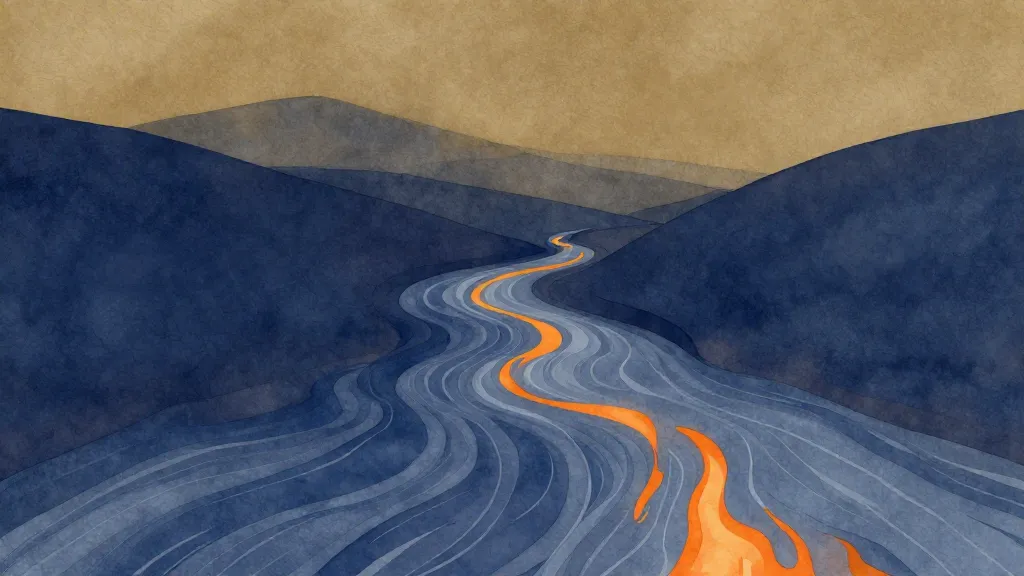
If you look at a river today and return to the exact same spot tomorrow, are you looking at the same river?
About 2,500 years ago, a thinker named Heraclitus lived in the busy city of Ephesus. He spent his life observing how the world is in a state of constant flux, arguing that change is the only thing that stays the same. His ideas about the unity of opposites and the hidden logic of the universe changed how we think about time, nature, and ourselves.
Imagine you are standing on the edge of the Aegean Sea in the year 500 BC. The city of Ephesus is a place of white marble and salt air, where merchants from across the world trade purple silks and spicy cinnamon. It is a city of noise, but one man prefers the quiet of the mountains or the shadow of the great Temple of Artemis.
Heraclitus was not like the other citizens. He was born into a powerful, royal family, but he didn't want to be a king or a politician. He gave his royal titles to his brother and walked away from the halls of power. He felt that most people were walking through life as if they were asleep, never noticing the deep patterns of the world around them.
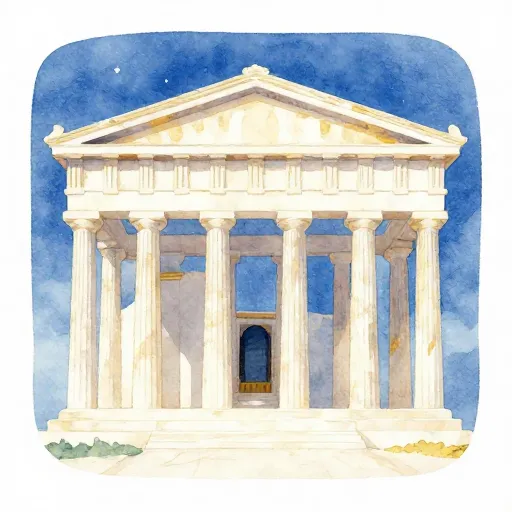
Imagine the Temple of Artemis in Ephesus. It was one of the Seven Wonders of the Ancient World, with 127 giant pillars reaching toward the sky. Heraclitus used to sit on its steps, watching the crowds of travelers, and eventually deposited his only book there so it would be safe for future generations.
He became known as "The Obscure" because he wrote in riddles and short, punchy sentences. He didn't want to give people easy answers. He wanted them to wake up and look at the world with fresh eyes. He believed that if you looked closely enough at a flickering flame or a rushing stream, you would see a secret truth about existence.
This truth starts with a very simple observation. Everything is moving. Even the things that look solid, like a mountain or a chair, are changing in tiny ways that we cannot see with our eyes alone.
The Mystery of the River
Heraclitus is most famous for his thoughts on water. He spent a lot of time watching the rivers that flowed near Ephesus. To most people, a river has a name and a place on a map, which makes it seem like a permanent thing. But Heraclitus saw something different.
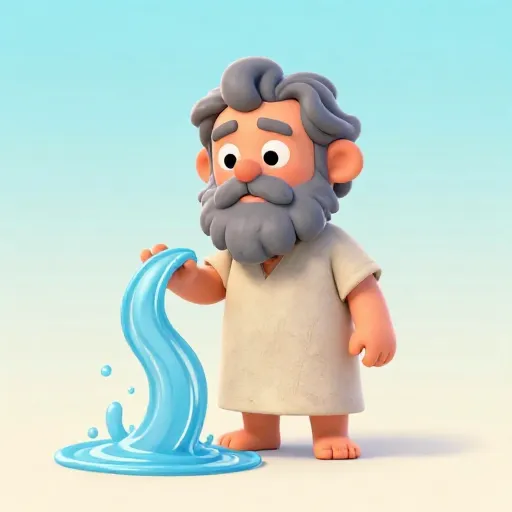
No man ever steps in the same river twice, for it's not the same river and he's not the same man.
Think about what happens when you step into a stream. The water that touches your toes is immediately gone, swept downstream toward the sea. New water, which was further up the mountain a moment ago, rushes in to take its place. Even though you call it "The River," the actual stuff it is made of is different every single second.
It isn't just the water that changes, though. You change too. Between the time you put your left foot in and your right foot in, your heart has beaten, you have breathed in new air, and some of your cells have grown or died. You are a slightly different person than you were a moment ago.

Finn says:
"Wait, if I'm changing every second, does that mean I'm not the same Finn who started reading this page? That's a little bit trippy."
This idea is called becoming. In most of our lives, we talk about "being," as if things just stay the way they are. Heraclitus thought that was a mistake. To him, the world isn't a collection of objects like a toy box. It is a series of events, like a long, ongoing song.
When we realize that everything is in flux, it can feel a little bit scary. If nothing stays the same, how can we rely on anything? Heraclitus would say that the beauty of life comes from this movement. A song only exists because the notes change: if the singer just held one note forever, the music would disappear.

Find a photo of yourself from three or four years ago. Look at your face, your height, and your hair. Then, think about what you liked to play with or what you were afraid of back then. In what ways are you a totally different person? In what ways are you still the same 'river'?
The World is a Living Fire
If the world is always changing, what is it actually made of? Other philosophers of the time thought the world was made of solid earth or endless water. Heraclitus had a more energetic idea. He believed the fundamental element of the universe was fire.
He didn't necessarily mean that everything was literally burning. Instead, he used fire as a metaphor. Fire is a process. It needs to consume wood or oil to exist, and as it burns, it creates light, heat, and smoke. It is always transforming one thing into another.
The sun is new every day.
Fire represents the perfect balance of change. It looks like a single thing, a flame, but it is actually a constant movement of energy. Heraclitus thought the entire cosmos was like an "ever-living fire." It has a rhythm, like a breathing chest, expanding and contracting, heating up and cooling down.
This leads us to his most difficult idea: the Logos. This is a Greek word that can mean "word," "reason," or "account." For Heraclitus, the Logos was the hidden logic that keeps the world from turning into total chaos. Even though everything is changing, it changes according to a plan or a pattern.

Mira says:
"It's like coding! The screen changes and the game moves, but the code underneath stays the same. The Logos is like the world's source code."
The Harmony of Opposites
Heraclitus noticed that the world is full of things that seem to fight each other. Day fights night, winter fights summer, and hunger fights fullness. We often think of these things as enemies. We want the day to stay and the night to go away, or we want the summer to last forever.
However, Heraclitus believed in the unity of opposites. He argued that you cannot have one without the other. You only understand what "hot" is because you have felt "cold." You only appreciate being healthy because you know what it feels like to be sick. The opposites are actually two ends of the same string.
Everything is always changing. Nothing stays the same for even a second. Permanence is just an illusion our eyes create because we can't see fast enough.
Behind all the change, there is a core reality that never moves. If everything changed all the time, we wouldn't be able to recognize anything at all.
He used the example of a bow or a lyre (a small harp). To make a bow work, you have to pull the string tight in one direction while the wood pulls in the other. If there was no tension, the bow would just be a stick and a piece of string. It would be useless.
In the same way, the tension between opposites is what creates the "harmony" of the world. Conflict and struggle aren't mistakes: they are the very things that make life happen. If everything was perfectly peaceful and still, the world would stop moving. And if it stopped moving, it would die.

The upward and the downward path are one and the same.
This way of thinking asks us to be very brave. It suggests that we shouldn't be afraid of change or even of difficult times. If the "upward and downward paths" are the same, it means that even when things feel like they are going downhill, they are still part of the great cycle of the universe.
Finn says:
"I guess riddles are a good way to teach. They make your brain do the work instead of just letting someone else tell you what to think."
The Obscure Legacy
Because Heraclitus wrote in short, mysterious fragments, people have been arguing about what he meant for thousands of years. Some people thought he was the "Weeping Philosopher" because he seemed sad about how quickly life passes by. Others saw him as a scientist before science existed, sensing the energy that moves through all matter.
His ideas traveled far beyond the city of Ephesus. They influenced the Stoics, who believed in living in harmony with the natural order. Much later, they inspired modern scientists who discovered that even solid atoms are actually full of vibrating energy and moving particles.
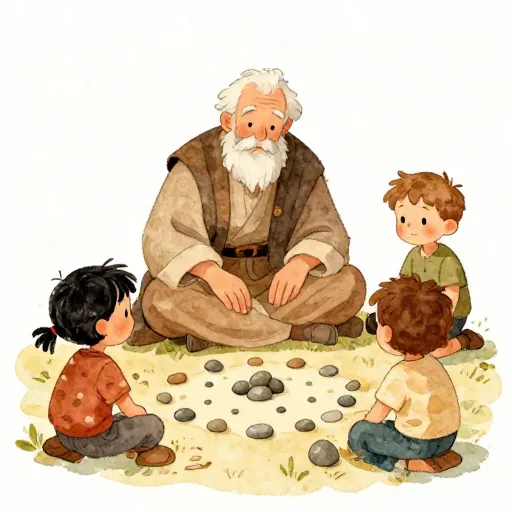
Heraclitus was once asked by the people of Ephesus to write new laws for the city. He refused, saying the city was already too messy with greed. Instead, he went to the temple to play 'knucklebones' (an ancient game like jacks) with a group of children, saying their simple play was more important than politics.
The Flow of an Idea
Heraclitus didn't want followers who just memorized his words. He wanted people to listen to the Logos, the underlying rhythm of nature. He reminds us that while we might want to hold onto a moment forever, the magic of the moment is that it is passing.
We are part of the river. We are part of the fire. We are a small but important note in a song that never ends. By accepting that everything flows, we can stop fighting the current and learn how to swim.
Something to Think About
If you could stop time for one minute, what is one thing in your life you would want to keep exactly as it is right now?
Heraclitus believed that change is what makes life beautiful, but humans often wish things would stay the same. There is no right or wrong way to feel about change: it is simply the river we are all swimming in.
Questions About Philosophy
Why did Heraclitus write in riddles?
Did he really think everything was made of fire?
What is the 'Unity of Opposites'?
Keep Flowing
The next time you stand by a stream, or even just watch the steam rise from a cup of cocoa, remember Heraclitus. The world is never finished, and neither are you. Every day is a new sun, and every moment is a chance to step into a brand-new river.
