Have you ever wondered if the world looks the same to a honeybee, a cat, or a giant alien from another galaxy?
In the 18th century, a thinker named Immanuel Kant realized that we don't just 'see' the world as it is. Instead, our minds act like a set of mental filters that organize our reality, giving us a unique human perspective on space, time, and morality.
Imagine a small city on the edge of the Baltic Sea called Königsberg. It is the year 1780, and the cobblestone streets are damp with morning mist. Every single day, at exactly half past three in the afternoon, a thin man in a grey coat steps out of his front door.
He walks the same path, past the same shops, and over the same bridge. He is so incredibly punctual that the people of the city actually set their pocket watches by him. When they see him pass, they know it is exactly 3:30. This man is Immanuel Kant, and while his body rarely leaves his hometown, his mind is traveling to the furthest edges of existence.
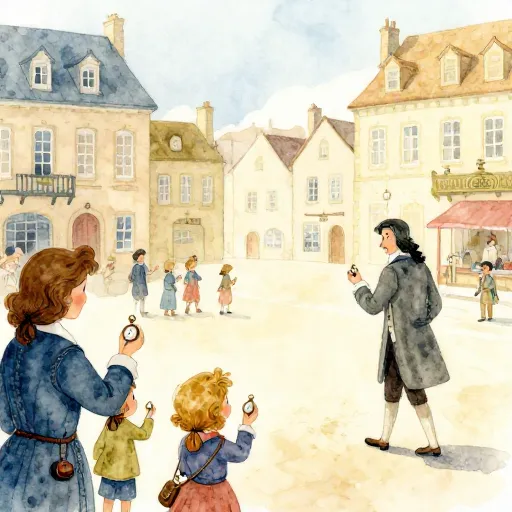
Kant was so obsessed with his schedule that he allegedly only missed his daily 3:30 PM walk once in his entire life. Why? He had just received a new book by the philosopher Jean-Jacques Rousseau and was so excited to finish reading it that he forgot to leave his house!
Kant lived during a time we now call the Enlightenment. It was an era when people were starting to trust their own reason more than old legends or superstitions. But Kant noticed a problem that other philosophers were struggling to solve.
Some thinkers, like David Hume, argued that we can only know what our five senses tell us. If we can't touch it or see it, they said, we can't be sure it exists. This made the world feel a bit like a collection of random accidents. Kant wanted to find a firmer ground for how we understand the universe.

Sapere Aude! Have courage to use your own understanding!
The Mental Goggles
To understand Kant's biggest breakthrough, imagine you were born wearing a pair of built-in green goggles. You would look at the grass and see green. You would look at a white cat and see a green cat. You would look at the clouds and see green puffs in the sky.
Close your eyes and try to imagine an object that isn't in space (it's nowhere) and isn't in time (it has no beginning or end). It's almost impossible, right? This is what Kant meant when he said space and time are the 'framework' of our thinking. We can't think 'outside' of them!
If someone asked you, 'What color is the world?' you would say, 'That's easy, the world is green.' You wouldn't even realize you were wearing the goggles. You would think 'green-ness' was a property of the world itself, rather than a filter in your own eyes.
Kant suggested that the human mind works exactly like this. He argued that we are born with 'mental goggles' that we can never take off. These goggles are what he called Space and Time.

Mira says:
"So if time is a filter in my head, does that mean a turtle's 'now' might feel different than my 'now'? Maybe they aren't slow at all, they just have a different clock app running!"
Before Kant, most people thought that space and time were like big empty containers that existed 'out there' in the universe. They thought we just happened to live inside them. Kant flipped this idea completely upside down. He called this his Copernican Revolution, named after the astronomer who realized the Earth moves around the Sun.
Kant argued that space and time are actually features of our own minds. They are the ways our brains organize all the messy data coming in from our eyes and ears. Without these mental filters, the world would just be a 'blinking, buzzing confusion' that we could never understand.
The Thing-in-Itself
This leads to one of the most mysterious and beautiful ideas in all of philosophy. If we are always looking through our human filters, what does the world look like without them? What is the world like when no one is looking at it?
Kant called the world as we see it the Phenomena. This is the world of trees, stars, and birthday cakes that we can experience. But he said there is another side to reality called the Noumena, or the Thing-in-Itself.

Imagine you are an explorer who has found a beautiful, ancient stained-glass window. You can describe the colors of the glass and the shapes of the lead, but you can never walk through the glass to see the world on the other side. Our senses are the glass, and the 'Thing-in-Itself' is the world on the other side.
The Thing-in-Itself is the reality that exists behind the curtain. It is the world before our minds have had a chance to organize it into space and time. Because we can never take off our 'mental goggles,' Kant said we can never truly know what the Noumena is like.
It is a bit like being a character in a video game. You can explore every corner of the game's map, but you can never step outside the computer to see the code that makes the game work. The code is there, and it's real, but it's hidden from your view.
Finn says:
"It's like looking at a wrapped present. I can see the paper and the bow, but I can't know what's actually inside until I open it. But Kant says we can *never* open the box of the universe!"
This might sound a bit frustrating at first. It means there are secrets about the universe we might never uncover. But for Kant, this was a source of great wonder. It meant that our minds are not just passive mirrors reflecting the world. Our minds are creators, actively building the reality we live in every single day.
The Rule of Rules
Kant didn't just think about stars and space. He also thought deeply about how we should treat each other. He wanted to find a way to decide what is 'right' and 'wrong' using the same kind of logic he used for science.
He came up with a famous test called the Categorical Imperative. That is a very fancy name for a very simple question. Before you do something, you should ask yourself: 'Would it be okay if everyone in the world did this all the time?'
The most important thing is the outcome. If telling a small lie saves someone's feelings, you should do it because it creates more happiness in the world.
The most important thing is the rule. If everyone lied whenever they wanted to, 'truth' would lose its meaning. You must follow the rule of honesty, regardless of the outcome.
Imagine you are thinking about cutting in line for the slide at the park. If you use Kant's test, you have to imagine a world where everyone cuts in line. In that world, lines wouldn't even exist anymore. There would just be a giant, angry huddle of people pushing each other, and no one would ever get to slide.
Because a world of constant line-cutting 'breaks' itself, Kant would say that cutting in line is logically wrong. It isn't just about how you feel in the moment. It is about whether your action could work as a universal law for everyone.

Act only according to that maxim whereby you can at the same time will that it should become a universal law.
Freedom and Duty
Kant believed that being a good person isn't about doing things because you're afraid of getting in trouble. It also isn't about doing things just because they make you feel happy. Instead, he believed in Duty.
To Kant, doing the right thing means following the rules you have set for yourself using your own reason. This is what makes humans special. A dog might stay off the couch because it's afraid of a scolding, but a human can decide to be honest simply because they believe honesty is a rule that makes sense.
Finn says:
"I tried the 'everyone does it' test with eating dessert for breakfast. If everyone did it, would the world break? Or would we just have a lot of very happy, very hyper people?"
This kind of freedom is a big responsibility. It means we are the ones who 'write the laws' for our own lives. Kant believed that every person has a special kind of Dignity because they have the power to think and choose. Because of this, he said we should never 'use' people like they are tools. Every person is an end in themselves.
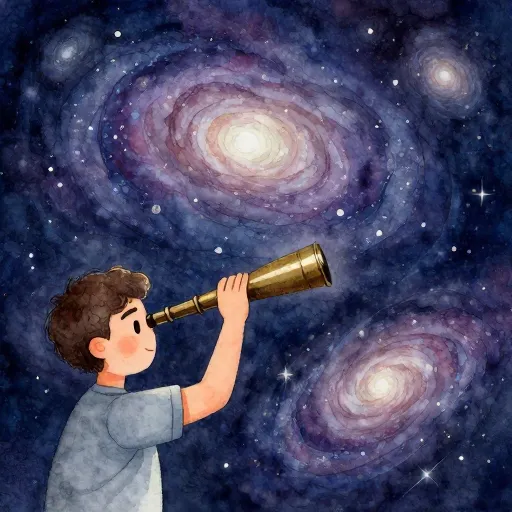
Kant was one of the first people to suggest that our galaxy, the Milky Way, is just one of many 'island universes' in space. Long before we had powerful telescopes, his logic told him the universe was much bigger than anyone imagined!
Through the Ages
Kant's ideas didn't stay in his little city of Königsberg. They traveled across the world and changed how we think about almost everything, from how we build computers to how we write laws for different countries.
Through the Ages
Kant's life was quiet, but his thoughts were loud. He showed us that the mind is not a dark room, but a brilliant light that illuminates the world. He taught us that even though we might not be able to see the 'Thing-in-Itself,' we can still use our reason to be kind, fair, and curious.
He ended one of his most famous books by talking about the two things that amazed him the most. One was the vast, sparkling sky full of stars. The other was the quiet voice inside us that tells us to do what is right. He believed they were both part of the same grand mystery.

Two things fill the mind with ever new and increasing admiration and awe: the starry heavens above me and the moral law within me.
Something to Think About
If you could design a new 'mental filter' for humans to see the world through, what would it be?
There are no right or wrong answers here. Think about how a new filter - like being able to sense magnetic fields or 'seeing' people's emotions as colors - might change how we understand what is real.
Questions About Philosophy
Did Kant really never leave his hometown?
What is the 'Thing-in-Itself' exactly?
Why is he called an 'Enlightenment' thinker?
The Adventure of Thinking
Immanuel Kant showed us that thinking is one of the greatest adventures a human can have. You don't need a spaceship to explore the deep mysteries of space and time: you just need to turn your curiosity inward. The next time you look at a tree or follow a rule, remember that your mind is working hard behind the scenes, painting the world with its own special light.
