If you could do anything you wanted, right now, would you actually be happy?
In the foggy, busy streets of 19th-century London, a man named John Stuart Mill spent his life thinking about liberty and the best way to organize a fair society. He believed that every person is an individual with the right to choose their own path, as long as they don't hurt anyone else along the way.
Imagine a boy sitting in a room filled with dusty books. It is 1809, and while other three-year-olds are playing with wooden blocks, this boy is learning ancient Greek. By the time he is eight, he has read through history books that would make a college student sweat.
This was the childhood of John Stuart Mill. His father, James Mill, wanted to create a 'genius machine.' He believed that if you poured enough knowledge into a child's head, they would grow up to solve all the world's problems.
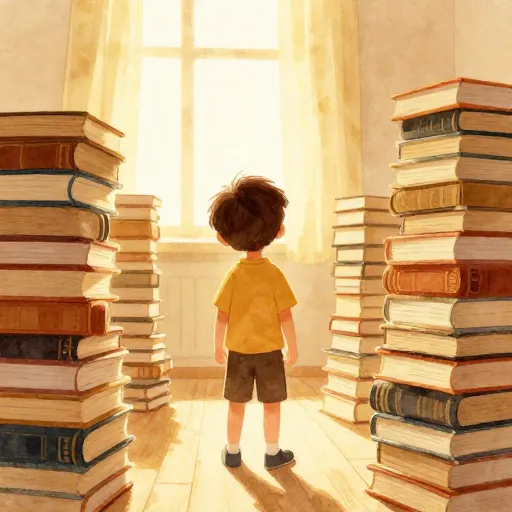
Mill never went to a university! His father thought he could teach John everything he needed to know at home. By age 14, John had completed the equivalent of a full university education.
Young John did not go to school or play with other children. Instead, his days were spent in a world of logic, math, and debate. He was a spectacular success in his father's eyes, but inside, something was missing.
He had become a master of empiricism, the idea that all knowledge comes from what we can see and measure. But as he grew older, he realized that humans are more than just walking calculators. We have feelings, dreams, and a need for something called wonder.

Finn says:
"If Mill was studying Greek at age three, did he ever get to have a snack break or play tag? I wonder if being that smart makes you feel lonely."
The Happiness Calculation
When Mill was a young man, he followed a set of ideas called utilitarianism. This was a philosophy started by his father's friend, Jeremy Bentham. Bentham had a very simple rule: the best thing to do is whatever brings the 'greatest happiness to the greatest number of people.'
To Bentham, happiness was like a score in a game. If an action gave you ten 'happy points' and only two 'sad points,' it was a good action. It did not matter if the happiness came from eating a sandwich or writing a symphony.
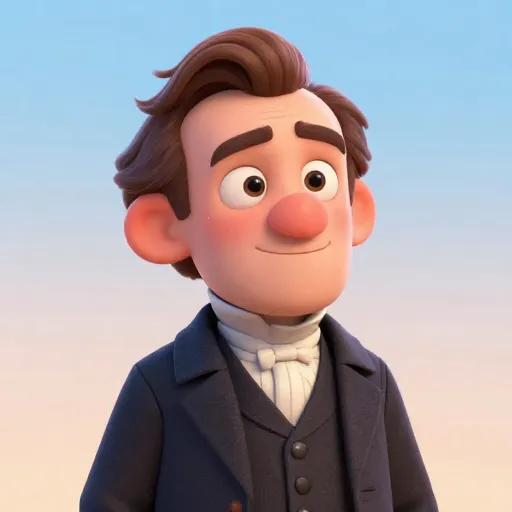
It is better to be a human being dissatisfied than a pig satisfied; better to be Socrates dissatisfied than a fool satisfied.
Mill eventually disagreed with his teacher on this point. He believed that some types of happiness are more valuable than others. He called these 'higher pleasures.'
Think about the difference between the feeling of eating a giant bag of candy and the feeling of finally learning how to ride a bike. The candy is great for a moment, but the bike-riding stays with you. Mill argued that we should aim for the kind of happiness that helps us grow as people.
The Happy Points Game: Imagine you have 10 'Happy Points' to give out. Which would you spend them on: A) Watching a 30-minute cartoon, or B) Spending two hours practicing a difficult piano piece until you finally get it right? Mill would argue that B is a 'higher' pleasure. Do you agree?
The Crisis and the Cure
At the age of twenty, Mill had what we might call a 'mental crisis.' He realized that even if all his goals were achieved, he still would not be truly happy. He felt like a dry, empty vessel of facts.
He found his cure in an unexpected place: poetry. Reading the poems of William Wordsworth helped him discover his own emotions. He realized that for a society to be truly great, it had to care about the inner life of its citizens, not just their physical needs.

Mira says:
"It's interesting that poetry 'cured' him. It's like his brain was a library that finally opened a window to let the fresh air in."
This shift in his thinking led him to his most famous ideas. He began to wonder: how much power should a government, or even a group of neighbors, have over what a person thinks or does?
He decided that the only way for humans to truly flourish was to have liberty. This means the freedom to be yourself, to try new things, and to express your own unique 'experiments in living.'
The Harm Principle
If everyone is free to do whatever they want, won't things get messy? Mill had a very clear answer for this, which we now call the harm principle. It is one of the most important rules in the history of law.

The only purpose for which power can be rightfully exercised over any member of a civilized community, against his will, is to prevent harm to others.
In other words, you have the right to swing your arms around as much as you like, but your freedom ends where someone else's nose begins. You are the boss of your own body and mind, but you are not the boss of anyone else's.
The government should make rules to keep people healthy, like banning sugary drinks or making everyone exercise.
Individuals should be free to make their own mistakes, even if those mistakes are bad for their health, as long as they don't hurt others.
Mill argued that this rule applies to more than just physical hitting. It applies to our ideas, too. He believed that the 'tyranny of the majority' was a huge danger. This is when a big group of people tries to force a smaller group to act or think just like them.
He thought that even if one person had an opinion that everyone else disagreed with, that person should still be allowed to speak. Why? Because they might be right. And even if they are wrong, hearing their ideas makes us think harder about why we believe what we believe.
Finn says:
"Wait, so if I want to wear my pajamas to the grocery store, and it doesn't hurt anyone, Mill would say I should be allowed to do it?"
A Partnership of Equals
One of the most important people in Mill's life was a woman named Harriet Taylor. At a time when most men thought women should not have a say in politics, Mill and Harriet were intellectual partners.
They worked together on books that argued for suffrage, which is the right to vote. Mill believed that a society that kept half its people (women) from contributing was like a person trying to run a race with one leg tied behind their back.

Imagine a world where only people with blue eyes are allowed to vote or choose their jobs. Everyone else has to do what the blue-eyed people say. This is how Mill felt about the way women were treated in the 1800s. He thought it was a giant waste of human talent and a huge mistake for society.
He was one of the first people in the British Parliament to officially demand that women be given the same rights as men. He saw this not just as a matter of kindness, but as a matter of justice. If every individual is 'sovereign' over themselves, that must include women too.
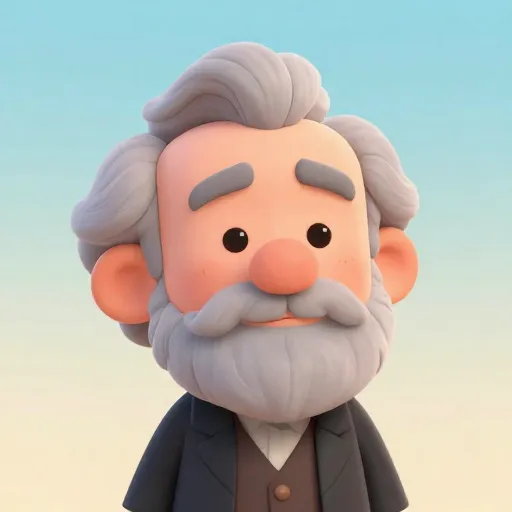
Over himself, over his own body and mind, the individual is sovereign.
Experiments in Living
Mill didn't want everyone to be the same. He loved the idea of people being 'eccentric' or unusual. He thought that a world where everyone followed the same rules and wore the same clothes would be incredibly boring and stuck in the past.
He called these different ways of life 'experiments in living.' Just like a scientist tries different things in a lab to see what works, Mill thought humans should try different ways of being happy. This is how society makes progress.
Through the Ages: The Idea of Liberty
Today, we see Mill's fingerprints everywhere. Every time you hear someone talk about 'free speech' or 'human rights,' they are using the tools that Mill helped build. He taught us that a healthy society isn't one where everyone agrees, but one where everyone is free to disagree.
Mill was actually arrested when he was 17 years old! He wasn't a criminal, though. He was passing out pamphlets that explained how poor families could have fewer children so they wouldn't struggle so much. Even then, he was trying to use his ideas to help people.
Mill's life was a journey from being a 'genius machine' to being a person who valued poetry, love, and the messy, beautiful freedom of being human. He showed us that while logic is important, it is the freedom to choose our own path that makes life worth living.
Something to Think About
If you were the only person in the world who believed something was true, would you still have the right to say it?
Mill believed your voice would be the most important one to hear. There isn't a simple 'yes' or 'no' here, but thinking about it helps us understand what it means to be truly free.
Questions About Philosophy
Did John Stuart Mill believe in any rules?
Why did he care so much about women's rights?
What is 'Utilitarianism' in simple terms?
The Guardian of the Individual
John Stuart Mill reminds us that being an individual is a big responsibility. It means we get to choose who we want to be, but it also means we have to respect everyone else's right to do the same. As you go through your day, look for 'experiments in living' around you. You might find that the world is much more interesting when everyone is allowed to be a little bit different.