
Have you ever stood at the top of a high slide and felt a strange mix of excitement and fear in your stomach?
That 'bubbly' feeling is something a Danish philosopher named Søren Kierkegaard spent his whole life studying. He is often called the father of existentialism, a way of thinking that focuses on what it actually feels like to be a human being making choices in a big, mysterious world.
Imagine walking through the streets of Copenhagen in the year 1840. The city is filled with the sound of horse-drawn carriages on cobblestones and the smell of roasting coffee.
Among the crowd is a thin man with wild, sandy hair and trousers that are always slightly too short. This is Søren Kierkegaard. He doesn't sit in a quiet library all day: he walks the streets, talking to everyone from the King to the street sweepers.

Kierkegaard had a special 'standing desk' in every room of his house so he could write down ideas the second he walked in from his daily 'people-watching' strolls.
Kierkegaard was obsessed with a single question: What does it mean to be an individual? He noticed that most people around him were just following the crowd. They did what their parents did, believed what the newspapers said, and went to church because everyone else did.
He felt that people were living their lives in 'copy-paste' mode. They were forgetting the most important thing about being alive: the power to choose for yourself.
The Problem of the Crowd
Kierkegaard used the word the crowd to describe the way we lose ourselves when we try to fit in. He thought that when we are part of a crowd, we stop thinking for ourselves.

Mira says:
"I notice that when my whole class starts liking the same song, I start liking it too. Is that me being 'the crowd,' or do we just all have the same taste?"
In a crowd, nobody is responsible for anything. If everyone is being mean to someone on the playground, it feels easier to join in because 'everyone is doing it.'
Kierkegaard believed this was a trap. He argued that truth isn't something you find by counting how many people agree with you. Instead, he believed in subjectivity, which is the idea that the most important truths are the ones you feel and live personally.
Focuses on facts that are the same for everyone, like '2 + 2 = 4' or the height of a mountain.
Focuses on what things mean to you personally, like 'Who do I love?' or 'What is worth being brave for?'
The Dizziness of Freedom
If being an individual is so great, why is it so hard? Kierkegaard had an answer for that, too. He called it anxiety (or 'angst' in his language).
To him, anxiety wasn't just a bad feeling you get before a test. It was actually a sign of your own power. He famously said that anxiety is the 'dizziness of freedom.'

Anxiety is the dizziness of freedom.
Think about standing on the edge of a tall cliff. You feel dizzy, right? That dizziness isn't just a fear of falling: it is the sudden realization that you could throw yourself off, or you could stay safe.

Imagine you are standing at the edge of a diving board. You feel that 'whoosh' in your stomach. That isn't just a physical feeling: it is your brain realizing that in one second, everything is going to change because of a choice you make.
That feeling of 'I could do anything' is overwhelming. It is like being in a giant toy store and being told you can only pick one thing. The pressure of having to choose is what makes us feel anxious.
Living Forwards, Understanding Backwards
Kierkegaard realized that life has a very annoying rule. You have to make your big decisions right now, but you won't know if they were the 'right' ones until much later.

Life can only be understood backwards; but it must be lived forwards.
Think about starting a new hobby, like playing the violin. On the first day, you don't know if you'll be good at it or if you'll even like it. You just have to start.

Finn says:
"If I can only understand my life backwards, does that mean I'm basically guessing every time I make a choice? That feels a bit like a prank!"
You only understand the 'story' of your life when you look back at your old journals or photos. But while you are living, you are always facing a future that hasn't happened yet. This is why Kierkegaard thought being a person takes so much courage.
The Three Ways to Live
Kierkegaard suggested that people usually move through different 'stages' or ways of living. He didn't think these were like levels in a video game that you finish, but more like different mindsets.
- The Aesthetic Stage: This is when you live for fun, beauty, and excitement. You want to avoid being bored. It feels great for a while, but eventually, you might feel empty, like you've eaten too much candy.
- The Ethical Stage: This is when you start living by rules and duties. you want to be a 'good person' and do what is right. This is more solid, but it can feel stiff or like you are just following a script.
- The Religious Stage: For Kierkegaard, this was the highest level. It wasn't just about going to church. It was about making a personal, total commitment to something bigger than yourself, even if it seems 'absurd' or impossible to others.
The 'No-Reason Choice' game: Next time you have to pick between two things that don't really matter (like two different colored pens), try picking one immediately without giving yourself a reason. Notice how it feels to just 'leap' into a choice without overthinking it.
The Leap of Faith
This brings us to his most famous idea: the leap of faith. Kierkegaard believed that for the most important things in life: love, belief, or following a dream: thinking isn't enough.
You can make a list of pros and cons until you are a hundred years old, but eventually, you have to stop thinking and start leaping.
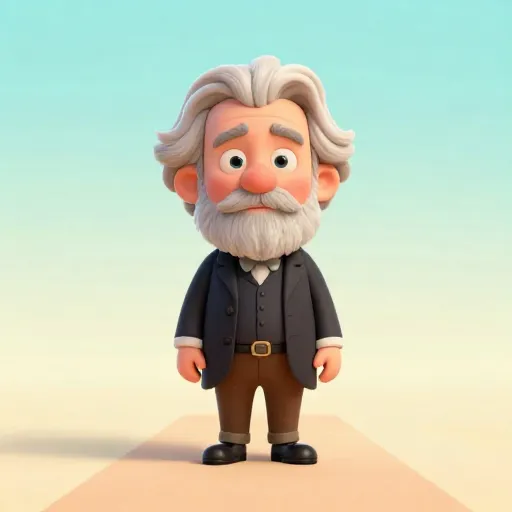
To dare is to lose one's footing momentarily. Not to dare is to lose oneself.
A leap of faith happens when you commit to something even though you can't prove it's the right choice. It's like jumping into a pool of water when you can't see the bottom. You trust that you will be okay, or that the jump itself is worth it.
Mira says:
"The 'leap' makes sense to me. You can't think your way into a friendship: you just have to decide to trust someone and see what happens."
Through the Ages
Kierkegaard was mostly ignored while he was alive. People in Copenhagen thought he was a bit strange. But decades after he died, his ideas exploded across the world.
Through the Ages
In the 20th century, after big wars made the world feel confusing, thinkers like Jean-Paul Sartre looked back at Kierkegaard. They realized he was right: we are 'condemned' to be free. We have to create our own meaning in a world that doesn't provide a handbook.
Kierkegaard wrote many of his books using fake names (pseudonyms) like 'Johannes de Silentio' (John of Silence). He wanted readers to judge the ideas, not the man who wrote them!
Why Kierkegaard Matters Now
Today, we are more connected to 'the crowd' than ever before. With social media, we can see what thousands of people are doing, wearing, and thinking every second.
Kierkegaard would probably tell us to put the phone down and go for a walk. He would tell us that it's okay to feel 'dizzy' about who you want to be. That dizziness is just your freedom waking up.
He didn't want to give us a set of answers. He wanted to give us the courage to be the only person who can live our life: ourselves.
Something to Think About
If you could only do things because YOU wanted to, and not because you were told to or because your friends were doing it, what is one thing you would do differently today?
There isn't a right or wrong answer here. Kierkegaard would say that just by thinking about this, you are already starting your journey as an individual.
Questions About Philosophy
Was Kierkegaard a religious person?
Is 'angst' the same as being stressed?
Why did he use fake names for his books?
The Courage to be You
Kierkegaard's life reminds us that being a person is a bit of an adventure. It's okay to feel dizzy, it's okay to feel different from the crowd, and it's okay to not have all the answers. The most important thing is that you keep walking, keep thinking, and - when the time is right - keep leaping.
