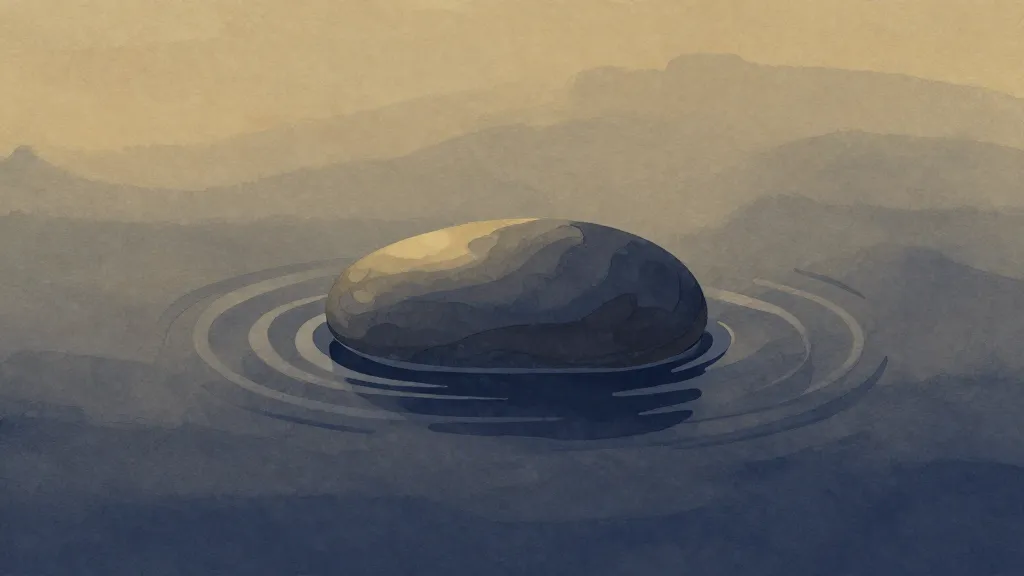
Have you ever noticed that if you try really, really hard to fall asleep, you stay wide awake?
Around 2,500 years ago, a thinker named Lao Tzu noticed that life often works in backwards ways. He taught that by pushing less, we might actually get more done, a philosophy known as Taoism.
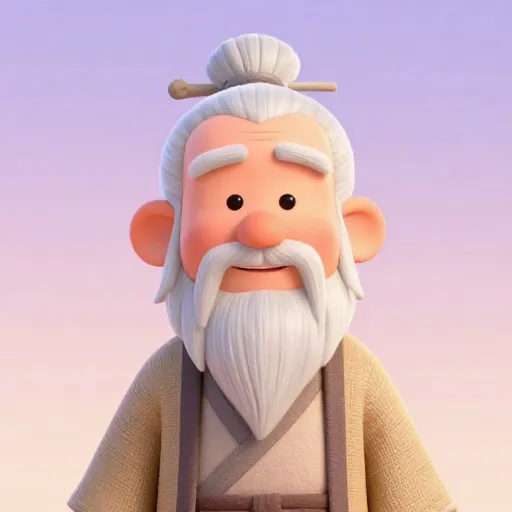
Imagine a library in ancient China, thousands of years ago. The air smells like old bamboo scrolls and ink. In the middle of this quiet place sits a man named Lao Tzu.
His job was to look after the royal archives, which meant he spent his days reading the history of kings, wars, and secrets. He saw how people struggled for power and how often they ended up unhappy.
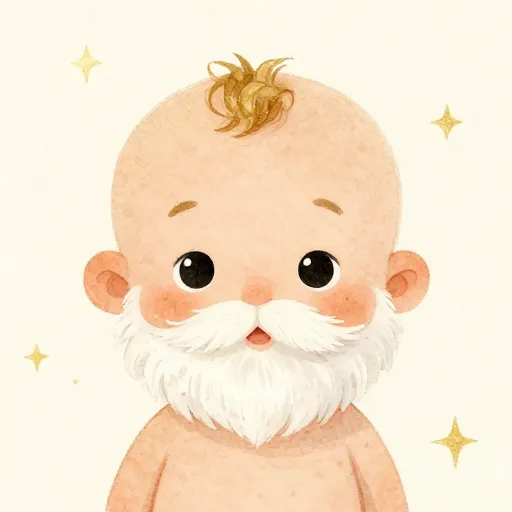
The name 'Lao Tzu' isn't actually a regular name. In Chinese, it can mean 'Old Master' or even 'Old Boy.' Some legends say he was born with white hair and the wisdom of an 80-year-old!
History tells us that Lao Tzu eventually grew tired of the busy, noisy world of politics. He decided to leave the city and head into the mountains to find peace.
But as he reached the border, a gatekeeper recognized him. The guard wouldn't let him leave until he wrote down his wisdom so it wouldn't be lost forever.

Finn says:
"If Lao Tzu didn't want to be famous, why did he write the book? Maybe he was just being kind to the gatekeeper!"
Lao Tzu sat down and wrote a short, mysterious book called the Tao Te Ching. It is only about 5,000 characters long, but people have been scratching their heads over it for centuries.
Once he finished, he climbed onto the back of a water buffalo and rode away into the mist. No one ever saw him again, but his words changed the world.
The Mystery of the Tao
The first thing Lao Tzu explains is that the most important thing in the universe cannot be described with words. He calls this the Tao, which translates to 'The Way' or 'The Path.'
Think of the Tao as the natural rhythm of the universe. It is the way the stars move, the way the seasons change, and the way a seed knows how to become a tree.
Nature does not hurry, yet everything is accomplished.
Lao Tzu says that the moment we try to define the Tao, we lose it. It is like trying to catch a handful of smoke or describe the taste of water.
If you name something, you put it in a box. But the Tao is everything and everywhere, so it cannot fit into any box we make.
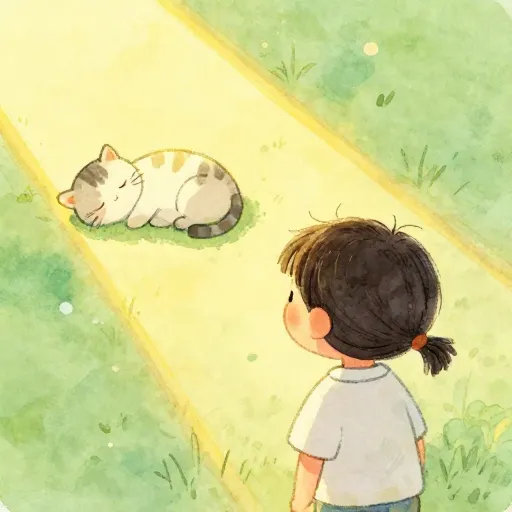
The next time you go outside, try to find something that is 'doing its job' without trying. Look at how a cloud floats or how a cat stretches. Do they look like they are working hard, or are they just being themselves?
Instead of thinking about it, Lao Tzu suggests we feel it. Have you ever been so busy playing or drawing that you forgot what time it was?
In those moments, you aren't 'trying' to have fun or 'trying' to be creative. You are just in the flow, moving with the Tao.
The Power of Being Soft
Most people think that to be strong, you have to be hard, loud, or fast. Lao Tzu thought the exact opposite.
He loved to use water as an example. Water is soft, clear, and gives way to everything, yet it can wear down the hardest mountains over time.

Mira says:
"I saw this at the park! The big branches on the oak tree broke in the wind, but the thin weeds just danced and stayed safe."
Think about a heavy snowstorm. An old, stiff oak tree might try to fight the weight of the snow until its branches snap under the pressure.
But a blade of grass or a flexible willow branch just bends. When the snow slides off, the branch pops back up, perfectly fine.
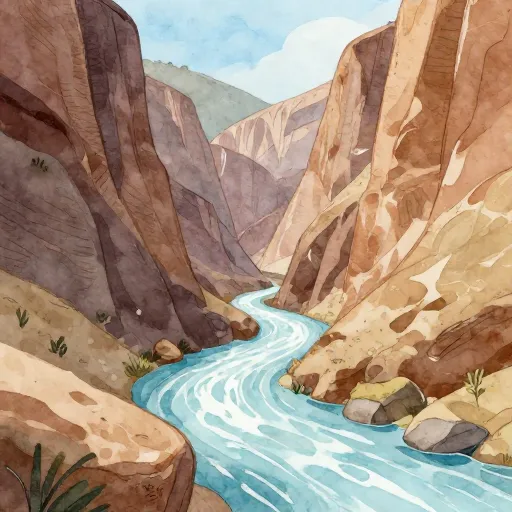
Imagine the tallest mountain in the world. It looks invincible, right? Now imagine a tiny drop of water landing on it. Then another. And another. Over millions of years, those tiny, soft drops will carve a giant canyon right through the middle of that hard rock.
Lao Tzu called this Ziran, which means 'naturalness' or being 'self-so.' It is about being exactly who you are without trying to be something else.
When we stop trying to be the 'strongest' or the 'smartest,' we stop breaking our own branches. We become more like water, finding the easiest path forward.
Doing by Not Doing
One of the most famous ideas from Lao Tzu is Wu Wei. This is often translated as 'non-action,' but that doesn't mean staying in bed all day!
Wu Wei is more like 'effortless action.' It is the art of knowing when to act and when to let things happen on their own.
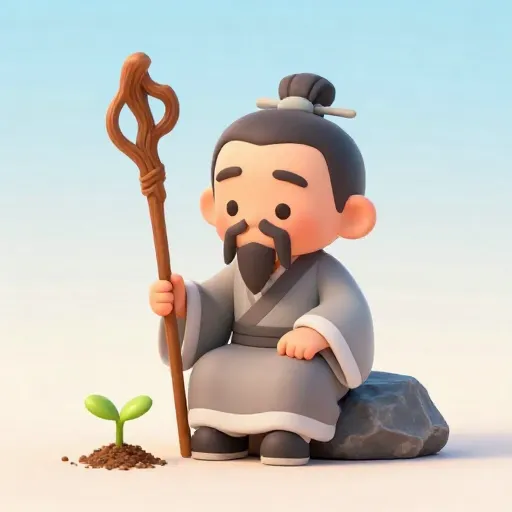
A journey of a thousand miles begins with a single step.
Imagine you are in a boat on a river. You could spend all your energy rowing as hard as you can against the current, getting tired and grumpy.
Or, you could put the oars down, use the rudder to steer, and let the river’s energy carry you where you need to go.
We need strict rules, rituals, and respect for hierarchy to have a good society.
The more rules you have, the more criminals you create. We should trust nature instead.
Lao Tzu thought leaders should lead this way, too. He believed the best rulers were the ones people hardly noticed, because they let everyone live naturally.
Instead of making thousands of complicated rules, a Taoist leader trusts that people are naturally good when they aren't being pushed around.
The Uncarved Block
Lao Tzu often spoke about the Pu, or the 'uncarved block.' Imagine a piece of wood that hasn't been turned into a table, a chair, or a toy yet.
In its natural state, the wood has 'infinite potential.' It could be anything! But once you carve it into a spoon, it can only be a spoon.
Finn says:
"What if being an 'uncarved block' just means being okay with not knowing what I want to be when I grow up yet?"
He thought that as we grow up, society tries to 'carve' us into specific shapes. We are told how to dress, what to like, and how to act to be 'successful.'
Lao Tzu invites us to remember the uncarved block inside ourselves. He wants us to find the simple, quiet person we were before we started trying so hard to please others.
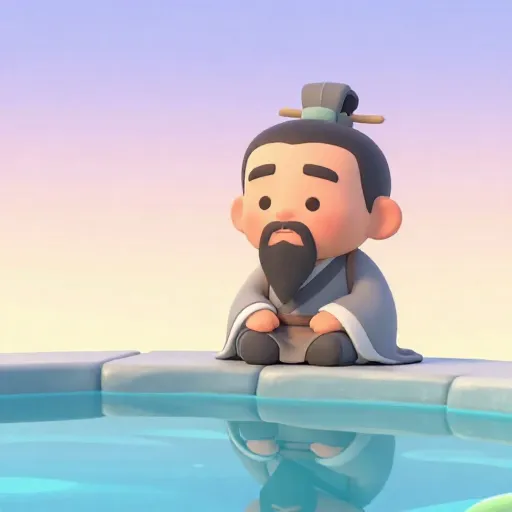
Knowing others is intelligence: knowing yourself is true wisdom.
This doesn't mean we shouldn't learn or grow. It means we should grow like a plant grows, from the inside out, rather than being carved by a knife from the outside in.
The Way Through the Ages
A World of Opposites
You might have seen a circle with a black swirl and a white swirl, called the Yin and Yang. This is a big part of Lao Tzu’s world.
He believed that everything in the world has an opposite, and you can't have one without the other. You can't know what 'tall' is without 'short,' or 'light' without 'dark.'
Lao Tzu's book, the Tao Te Ching, is one of the most translated books in human history. Only the Bible has been translated into more languages!
Because of this, Lao Tzu didn't see 'bad' times as something to be scared of. He knew that just as winter turns into spring, difficult times eventually turn into better ones.
He taught us to be humble because when you are at the bottom, the only way is up. And when you are at the top, you should be careful, because things always change.
The Legacy of the Old Master
Lao Tzu’s ideas didn't stay in the mountains of China. They flowed through history like the water he loved so much.
His focus on nature helped people think about how to protect the environment long before 'ecology' was a word. He reminded us that we are part of nature, not its masters.
Today, we see his influence in everything from martial arts to the way some people practice mindfulness and meditation.
He remains a mysterious figure, a man who became famous for telling everyone that being famous doesn't matter.
Something to Think About
If you stopped 'trying' for one whole hour today, what would you actually do?
There isn't a right answer here. Would you sit still? Would you draw? Would you realize you're already doing exactly what you're supposed to be doing?
Even now, 2,500 years later, we can still hear him whispering: slow down, breathe, and let the river take you home.
Questions About Philosophy
Was Lao Tzu a real person?
What is the difference between Taoism and a religion?
Is Wu Wei the same as being lazy?
The End of the Path (Is Just the Beginning)
Lao Tzu didn't want to be a famous teacher with all the answers. He wanted to be a guide who points toward the woods and says, 'Go see for yourself.' The next time you feel like you're pushing against a door that says 'PULL,' remember the Old Master and his water buffalo. Maybe there's an easier way.