Have you ever looked at a messy room, a rainy day, or a broken toy and wondered: Could the world be any better than this?
In the 1600s, a man named Gottfried Wilhelm Leibniz spent his life trying to prove that everything happens for a reason. He was a polymath who believed that the universe was a perfectly designed machine where even the smallest monads played a vital role in creating harmony.
Imagine a young boy standing in a library that smells like old leather and dust. His father was a professor, and when the boy was only six years old, his father died. Left alone with a massive collection of books, the boy did something unusual: he began to read every single one of them.
By the age of twelve, he was reading difficult books in Latin that most adults couldn't understand. This was Gottfried Wilhelm Leibniz. He lived in a time of great change in Europe, just as the Scientific Revolution was beginning to bloom like a garden after a long winter.
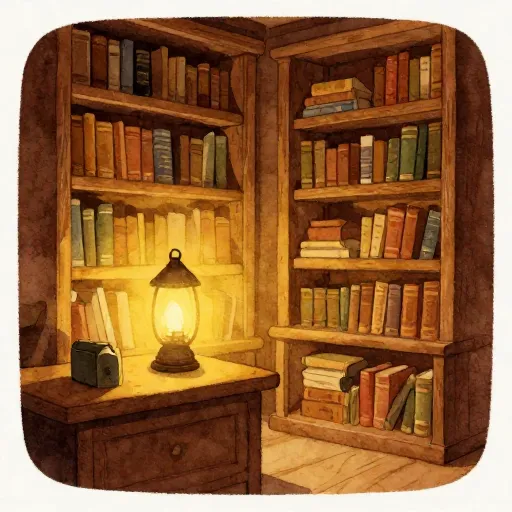
Imagine a room filled with books from the floor to the ceiling. There are maps of the stars on the walls and a heavy brass telescope in the corner. This was Leibniz's world. He worked as a librarian for much of his life, organizing thousands of books and writing his own ideas in the margins of almost every single one.
Leibniz lived in Germany during the 17th century. It was a place that had been torn apart by wars and arguments about religion. Because of this, he became obsessed with a single, giant idea: finding a way to make everything fit together. He wanted to find the logic that connected math, God, science, and people.
He didn't just want to know how things worked. He wanted to know why they worked that way and not some other way. This search led him to develop the Principle of Sufficient Reason, which says that nothing happens without a reason, even if we aren't smart enough to see it yet.
Everything that is possible demands to exist.
The Puzzle of the Best World
One of the most famous things Leibniz ever argued was that we live in the "best of all possible worlds." This might sound strange. You might think of a world without homework, or a world where it never rains on your birthday, as being much better than this one.
Leibniz wasn't saying this world is perfect in the way a fairy tale is perfect. Instead, he thought of God as a master architect or a brilliant mathematician. Before creating the universe, God looked at every possible way a world could be built: some with more gravity, some with different colors, some where humans had wings.

Finn says:
"So wait... if I stub my toe and it really hurts, Leibniz thinks that was the best possible thing that could happen? That sounds like he's never stubbed a toe before!"
Leibniz argued that God chose this specific world because it has the most variety and the most beauty while following the simplest rules. It is a world of Optimism, but not the kind of optimism that means "just be happy." It is the belief that the universe is logically the best version it could be.
Think of a beautiful painting. If you look very closely at one tiny corner, you might see a dark, ugly smudge of brown paint. You might think, "Why did the artist put that there? It would be better if it were bright gold!" But when you step back, you see that the brown smudge is a shadow that makes the gold light look ten times brighter.

Go outside and find two things that look exactly the same. Two leaves from the same bush, two pebbles from the driveway, or even two blades of grass. Hold them side-by-side. Can you find even one tiny difference? Leibniz bet his reputation that you always will.
The Mystery of the Monads
If you take a Lego castle and break it down, you get bricks. If you break the bricks, you get plastic. If you break the plastic, you get atoms. But Leibniz asked: what happens if you keep breaking things down forever? Is there a "bottom" to the universe?
He decided that the world wasn't actually made of little bits of hard matter. Instead, he believed everything was made of tiny, soul-like points of energy called monads. These aren't like atoms because they don't have a size or a shape. You can't touch a monad, but you are made of them.

Mira says:
"I think I get it. It's like the universe is a giant computer program and monads are the tiny lines of code. Even the small lines that don't seem to do much are needed for the whole game to run!"
Leibniz called monads "perpetual living mirrors of the universe." He believed that every single monad, no matter how tiny, contains a little map of the entire universe inside it. It is as if every drop of water in the ocean knew where every other drop of water was moving.
This led to a very strange idea called Pre-established Harmony. Imagine two clocks that are perfectly synchronized. They aren't connected by any wires, and they don't "talk" to each other. Yet, they both strike twelve at the exact same moment because they were both built perfectly by the same clockmaker.
He believed the universe is like a set of clocks that were wound up at the beginning of time. They don't affect each other, but they all work together because the design was perfect from the start.
He believed that things in the world are constantly bumping into each other and changing each other. To him, the universe is about action and reaction, like a giant game of pool.
The Great Calculus Battle
While Leibniz was thinking about the soul and the universe, he was also doing some of the hardest math in history. He invented Calculus, which is a way of measuring how things change over time, like the speed of a falling apple or the curve of a planet's orbit.
However, there was a problem. In England, another famous scientist named Isaac Newton was also inventing calculus at the exact same time. For years, the two men and their friends argued about who came up with it first. It was the biggest rivalry in the history of science.
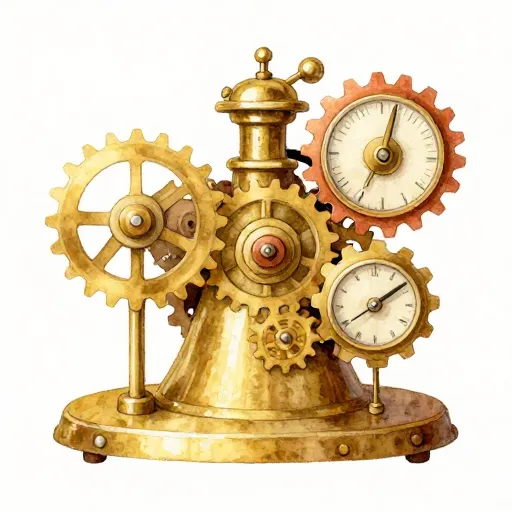
Leibniz invented a machine called the 'Stepped Reckoner.' It was one of the first calculators that could multiply and divide. He used a special gear called a 'Leibniz wheel' that was so well-designed, it was still being used in calculators until the 1970s!
Today, we know that both men probably figured it out on their own. But history has a favorite: even though Newton is more famous, we use the symbols and the language that Leibniz invented. When you see a weird, long "S" shape in a math book, that is Leibniz's handwriting reaching out from the 1600s to help you calculate area.
Leibniz also loved the idea of a Universal Characteristic. He dreamt of a special alphabet of thoughts. He thought that if we could turn every idea into a number or a symbol, we would never have to argue again. We would just sit down with a piece of paper and say, "Let us calculate," to find the truth.

It is not possible that there should be two individuals entirely alike.
The Garden of No Equals
Leibniz had another rule called the Identity of Indiscernibles. This is a very long name for a very simple, beautiful idea: no two things in the universe are exactly the same. He once challenged a friend to find two leaves in a garden that were identical.
His friend spent a long time looking at every tree and bush. He found leaves that looked very similar, but when he looked closer, there was always a tiny difference in a vein, a spot, or a jagged edge. Leibniz argued that if two things were truly, 100 percent identical, they wouldn't be two things: they would be the same thing.
Finn says:
"If no two things are the same, does that mean there's no such thing as a 'standard' Lego brick? Under a microscope, is every single brick its own unique character?"
This means that you are unique not just because you have different DNA, but because the universe is designed to never repeat itself. To Leibniz, variety was one of the greatest marks of a well-made world. A world with a billion different things is more "perfect" than a world with a billion identical things.
This also applied to how he saw people. Since every person is made of their own unique set of monads, every person sees the world from a slightly different perspective. No one sees the whole truth, but everyone sees a tiny piece of it that no one else can see.
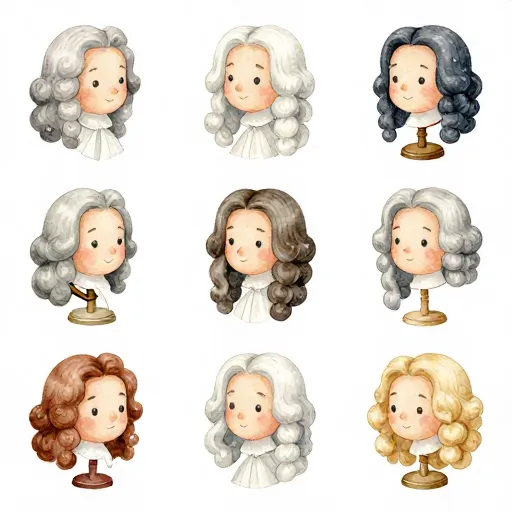
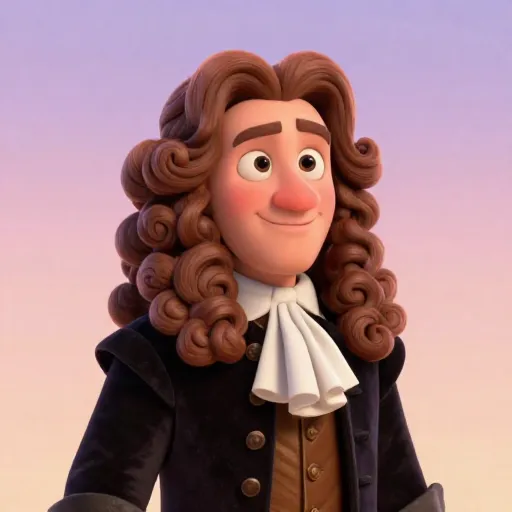
Leibniz was so famous for his giant wigs that people joked he had a different wig for every day of the month. Wigs were very fashionable back then, and Leibniz's wig was like a super-sized version of a rockstar's hair today!
Coding the Future
One of Leibniz's most incredible inventions was something most people in his time didn't understand: Binary. He noticed that you could represent any number in the world using only two digits: 0 and 1. He even related this to the idea of God (1) creating the world out of nothing (0).
He didn't have electricity or microchips, but he designed a mechanical calculator that used these ideas. He was thinking like a computer programmer 300 years before the first computer was actually built. He saw that information was the most powerful thing in the world.

Music is the pleasure the human mind experiences from counting without being aware that it is counting.
Through the Ages
Because Leibniz was a diplomat, he traveled all over Europe in a horse-drawn carriage. While the carriage bumped along muddy roads, he would sit inside and write letters to hundreds of other thinkers. He was like a human internet, connecting people from different countries through the power of ideas.
He wanted to unite the churches, create a global library, and build machines to do the boring work of counting so that humans could focus on thinking. He believed that the more we learn about the world, the more we see the Logic and the beauty behind it all.
Even when life was hard, Leibniz stayed curious. He didn't see the world as a place of accidents. He saw it as a grand, complicated song where every note, even the low ones, was necessary for the music to sound right.
Something to Think About
If you were the architect of a new world, what one rule would you choose to make it the 'best' possible version?
There are no right or wrong answers here. Leibniz thought the best rule was 'variety through simple laws,' but your world might need a different foundation.
Questions About Philosophy
Did Leibniz or Newton actually win the calculus argument?
What is a monad in simple terms?
Why did he think this is the 'best' world if bad things happen?
A World of Reasons
Gottfried Wilhelm Leibniz left us with a universe that is vibrant, alive, and deeply connected. He teaches us that curiosity has no limits and that even a single leaf in a garden is a masterpiece of unique design. Next time you see a pattern in the clouds or a rhythm in a song, remember the man in the giant wig who believed that everything, no matter how small, is exactly where it needs to be.