Have you ever wondered why some arguments make perfect sense while others feel like a pile of mismatched socks?
We use a secret set of rules called logic to sort out the world. It is the tool that helps us decide what is true, what is possible, and what is just plain silly.
Imagine you are standing in a sunny garden in Ancient Greece over two thousand years ago. You aren't just there to look at the olive trees: you are there to learn how to use your brain like a precision instrument.
Around you, people are arguing about everything from the stars to the shape of justice. But one man, a teacher named Aristotle, noticed something peculiar about these arguments. He realized that while the topics changed, the patterns of the thinking stayed the same.

Imagine a school called the Lyceum. It isn't a building with desks, but a grove of trees. Aristotle and his students are walking in circles, talking loudly about the moon. They believe that walking helps the brain follow the 'path' of an idea.
Aristotle didn't just want to know what people were thinking. He wanted to understand how they were thinking. He began to write down the rules for this mental gymnastics, creating the first formal system of logic.
He believed that if we could master these rules, we could avoid being fooled by fast talkers. We could build ideas that were as solid as stone temples.
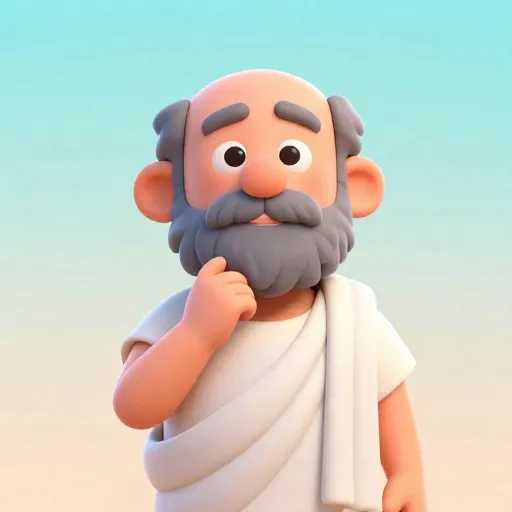
Logic is the beginning of wisdom, not the end.
The Building Blocks of a Thought
To understand logic, we have to look at the pieces that make up an idea. Think of a logical argument like a small building. It needs a solid foundation and walls that fit together perfectly.
In logic, we call the foundation the premise. A premise is a statement that we assume is true, like "All dogs have four legs" or "It is raining outside."

Finn says:
"So, if the foundation of a building is shaky, the whole house falls down. Does that mean if my starting idea is wrong, everything else I think will be wrong too?"
Most arguments need at least two premises to get started. Once you have your premises, you move toward the conclusion. The conclusion is the finish line of your thought: it is the thing you are trying to prove.
Aristotle's favorite way to show this was a three-step dance called a syllogism. It looks like a simple math equation, but it uses words instead of numbers.
- Premise A: All humans are mortal (they don't live forever).
- Premise B: Socrates is a human.
- Conclusion: Therefore, Socrates is mortal.
Can you build your own syllogism? Fill in the blanks: 1. All [Group of things] are [Trait]. 2. [Specific thing] is a [Group of things]. 3. Therefore, [Specific thing] is [Trait]. Example: All fruits have seeds. An apple is a fruit. Therefore, an apple has seeds.
Truth vs. Validity: The Great Puzzle
Here is where logic gets a little bit strange and a lot more interesting. In logic, an argument can be "perfectly built" even if it is completely wrong about the world.
We call the "perfect build" of an argument its validity. If the conclusion follows naturally from the premises, the argument is valid. It doesn't matter if the premises are true or not.
The logic is valid because it follows the 'If A, then B' rule perfectly. The structure is strong.
The argument is false because the facts are wrong. You can't reach a true place by starting in a make-believe land.
Imagine I say: "All cats are made of cheese. Mittens is a cat. Therefore, Mittens is made of cheese."
Logically, this is a perfect argument! The "if/then" part works exactly as it should. However, because the starting point is false, the whole thing is what logicians call "unsound."

Mira says:
"It's like a computer game! The game has rules that always work, but you can still use those rules to do something totally impossible in real life."
We need both soundness and validity to find the truth. Soundness means the argument is built correctly and the facts you started with are actually true. Finding where an argument breaks is the first step in becoming a great thinker.
Exploring the East: The Nyaya Way
While Aristotle was walking around Athens, thinkers in India were developing their own incredible system of logic called Nyaya. They were just as obsessed with the truth, but they looked at it through a different lens.
In the Nyaya tradition, logic wasn't just about the words on a page. It was about how we perceive the world with our eyes, ears, and memories.
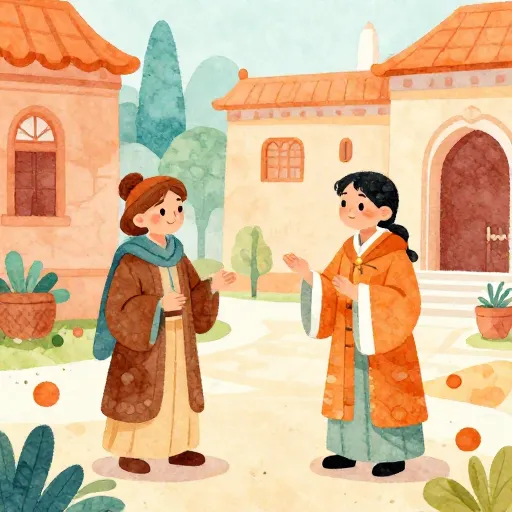
In Ancient India, logic was often used in giant public debates. The winner didn't just get bragging rights: sometimes they won a whole school or became the advisor to a king!
They developed a five-step process to prove something. Instead of just three steps, they included an example to make sure the idea was grounded in real life.
If they wanted to prove there was a fire on a distant mountain, they would point to the smoke. They would then remind you of a kitchen hearth where you've seen smoke and fire together before. This made their logic feel very practical and connected to the world around them.
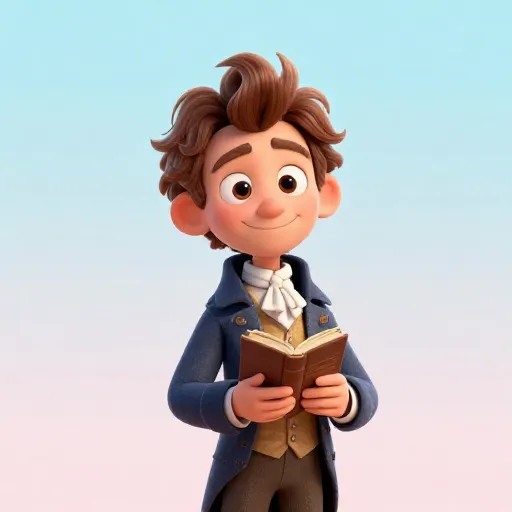
The rule is, jam to-morrow and jam yesterday: but never jam to-day.
Deductive vs. Inductive: Two Ways to Travel
There are two main ways our brains travel from a premise to a conclusion. The first is deductive reasoning, which is like a one-way street that leads to a certain answer.
If the rules are followed in deduction, the answer must be true. If you know all birds have feathers and you are holding a bird, you can be 100% sure it has feathers. There is no room for doubt.
Sherlock Holmes is famous for 'deduction,' but he actually uses 'induction' most of the time! He looks at clues like mud on a shoe and makes a very likely guess about where someone has been.
But life isn't always that certain, which is why we have inductive reasoning. This is more like being a detective. You collect clues and make a very good guess about what is likely to happen.
If you see the sun rise in the east every morning for ten years, you use induction to assume it will rise in the east tomorrow. You can't be 100% certain (the universe is a wild place!), but it is a very safe bet.
The Trap of the Fallacy
Sometimes, people use arguments that sound logical but are actually hollow inside. These are called a fallacy. A fallacy is a mistake in reasoning, like a bridge that looks strong but is made of cardboard.
One common fallacy is the "Ad Hominem," which is a fancy Latin way of saying "attacking the person." This happens when someone can't find a flaw in your idea, so they make fun of your shoes or your haircut instead.
Finn says:
"Wait, I see fallacies all the time in commercials! They try to make me think that if I buy those sneakers, I'll suddenly be able to dunk like a pro."
Another is the "Slippery Slope." This is when someone claims that if you do one small thing, a giant disaster will definitely happen. "If you don't clean your room today, you will never go to college and you'll end up living in a cave!"
Logic helps us spot these traps. When we recognize a fallacy, we can stop the argument and say: "Wait a minute, that doesn't actually follow."
Through the Ages: The Journey of Logic
Logic in the Age of Machines
In the 1800s, a mathematician named George Boole had a radical idea. He wondered: What if we treated logic exactly like math? He turned "True" and "False" into 1s and 0s.
This might sound dry, but it changed everything. Every smartphone, computer, and video game console in the world today runs on Boolean logic.

Everything is vague to a degree you do not realize till you have tried to make it precise.
When a computer decides whether to show a pixel on a screen, it is using the same "if/then" rules that Aristotle talked about in the garden. Logic jumped out of our heads and into our pockets.
Later, thinkers like Bertrand Russell tried to use logic to explain the very foundations of the universe. They found that even logic has its limits, leading to strange puzzles called a paradox.
A paradox is a statement that seems to contradict itself, like saying: "This sentence is a lie." If it's true, it's a lie. If it's a lie, it's true! These loops show us that while logic is powerful, the world still holds plenty of mysteries that logic can't quite catch.
Something to Think About
If a robot was programmed to be perfectly logical, do you think it could ever understand a joke or a poem?
There is no right or wrong answer here. Some people think logic is the foundation of everything, while others think the most important parts of being human are the ones that don't follow any rules at all.
Questions About Philosophy
Why is logic called a 'formal' science?
Is being logical the same as being right?
Can logic help me win arguments with my parents?
The Adventure of the Mind
Logic isn't just a set of dusty rules from long ago: it is a superpower you carry with you every day. It allows you to peel back the layers of a complicated story and see what's really going on inside. As you go through your day, keep an eye out for 'if/then' moments. You might find that the world is a lot more structured, and a lot more mysterious, than you ever imagined.