
Have you ever felt like you were holding two completely different ideas in your head at the same time?
Maybe you love the logic of math and science, but you also feel a sense of wonder when you look at the stars or hear an old story. In the 12th century, a thinker named Maimonides dedicated his life to showing that these two worlds do not have to be enemies.
The City of Three Cultures
Imagine walking through the streets of Córdoba, Spain, nine hundred years ago. The air smells like orange blossoms and roasted spices. You hear people talking in Arabic, Hebrew, and Latin all at once.
This was the Golden Age of Spain, a time when Jewish, Muslim, and Christian scholars lived side-by-side. They didn't just share the same streets: they shared books, math problems, and big questions about the universe.

Imagine a library where the shelves are packed with scrolls and books from every corner of the earth. In Córdoba, the royal library had hundreds of thousands of books. At a time when many people didn't have even one book, the scholars here were reading everything from star maps to poetry.
In the year 1138, a boy named Moses ben Maimon was born into this world of bustling ideas. We usually call him Maimonides today, which is the Greek way of saying "Son of Maimon."
His father was a judge and a teacher who taught him that thinking was a way of being close to the truth. Maimonides grew up reading ancient Greek philosophy and new Arabic science books at the same time.

Finn says:
"If everyone was sharing ideas in Córdoba, does that mean they were all working together like one giant brain? I wonder what they would have discovered if they had the internet back then!"
Life on the Move
When Maimonides was a teenager, his world changed suddenly. A new group of rulers came to Córdoba and told the Jewish people they had to leave or change their beliefs.
His family became refugees, traveling across the Mediterranean Sea in search of a safe place to live. They spent years moving through North Africa, eventually settling in the busy city of Cairo, Egypt.

Maimonides and his family may have lived in caves while they were traveling through North Africa to stay hidden. He used this quiet time to memorize books because he didn't know when he would have access to a library again!
Even while he was traveling and hiding, Maimonides never stopped studying. He realized that when life feels chaotic, your mind can be a quiet place where you organize what you know.
He didn't want to just follow traditions because someone told him to. He wanted to understand the "why" behind everything, from how the stars move to why we should be kind to our neighbors.
The Guide for the Perplexed
Maimonides noticed that many people felt stuck between two worlds. On one side was their religious tradition, and on the other was the logic of science and philosophy.
They felt perplexed, which is a fancy word for being very, very confused. It’s the feeling you get when two things you believe to be true seem to crash into each other.

The truth is the truth, whoever says it.
To help these people, he wrote his most famous book, The Guide for the Perplexed. He didn't write it for everyone: he wrote it for people who were smart enough to be confused.
He argued that the mind is a gift, and using it to think clearly is one of the most important things a human can do. If science tells us something is true, and a religious book seems to say something else, Maimonides thought we probably just didn't understand the book correctly.

Mira says:
"I like that he says it's okay to be confused. Sometimes I feel like if I don't understand something right away, I'm doing it wrong. But Maimonides says being confused means you're actually paying attention."
The Mystery of the Unknowable
One of his most famous ideas is called Negative Theology. This sounds complicated, but it is actually a very humble way of looking at the world.
Maimonides believed that some things are so big and so mysterious that our words are too small to describe them. He thought that if you try to say what the Creator is like, you will always get it a little bit wrong.

Think of a mystery, like what is at the bottom of the deepest part of the ocean. Instead of guessing what's there, try to name five things you know are NOT there. (For example: 'It's not a giant pizza' or 'It's not a sunny park'). See how much clearer the mystery feels as you cross things out?
Instead of saying what something is, Maimonides suggested we describe what it isn't. By crossing off the things that aren't true, we get closer and closer to the mystery at the center.
It is like a game of 20 Questions where every "no" helps you find the answer. The more we learn about what is not true, the more we respect how big the truth actually is.

Silence is the highest praise.
The Golden Path
Maimonides wasn't just interested in the stars and big mysteries: he was also a doctor. He became the personal physician to the famous Sultan Saladin in Egypt.
He spent his days treating hundreds of patients and his nights writing about how to live a good life. He believed that a healthy body and a healthy mind went together, and both required balance.
Living with too much of something: like eating only candy, or working all day without any play. It feels exciting for a moment, but eventually, it makes you feel tired or sick.
Finding the balance in the middle: eating enough healthy food to have energy for the candy, and finishing your work so your playtime feels really good. It's about staying steady.
He called this balance the Golden Path or the Middle Way. He believed that most of our problems come from going to extremes, like being too angry or too shy.
- If you are too brave, you might be reckless and take silly risks.
- If you are too scared, you might be a coward and never try anything new.
- The Golden Path is right in the middle: having just enough courage to do what is right.
Mira says:
"The Golden Path reminds me of how I play the violin. If I press too hard, the sound is scratchy. If I don't press enough, there's no sound at all. The music is right in the middle."
A Doctor for the Whole Person
As a physician, Maimonides was ahead of his time. He told his patients that eating well, exercising, and getting enough sleep were just as important as any medicine.
He also noticed that when people are sad or worried, their bodies start to feel sick too. He was one of the first people to write about how our emotions affect our physical health.
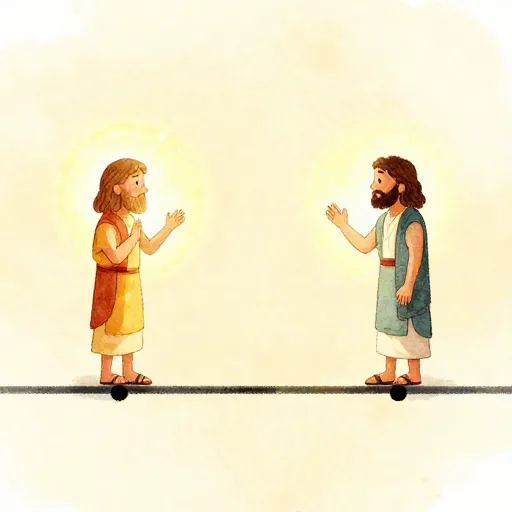
Maimonides was so famous that people used to say, 'From Moses to Moses, there was no one like Moses.' They meant that from the time of the Bible until Maimonides lived, he was the greatest teacher they had ever known.
He treated everyone who came to his door, whether they were kings or commoners. For Maimonides, every human being was a world of their own, and helping someone feel better was a way of honoring the logic of the universe.
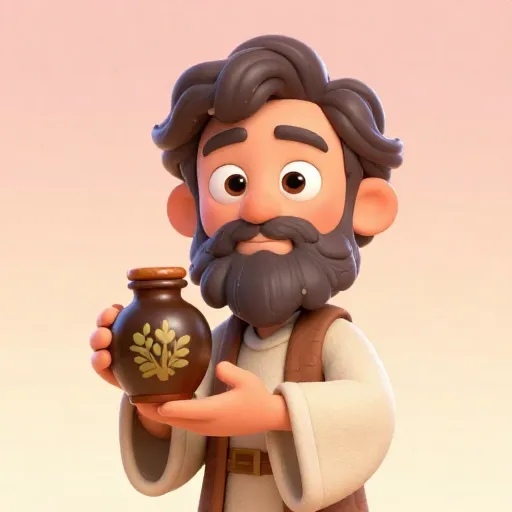
The physician should not treat the disease, but the patient who is suffering from it.
Through the Ages
Thinking Without Borders
Maimonides proved that ideas don't have borders. He was a Jew who wrote in Arabic, used Greek logic, and lived in North Africa and the Middle East.
His books traveled on the backs of camels and in the hulls of ships. Soon, thinkers in Europe were reading his work to help them understand their own questions about the world.
He didn't give people easy answers. Instead, he gave them a way to think. He showed us that being "perplexed" isn't a bad thing: it is the start of a great adventure.
Something to Think About
Is there something you believe that you can't quite find the words to describe?
Maimonides would say that it is okay if your words feel too small. Sometimes the biggest ideas are the ones that don't fit into a sentence. How does it feel to think about something that is a mystery?
Questions About Philosophy
Was Maimonides a scientist or a religious leader?
Why did he write his book for 'perplexed' people?
What is his 'Golden Path' idea?
The Adventure of Thinking
Maimonides left us with a powerful gift: the permission to be curious. He showed us that we don't have to choose between our heads and our hearts. Whether you are looking at a tiny cell through a microscope or wondering about the meaning of life, you are walking the path he started long ago. Keep asking your big questions: they are the bridge to your own golden path.
