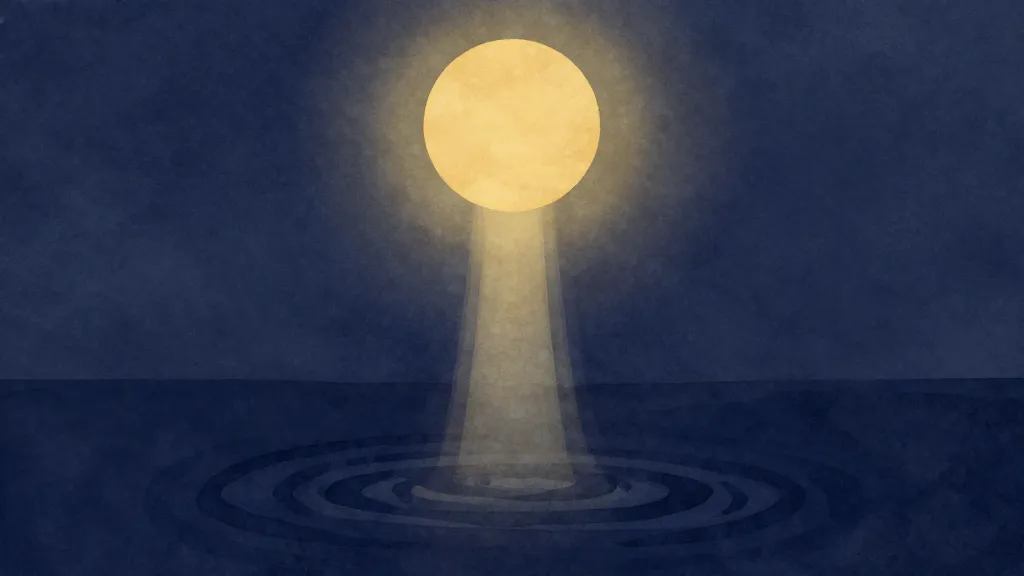
Have you ever looked at a star, or a ladybug, or even a pebble, and felt like you were somehow connected to it?
Around 1,700 years ago, a group of thinkers called Neoplatonists began to wonder if the whole universe was like a giant fountain. They followed the ideas of a philosopher named Plotinus, who believed everything in existence comes from one single, magical source.
Imagine you are standing in the middle of a bustling city in the year 250 AD. You might be in Rome, or perhaps the sun-drenched city of Alexandria in Egypt. The streets are filled with the smell of roasting chickpeas and the sound of wooden cart wheels clicking over stone.
In a quiet house away from the noise, a teacher is sitting with his students. He doesn't look like a typical Roman politician in a fancy toga. He looks like someone who has been thinking very hard for a very long time. This is Plotinus, the man who would start a way of thinking we now call Neoplatonism.
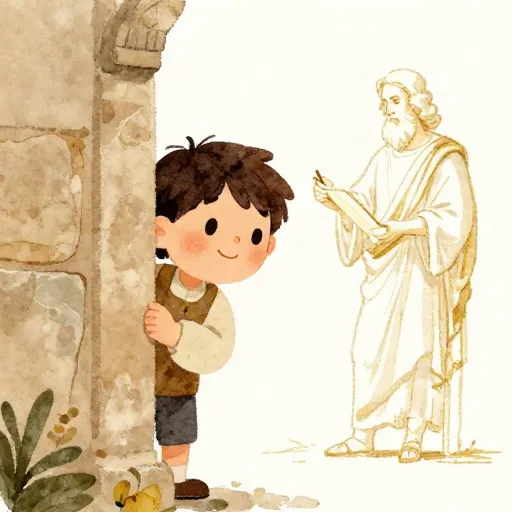
Plotinus was so modest that he refused to let anyone paint his portrait! He told his friends that his body was just a 'shadow of a shadow' and wasn't worth remembering. One student had to sneak an artist into his lectures to sketch him in secret.
Plotinus loved the ideas of Plato, a famous philosopher who lived hundreds of years before him. But Plotinus didn't just want to copy Plato's homework. He wanted to take Plato’s ideas and stretch them until they covered the entire universe.
He started with a question that sounds simple but is actually very deep: where does everything come from? Not just where do trees come from, but where does the idea of a tree come from?

Finn says:
"So, if everything comes from one source, does that mean I'm actually related to a piece of cheese? Or a supernova?"
The Fountain of Everything
To explain his big idea, Plotinus used the metaphor of a fountain. Imagine a fountain that never runs out of water. The water at the very top, where it first bubbles up, is pure and powerful.
As the water spills over the edge, it creates different levels of pools. The further the water travels from the center, the more it spreads out and changes. This process is what Neoplatonists called Emanation.
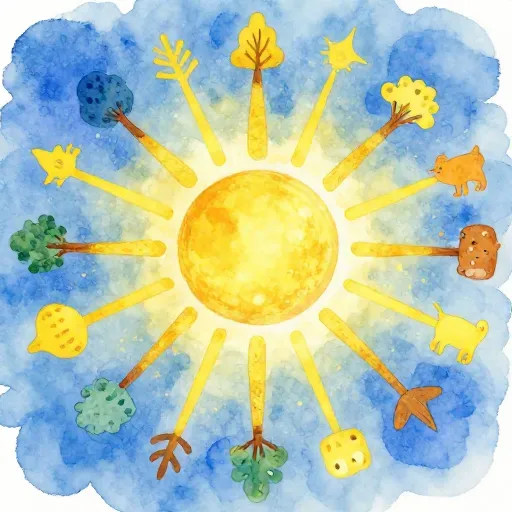
Imagine a giant, glowing sun in the middle of a dark room. The light is brightest right next to the sun. As the rays stretch further away, the light turns into a soft glow, then a dim twilight, until it finally fades into shadows at the very corners of the room. In Neoplatonism, we are the light rays.
At the very top of this cosmic fountain is something Plotinus called The One. He didn't call it "God" in the way most people did back then, and he didn't think it was a person with a face or a name.
To Plotinus, The One was so big and so perfect that we can't even describe it with words. If you say The One is "good," you are limiting it, because it is much more than just good. It is the source of everything, like the sun is the source of light.
The One is all things and no one of them.
The Three Layers of Reality
If The One is the top of the fountain, what are the other pools? Neoplatonists believed there were three main layers to reality. Think of them like the layers of an onion, or levels in a very complicated video game.
First, there is The One. Then, coming out of the One, is The Intellect (or Divine Mind). This is the level where all the perfect ideas live, like the perfect idea of a circle or the perfect idea of justice.
Try to think of a 'Perfect Circle.' In your head, it has no bumps and is perfectly round. Now, try to draw that circle. Is the drawing as perfect as the idea? Neoplatonists thought the 'idea' was more real than the drawing!
After The Intellect comes the World Soul. This is the energy that connects the world of ideas to the physical world we touch and see. It is like the bridge between a thought and an action.
Finally, at the very edge of the fountain, is the physical world. This includes the grass, the clouds, your breakfast, and your own body. Neoplatonists thought this physical world was beautiful, but it was also a bit blurry compared to the bright light of The One.

Mira says:
"It’s like the universe is a giant mirror that got broken into a billion pieces. Each piece still shows a tiny bit of the same big picture."
Finding the Way Back
If we all came from The One, why do we feel so separate sometimes? Why do we feel lonely or confused? Plotinus thought it was because our souls have traveled so far down the fountain that we have forgotten where we started.
He believed that the goal of life was to make the journey back up. He called this the "return." We don't do this by traveling in a spaceship, but by looking deep inside ourselves through Contemplation.
The best way to understand the world is to use your eyes and ears to study nature, plants, and animals directly.
The best way to understand the world is to close your eyes and look at the 'blueprints' of the universe inside your own mind.
By being quiet and thinking deeply, Plotinus believed we could climb back up the levels of the fountain. We move from the physical world, through our own thoughts, and eventually catch a glimpse of the bright light of The One.
Plotinus was so focused on this inner world that he sometimes forgot to eat or sleep. He didn't care about his physical appearance because he thought his soul was the most important part of him.

Withdraw into yourself and look.
Hypatia and the Library of Alexandria
Neoplatonism wasn't just for men sitting in quiet rooms in Rome. It traveled across the sea to Alexandria, a city famous for its massive library and its brilliant scientists.
One of the most famous Neoplatonists was a woman named Hypatia. She was a master of math and astronomy, and she used Neoplatonist ideas to help her understand the movement of the planets.
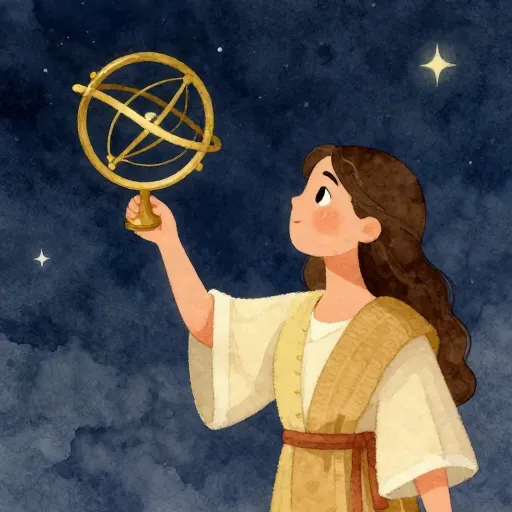
Hypatia was so popular in Alexandria that people would crowd the streets just to hear her speak. She used her Neoplatonist training to design the astrolabe, a tool used by sailors to navigate by the stars.
To Hypatia, studying the stars was a way of studying the mind of The One. She taught her students that the universe follows beautiful, logical patterns. Sadly, Hypatia lived during a time of great conflict, and her life ended because of people who were afraid of her power and her ideas.
Even after the ancient schools closed, Neoplatonism didn't disappear. It was like a underground river that kept flowing, popping up in different cultures and religions for the next thousand years.

Plotinus seemed ashamed of being in the body.
The Journey of the One
The Shadow and the Light
You might wonder: if everything comes from The One, and The One is perfect, where does bad stuff come from? Why is there sadness or mean behavior in the world?
Neoplatonists had a very interesting answer. They didn't think there was a "Source of Evil" that fought against the "Source of Good." Instead, they thought evil was just the absence of light.
Finn says:
"I like the idea that 'bad' is just being far from the light. It makes me feel like anyone can just turn around and walk back toward the lamp."
Imagine standing in a room with a single lamp. The closer you are to the lamp, the brighter everything is. As you move away, the light gets dimmer until you reach the corners, which are dark.
The darkness isn't a "thing" that was created; it’s just what happens when you are far away from the lamp. For a Neoplatonist, being "bad" just meant you were very far away from the light of The One.
Why Does This Matter Today?
You don't have to live in ancient Rome to think like a Neoplatonist. Today, many people still find comfort in the idea that we are all connected to a single source of life and energy.
When scientists talk about how all the atoms in our bodies were once inside stars, they are saying something very similar to what Plotinus said. We are made of the same "stuff" as the rest of the universe.
Neoplatonism reminds us to look beyond the surface of things. It suggests that even in the middle of a busy, noisy day, there is a quiet, glowing center inside every one of us that is connected to everything else.
Something to Think About
If you could only use one word to describe 'The One,' what would it be?
Plotinus thought no word was quite right, but every person sees a different part of the light. There is no wrong answer, only your own perspective.
Questions About Philosophy
Is Neoplatonism a religion?
Why is it called 'Neo' Platonism?
Did Plotinus believe in magic?
The Light Within
The next time you feel a sense of wonder while looking at a sunset or a complex math problem, remember Plotinus. He would say that feeling of 'wow' is your soul recognizing where it came from. Whether you are looking at the stars or looking inside yourself, you are exploring the same magnificent fountain of ideas.