Have you ever looked at a photograph of yourself as a baby and wondered where that baby went?
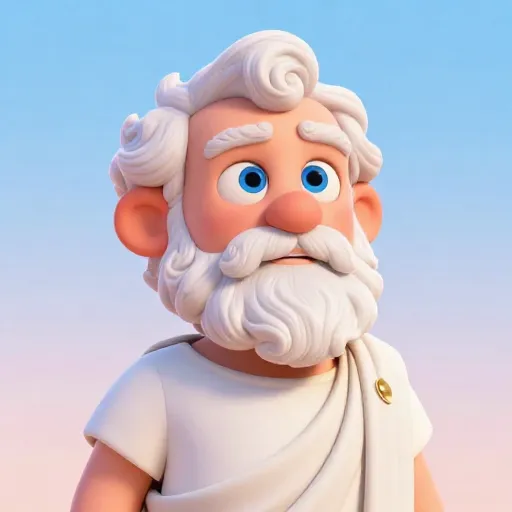
Around 2,500 years ago, a thinker named Parmenides began to ask deep questions about how the world stays the same even when it looks like it is changing. He lived in a sunny coastal city called Elea and spent his life exploring metaphysics, which is the study of what reality actually is.
Imagine you are standing on a beach in Southern Italy long ago. The sun is hot, the sea is a deep turquoise, and the air smells like salt and wild herbs.
This was the home of Parmenides. He was a wealthy and respected man who even helped write the laws for his city. But while most people were busy trading olives or building ships, Parmenides was busy thinking about the very nature of Existence.
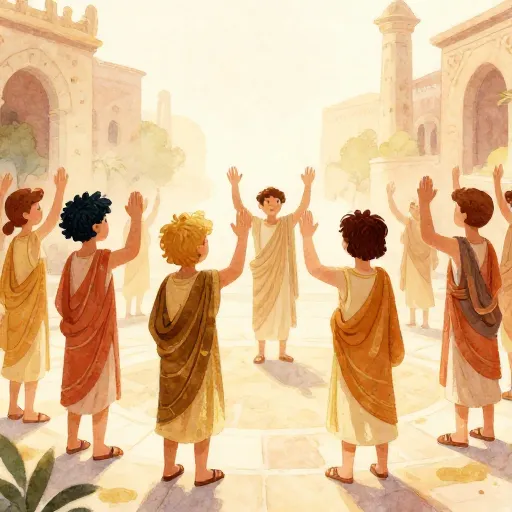
Parmenides was more than just a dreamer. He was so respected in his hometown of Elea that every year, the citizens had to swear an oath to obey the laws he had written!
Parmenides did not write his ideas in a boring textbook. Instead, he wrote a long, mysterious poem. In this poem, he describes a magical journey where he is carried in a chariot pulled by fast horses.
He travels from the world of darkness into the world of light. There, he meets a goddess who promises to tell him the absolute truth about the universe.

Mira says:
"It's like the universe is one giant, finished book. We are just reading it page by page, so it feels like things are happening, but the whole story is already there!"
The Great Rule: Nothing from Nothing
The goddess tells Parmenides something that sounds simple at first, but it changes everything. She says: "What is, is. What is not, is not."
Think about that for a second. It means that everything that exists right now has always existed in some way. Why? Because if it did not exist before, it would have had to come from Nothing.
For never shall this be proved, that things that are not are.
Parmenides argued that "Nothing" is not a thing. You cannot think about nothing. Go ahead, try to think about absolutely nothing: no space, no dark, no quiet, just nothing.
You cannot do it! The moment you think about it, you are thinking about something.
The Nothingness Challenge: Close your eyes and try to imagine a space with absolutely nothing in it. No air, no light, no darkness, no 'you.' Did you manage it? Usually, we just imagine a big black room, but a 'room' is still something!
Because "Nothing" does not exist, Parmenides realized that nothing can ever come out of it. If you have an empty box with truly nothing inside, you can wait for a billion years, and a puppy will never just pop into existence inside it.
This led Parmenides to a startling conclusion. If things cannot come from nothing, then nothing can ever truly be "born" or "created." And if things cannot turn into nothing, then nothing can ever truly "die" or disappear.
The Illusion of Change
If you watch a candle burn, it seems to change. It gets shorter, the wax melts, and the flame flickers. Most of us would say the candle is changing.
Parmenides, however, would say your eyes are lying to you. He believed that Perception, or what we see and hear, is often a trick. He called this the "Way of Opinion."
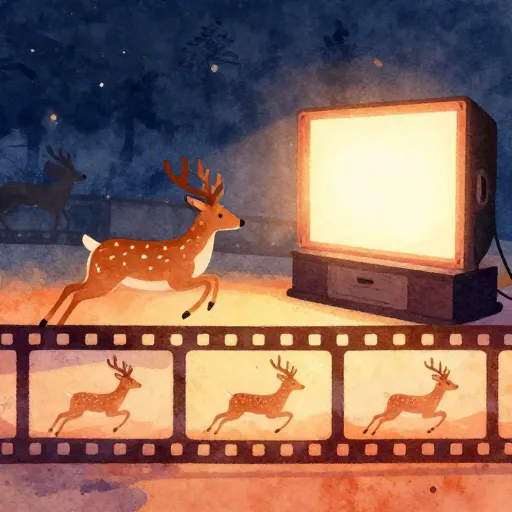
Imagine you are watching a movie. On the screen, a hero is running through a forest. It looks like there is a lot of movement, right? But if you go to the projection booth and look at the film, you'll see thousands of still pictures that aren't moving at all. Parmenides thought reality was the film, and our lives were just the movie playing on the screen.
He argued that if the candle truly is a candle, it cannot become not a candle. If it changed into something else, the "candle-ness" would have to go to "Nothing," and we already know that Nothing does not exist.
Therefore, the candle must stay exactly as it is forever. The change we see is just an Illusion. Real truth can only be found through Logic, not by looking at the world around us.
Finn says:
"Wait, if nothing ever changes, does that mean my birthday is always happening somewhere? And my chores are always waiting for me? That's kind of cool and kind of exhausting."
To Parmenides, the entire universe is like a giant, solid, unchanging block. He described it as a perfect sphere, equal in every direction.
In this block, there is no empty space. If there were empty space, that would be "Nothing," and we know that is impossible! Because there is no empty space, there is no room for anything to move.
Thinking and being are one and the same.
The Frozen Universe
Imagine a lake that is frozen solid all the way to the bottom. If you are a fish frozen inside that ice, you cannot move left or right. There is no "empty" water to move into.
Parmenides thought the whole universe was like that frozen lake. He believed in Monism, the idea that everything is actually one single, solid thing called "The One."
The world is like a river. It is always flowing, always changing, and you can never catch the same moment twice. Fire is the symbol of life.
The world is like a solid diamond. It is perfect, eternal, and never changes. Movement is just a trick our eyes play on us. Logic is the only truth.
This idea made a lot of people angry! Another philosopher named Heraclitus was living around the same time, and he believed the exact opposite. He famously said that you can never step into the same river twice because the water is always moving.
Parmenides would have laughed and said: "There is no river, and you aren't even stepping!"
Mira says:
"I think Parmenides is saying that our senses are like a pair of fuzzy glasses. Logic is what happens when we finally take the glasses off and see the world clearly."
Through the Ages
Parmenides' ideas were like a heavy stone dropped into a quiet pond. The ripples traveled through time for thousands of years.
His most famous student, a man named Zeno, came up with brilliant puzzles called Paradoxes to prove his teacher was right. One puzzle showed that an arrow flying through the air is actually standing still at every tiny moment of time.
Through the Ages
Later, the great philosopher Plato used Parmenides' ideas to suggest that there is a perfect world of "Forms" that never changes, even if our world looks messy. Even modern scientists like Albert Einstein thought about these ideas.
Einstein suggested that time might be like a giant map where the past, present, and future all exist at the same time. In this "Block Universe" theory, you are a baby, a kid, and an adult all at once: you just happen to be looking at one part of the map right now.

One road only is left for us to speak of, namely, that it is.
Look at an old photo album of your family. In one photo, someone is a baby. In another, they are a teenager. In the room with you, they are an adult. To your eyes, they changed. But to your mind, they are the same person. Which is more 'true': the different looks or the one person?
Parmenides challenges us to trust our minds more than our eyes. He asks us to wonder if the things that stay the same are more real than the things that change.
Maybe the "you" that exists today is the same "you" that will exist in eighty years, even if your hair turns grey and your height changes. Perhaps, underneath all the noise and movement of life, there is something quiet and still that never goes away.
Something to Think About
If you could step outside of time and see your whole life at once: the beginning, the middle, and the end: would you still feel like you were 'changing'?
There is no right or wrong answer to this. Philosophers have been arguing about it for thousands of years!
Questions About Philosophy
Did Parmenides really think I don't move when I run?
Why did he write his ideas as a poem?
Is Parmenides still relevant today?
The Stillness Within
The next time you feel like life is moving too fast, remember Parmenides and his golden sphere. He reminds us that even in a world that seems to be rushing by, there is a deeper reality that is steady, quiet, and always there. You are part of the 'One,' and according to Parmenides, that means you have always belonged exactly where you are.
