
Have you ever wondered if there is a 'perfect' version of everything somewhere else?
Around 2,400 years ago, a man in Athens began to think that the world we see with our eyes is like a blurry reflection in a mirror. He believed that through philosophy, we could discover a hidden world of perfect ideas that never change.
Imagine walking through a bustling city square in ancient Greece. You hear the clatter of chariot wheels and the smell of roasted meat from the market stalls.
In the middle of this noise, a tall man with broad shoulders is talking to a group of people. This is Plato, and he is trying to figure out what it means to be truly good or truly wise.
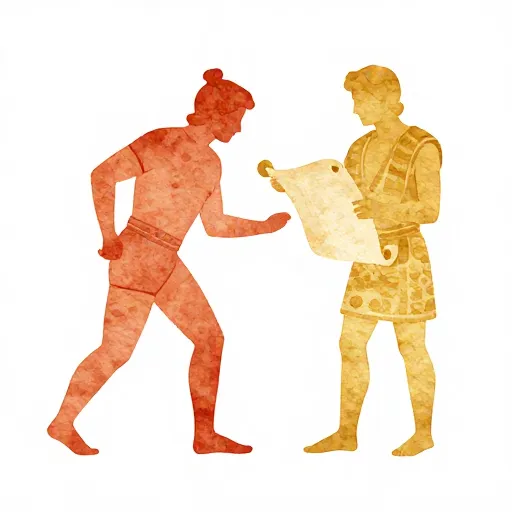
Plato's real name was Aristocles, but everyone called him 'Plato' which means 'The Broad.' He was a champion wrestler before he became a philosopher, proving you can have both a strong body and a strong mind!
Plato was not always a philosopher. When he was young, he was a star athlete and a soldier.
His name was actually Aristocles, but his wrestling coach supposedly gave him the nickname 'Plato,' which meant 'Broad.' Whether it was because of his wide shoulders or his wide range of ideas, the name stuck for the rest of history.
The beginning is the most important part of the work.
Plato lived in a city called Athens during a time of great change. He was a student of another famous thinker named Socrates, who taught him to ask questions about everything.
When Socrates was put on trial and killed for his ideas, Plato was heartbroken. He decided to leave the city and travel the world to find out how a society could be made more just and fair.
The School in the Olive Grove
When Plato eventually returned to Athens, he did something radical. He didn't just stand in the market and talk: he started the first university in the Western world.

Imagine a sunny garden filled with silver-green olive trees. There are no desks or blackboards. Instead, groups of people are walking down shaded paths, arguing about why the stars move or what makes a person 'good.' This was the Academy, the world's first university.
He called his school the Academy because it was located in a beautiful grove of olive trees dedicated to a hero named Academus. People from all over the Mediterranean came to learn there.
At the Academy, there were no tests or grades. Instead, students and teachers walked together under the trees, discussing math, science, and the nature of the soul.

Finn says:
"Wait, if learning is 'remembering,' does that mean I already know how to do long division and I just forgot where I put the answer?"
Plato believed that we shouldn't just learn facts by heart. He thought that learning was actually a way of 'remembering' things that our souls already knew before we were born.
He wanted his students to look past the surface of things. To Plato, the world around us was constantly changing, like clouds in the sky, and he wanted to find the things that stay the same forever.
The World of Perfect Forms
Think about a circle. You can draw one on a piece of paper, or trace one in the sand, or see one in the shape of a wheel.
But is any circle you see truly perfect? If you look closely with a magnifying glass, the line might be a little wobbly or the ink might be smudged.

Look at three different chairs in your house. One might be wooden, one plastic, and one soft. They are all different, right? But you know they are all 'chairs.' Try to draw the most 'perfect' chair you can imagine: the one that makes every other chair look like a messy copy.
Plato argued that even if we never see a perfect circle in real life, we still have the idea of a perfect circle in our minds. He called these perfect ideas Forms.
He believed there is a separate world, a higher reality, where the perfect 'Form' of everything exists: the perfect Chair, the perfect Tree, even the perfect Justice.

Mira says:
"It's like a video game. The code is the 'perfect' idea, and what we see on the screen is just the light showing us what the code says."
This way of thinking is called Idealism. It suggests that the most real things are not the objects we can touch, but the ideas we can understand with our minds.
Plato thought our world was just a collection of 'shadows' cast by these perfect Forms. To explain this to his students, he told one of the most famous stories in history.
The Mystery of the Cave
Imagine a group of people who have lived inside a dark cave since they were babies. They are tied down so they can only look at the back wall of the cave.
Behind them, a fire is burning. People walk past the fire carrying different objects, which cast shadows onto the wall that the prisoners are watching.
The shadows on the wall are real. They have names, they move, and they are all we can see. Why look anywhere else?
The shadows are just dark shapes made by real objects blocking the light. To find the truth, we have to turn around and look at the sun.
Because the prisoners have never seen the real world, they believe the shadows are the only things that exist. They give names to the shadows and have contests to see who can guess which shadow will appear next.
One day, a prisoner is set free. He turns around and is blinded by the light of the fire, then he crawls out of the cave into the sunshine.

Wonder is the feeling of a philosopher, and philosophy begins in wonder.
At first, the sun hurts his eyes. But eventually, he sees the trees, the flowers, and the sun itself. He realizes that the shadows in the cave were just tiny, dark versions of the real thing.
This story is called the Allegory of the Cave. Plato used it to show that most people live their lives looking at 'shadows' (the things we see) instead of 'the sun' (the truth).
The Perfect City
Plato didn't just think about shapes and shadows: he also thought about how people should live together. He wrote a very famous book called the Republic.
In this book, he tried to design the perfect city-state. He believed that a city could only be happy if it was led by people who loved wisdom more than power.
Plato is said to have invented the world's first alarm clock! He used a water clock that would whistle loudly when it reached a certain level, making sure his students at the Academy woke up on time for their morning lessons.
He called these leaders 'philosopher kings.' He thought that they should be trained from a young age to be brave, fair, and smart, and they should never own their own money or big houses.
Plato also had a very modern idea for his time. He believed that women should have the same education as men and could also be leaders of the city.
Finn says:
"If a philosopher king can't have any toys or money, why would anyone want the job? They must really, really love being wise."
To make sure everyone worked together, Plato used a Dialogue. This is a style of writing where characters have a conversation and debate different points of view.
By writing this way, Plato wasn't just telling people what to think. He was showing them how to think by exploring every side of an argument until they found the Justice at the center.
How Ideas Grow
Plato taught at the Academy for forty years. His most famous student was a man named Aristotle, who took Plato's ideas and changed them in his own way.
While Plato looked up at the stars and the world of perfect ideas, Aristotle looked down at the earth and the things he could touch. Together, they became the two most important thinkers in Western history.
Through the Ages
Even thousands of years later, we still use Plato's ideas. Every time you ask 'What is the right thing to do?' or 'Is this really true?' you are doing exactly what Plato did.
He taught us that wonder is the beginning of all knowledge. By being curious about the world, we can slowly crawl out of our own 'caves' and into the light.
Music gives a soul to the universe, wings to the mind, flight to the imagination and life to everything.
Plato believed that our souls are eternal and that our main job in life is to take care of them by learning and being kind. He thought that music and math were both ways to help the soul find balance.
He died peacefully at a wedding feast when he was eighty years old, but his school stayed open for almost 900 years after he was gone.
Something to Think About
If you could visit the 'World of Forms' and see the perfect version of one thing, what would it be?
There is no right or wrong answer here. Plato believed the more we imagine the 'perfect' version of things like kindness or friendship, the better we can make them in our own world.
Questions About Philosophy
Did Plato actually believe in a physical cave?
Why did Plato write in dialogues instead of just writing books?
Is Plato's Academy still there?
Stepping into the Light
Plato's ideas might seem strange at first, but they are an invitation to look a little closer at the world. He reminds us that even when things seem messy or confusing, there is often a beautiful, simple truth waiting to be discovered if we just have the courage to keep asking 'Why?'
