
What if everything you see: the trees, the stars, even your own hands: was actually just a ripple of light coming from a single, giant source?
Around 1,800 years ago, a man named Plotinus began teaching a new way of looking at the world called Neoplatonism. He believed that the universe wasn't just a collection of random objects, but a beautiful, flowing system where everything is connected to a mysterious center called The One.
Imagine walking through the busy streets of Rome in the year 244 CE. The city is loud, crowded, and full of people chasing after money or power. But in a quiet house on the edge of the city, a group of students is gathered around a man who seems to be looking at something no one else can see.
This man is Plotinus. He is humble, gentle, and strangely shy about his own life. In fact, he is so focused on the world of ideas that he once refused to let an artist paint his portrait. He thought his physical body was the least interesting thing about him.

Plotinus was so modest about his body that he wouldn't tell anyone his birthday or where exactly he was born. He felt that his physical life was just a temporary suit his soul was wearing!
Plotinus grew up in Egypt and traveled across the ancient world to find wisdom. He even joined an army just to try and reach India to talk to philosophers there. When he finally settled in Rome, he didn't want to be a politician or a general. He wanted to understand why we exist and where we come from.
His ideas were a fresh take on the famous philosopher Plato. While Plato lived hundreds of years before him, Plotinus felt like they were having a conversation across time. He took Plato's old ideas and turned them into a map of the entire universe.

Withdraw into yourself and look.
The Fountain of Everything
To understand Plotinus, you have to imagine a fountain that never stops flowing. This is his big idea called Emanation. He didn't think the world was built like a Lego set, brick by brick. Instead, he thought the world "overflowed" from a central source.
At the very top of everything is The One. Plotinus said it is impossible to describe The One because it is bigger than words. It is like the sun: you cannot look directly at it without being dazzled, but it is the reason you can see everything else.

Finn says:
"If everything is like a fountain, does that mean I'm made of the same stuff as a star or a ladybug? It feels like we're all part of one big, cosmic puddle!"
Because The One is so full of goodness and power, it cannot help but spill over. This spilling over creates the different levels of our world. The closer something is to the center, the brighter and more "real" it is. The further away it gets, the dimmer the light becomes.
This doesn't mean the light disappears. It just changes shape. Think of it like a pebble dropped into a pond. The splash is the center, and the circles moving outward are the different parts of the universe.
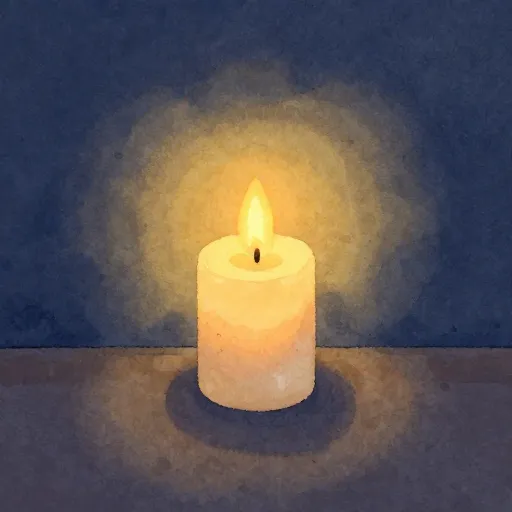
Imagine a giant candle in a dark room. The flame is The One. The bright glow right around the flame is the Intellect. The softer light reaching the corners of the room is the Soul. The very back of the shadows, where the light almost disappears, is Matter.
The Three Great Levels
Plotinus described three main levels of reality that exist beneath The One. The first is The Intellect, which is like a giant cosmic mind. It contains the Forms, the perfect blueprints for everything that could ever exist: the perfect idea of a circle, the perfect idea of justice, or the perfect idea of a cat.
Below the Intellect is The Soul. This is the level where life and movement happen. Plotinus believed there is a Universal Soul that connects all living things. Your individual soul is like a single drop of water that belongs to this massive, shimmering ocean.

The soul is many things, and all things: both the things above and the things below.
Finally, at the very edge of the light, we find Matter. This is the physical world we can touch and see. To Plotinus, matter is like the shadow at the end of a long hallway. It isn't "bad," but it is where the light of The One is at its weakest and most scattered.
He taught that we often get distracted by the shadows. We spend our lives worrying about our clothes, our toys, or our snacks. But Plotinus believed our true home is back at the center of the fountain, where the light is strongest.

Plotinus compared the soul to a sculptor. He said: 'Go back into yourself and look: and if you do not yet see yourself beautiful, then do as the sculptor does... cut away all that is excessive, straighten all that is crooked.' Try sitting quietly for one minute and imagine you are smoothing out the rough edges of your thoughts until they are calm and clear.
The Search for Beauty
Why do we find a sunset or a piece of music beautiful? Plotinus had a very specific answer. He believed that when we see something beautiful, our soul recognizes a little bit of the light from The One shining through it.
It is like seeing a photograph of a place you love. The photo itself is just paper and ink, but it reminds you of something much bigger. When you see a beautiful flower, your soul says, "Hey, I remember that glow!"

Mira says:
"I like the idea that beauty is a clue. It’s like when I see a really bright rainbow and feel happy for no reason. Maybe that’s my soul recognizing the light from the One."
Plotinus taught that Beauty is a clue. It is a trail of breadcrumbs leading us back to the source. If you find a person's face beautiful, he would say you are actually seeing the beauty of their soul. And if their soul is beautiful, it is because it is looking toward the Intellect.
This means that becoming a better person is a way of becoming more beautiful. For Plotinus, Contemplation, or thinking deeply and quietly, was the best way to polish your soul. The more you think about good and true things, the more you reflect the light of the source.
We find truth by exploring the world outside us: traveling, studying science, and using our five senses to gather facts.
We find truth by exploring the world inside us: being quiet, meditating, and looking at the ideas that already live in our minds.
Life in the School of Peace
Plotinus wasn't just a man who sat in a room and thought. He was a beloved teacher who lived with his students. People trusted him so much that they often left their children in his care when they died. His house was full of orphans and students, all living together like a big, philosophical family.
He was known for being incredibly patient. Even when he was busy writing his famous books, The Enneads, he would stop to help a student with a problem or settle an argument. He lived a very simple life, practicing Asceticism, which means he didn't care for fancy food or luxury.

Never did eye see the sun unless it had first become sunlike.
His goal was to be "alone with the Alone." This sounds lonely, but for Plotinus, it was the opposite. He meant that in the quietest part of your heart, you can find a connection to the source of the whole universe. He believed he experienced this feeling of total oneness only a few times in his life.
His students, especially a man named Porphyry, wrote down everything he said. Porphyry organized the writings into six groups of nine, which is why they are called the Enneads (from the Greek word for nine). Without Porphyry, we might never have known about the man who saw with his eyes closed.
Finn says:
"He wanted to build a whole city for philosophers! I wonder what the playground in Platonopolis would have looked like. Probably a lot of places to sit and think."
A Dream of a Better City
One of the most interesting things Plotinus tried to do was build a city called Platonopolis. He wanted to take an old, ruined city in Italy and turn it into a place where everyone lived according to philosophy. There would be no wars, no greed, and everyone would spend their time learning.
He almost convinced the Roman Emperor to let him do it. Unfortunately, some of the Emperor's advisors were jealous and stopped the plan. Even though Platonopolis was never built, the idea of a place dedicated to wisdom inspired people for centuries.

Plotinus had a very strange experience with a rival philosopher who tried to use 'magic' against him. Plotinus claimed his own soul was so strong that the magic just bounced off him and hit the other guy instead!
Plotinus Through the Ages
Why Plotinus Still Matters
Plotinus changed the way people thought about the soul. Before him, many people thought the soul was just a ghost or a puff of wind. He showed that the soul is something vast and deep, like an inner universe that is just as big as the one outside.
His ideas traveled through the ages. They influenced early Christian thinkers like Augustine, who loved the idea of the soul returning to a source of light. They inspired the artists of the Renaissance to paint beautiful things as a way to honor the divine. Even today, when people talk about being "spiritual but not religious," they are often using ideas that Plotinus first described.
He reminds us that even when the world feels loud and messy, there is a quiet place inside us that is connected to everything else. He invites us to close our eyes and look for the light that never goes out.
Something to Think About
If your soul was a work of art that you were sculpting every day, what would it look like right now?
There are no right or wrong answers here. Plotinus believed that just by thinking about this question, you are already beginning the journey back toward the light.
Questions About Philosophy
Why is it called Neoplatonism?
Did Plotinus believe in many gods?
What are the Enneads?
A Spark in the Dark
Plotinus reminds us that we are never truly alone or disconnected from the world. Whether you are looking at a flower, listening to music, or just sitting in silence, you are touching the edge of a great fountain of light. Keep looking for the beauty in the world, and you might just find your way back to the source.