
Have you ever been absolutely sure about something, only to find out later that you were completely wrong?
Maybe you thought a lemon would taste like a yellow orange, or that a shadow in your room was a monster. Most people feel embarrassed when they are wrong, but an ancient Greek man named Pyrrho thought that "not knowing" was actually the secret to a happy life. He founded a way of thinking called Skepticism, which taught people to stop worrying about being right and start enjoying the mystery of the world.
Imagine you are living in a small, sun-drenched town in Ancient Greece called Elis. The year is roughly 340 BC. You might see a man walking through the marketplace, looking incredibly calm, even while everyone else is shouting and arguing about politics or the weather.
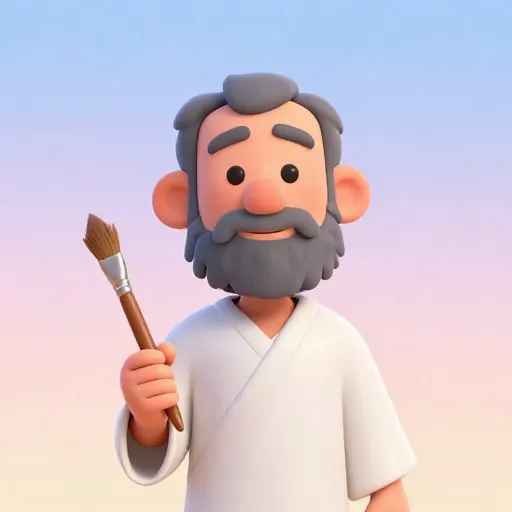
This man is Pyrrho. Before he became a famous thinker, he was a painter. He spent his days looking closely at the world, trying to capture the exact shade of a grape or the curve of a marble statue. This training taught him a very important lesson: things often look different depending on where you stand.

Pyrrho was a professional painter before he became a philosopher. Some people think this is why he was so good at noticing that things look different from different angles. He knew that light and shadow could change how a person looks in a portrait!
When Pyrrho was a young man, something life-changing happened. He was invited to join the army of Alexander the Great on a massive journey across the known world. This wasn't just a trip to the next town over: it was a trek across thousands of miles through deserts, mountains, and strange new cities.
Pyrrho traveled all the way to India. Along the banks of the mighty Indus River, he met people who thought about the world in ways he had never imagined. He met the Gymnosophists, which means "naked wise men." These were thinkers who lived very simply and spent their time questioning everything.

Finn says:
"So wait, he walked for thousands of miles just to find out that he didn't know anything? That sounds like a really long walk for a very short answer! But maybe not knowing is the start of a bigger adventure?"
Pyrrho watched how these wise men stayed calm even when life was difficult. He realized that back in Greece, people were often miserable because they were constantly fighting over what was "true." One person would say the sun was a god, another would say it was a ball of fire, and they would get angry trying to prove each other wrong.
Pyrrho came home to Greece with a radical new idea. He decided that we can never truly know the deep, hidden nature of things. We can only know how they appear to us in the moment. This was the birth of Skepticism, a word that comes from the Greek word skepsis, which means "to look carefully" or "to consider."
I do not define anything.
Think about a bowl of honey. To you, it tastes sweet and delicious. But what if you were a tiny ant? To an ant, the honey might be a sticky, dangerous trap. What if you were sick with a fever? To a sick person, the honey might taste bitter and strange.
So, is the honey sweet or is it bitter? Pyrrho would say it is neither. Or rather, it is "no more sweet than bitter." The honey is just honey. We only experience the Phenomena, which is the Greek word for how things show up to our senses. We don't know the "real" truth of the honey; we only know how it feels on our tongue right now.
Try the 'Is it...?' game. Pick an object in the room, like a chair. Instead of saying 'That is a chair,' try to describe only how it appears to you right now. Say 'It appears brown to me,' or 'It feels hard to my hand.' Notice how different it feels to describe your experience rather than stating a fact!
This might sound a bit confusing. Why would it make someone happy to not know if honey is sweet? Pyrrho believed that most of our stress comes from judging things. We judge a rainy day as "bad" or a broken toy as a "disaster." We get stuck in our opinions like they are heavy cages.
He taught his students to practice Suspension of Judgment. In Greek, this is called Epoché. It is like pressing the pause button on your brain. Instead of saying "This is bad," you say "I am experiencing this as bad right now, but I don't know if it really is."

Mira says:
"This reminds me of when we look through a microscope. What looks like a smooth leaf to our eyes is actually a bumpy jungle of cells. Pyrrho was right: how things 'look' changes depending on how we look at them!"
When you stop trying to decide if everything is good or bad, true or false, something amazing happens. You start to feel a deep, quiet peace. Pyrrho called this Ataraxia. It is the feeling of being like a calm sea that nothing can shake.
Imagine you are on a boat during a terrible storm. Everyone is screaming and running around in fear. But in the corner, there is a small pig, quietly eating its food, totally unbothered by the waves. Pyrrho once pointed to a pig just like that during a real storm at sea and told his friends that the pig had the right idea: it wasn't worrying about what might happen, it was just being present.

Imagine you are on a wooden ship in the middle of a dark, crashing ocean. The wind is howling. Suddenly, you see a philosopher sitting next to a pig. The pig is calmly chewing on some grain, not worried about the waves at all. The philosopher smiles and says: 'Be like the pig.'

Nothing is more this than that.
Pyrrho was so committed to his "I don't know" philosophy that some people told very funny, and maybe even slightly silly, stories about him. They said he was so unsure of his senses that he wouldn't move out of the way of a speeding wagon or a sharp cliff!
According to these legends, his friends had to follow him around to make sure he didn't walk into a wall or get bitten by a dog. They claimed he didn't "know" if the cliff was real or if the wagon would actually hurt him. However, most historians today think these stories were just ancient jokes made up by people who didn't understand him.
Finn says:
"I hope those stories about the cliffs aren't true. But I like the idea of the pig on the boat. It's like he's saying, 'I don't know if we'll sink, but this snack is definitely delicious right now!'"
In reality, Pyrrho lived to be nearly 90 years old, which was very old for those times. He was so respected in his hometown of Elis that they made him a high priest and passed a law saying that all philosophers didn't have to pay taxes! He didn't live like a confused person: he lived like a person who was simply very, very hard to upset.
He didn't write any books because he didn't want to turn his ideas into "facts" that people would fight over. He just lived his life as an example. His students, like a man named Timon, wrote down what they saw him do and how he spoke. They described him as a man who was always in a state of Equilibrium, which is a fancy word for perfect balance.
I am 100% sure that I am right and you are wrong! There is only one truth, and I have found it!
I'm not sure who is right, or if there is even a 'right' at all. Let's keep looking and stay friends while we do it.

He lived in a manner that was tranquil and serene.
Even though Pyrrho lived a long time ago, his ideas traveled across the centuries like a message in a bottle. They popped up again during the Renaissance and later during the Enlightenment. His way of thinking helped scientists realize that they should always keep testing their ideas because they might be missing something.
Through the Ages
Today, we use a little bit of Pyrrho's magic whenever we say, "I'm not sure, let's find out." It is the foundation of being curious. If we think we already know everything, we stop looking. But if we decide that the world is a giant mystery, every day becomes an adventure.
The town of Elis loved Pyrrho so much that they made a law saying philosophers didn't have to pay taxes. It was their way of saying 'Thank you for teaching us how to be calm!'
Pyrrho didn't want us to be lazy or to stop caring. He wanted us to be free. He thought that if we could let go of the need to be right all the time, we could finally be kind to each other. After all, it's hard to stay angry at someone for having a different opinion if you realize that both of you are just looking at different parts of the same puzzle.
Something to Think About
If you stopped worrying about being 'right' for just one whole day, how would your day change?
There is no right or wrong answer to this question. Just let your mind wander and see where it goes.
Questions About Philosophy
Was Pyrrho just lazy because he didn't want to decide things?
How can you be a Skeptic and still do your homework?
Is Skepticism the same as being cynical or mean?
The Power of Maybe
Pyrrho teaches us that 'I don't know' isn't a dead end: it's a doorway. When we stop trying to master the world, we can finally start to enjoy it. Next time you find yourself in a heated argument about the best flavor of ice cream or the rules of a game, remember Pyrrho. Take a deep breath, think of the peaceful pig on the storm-tossed ship, and try saying: 'Maybe we're both right in our own way.'