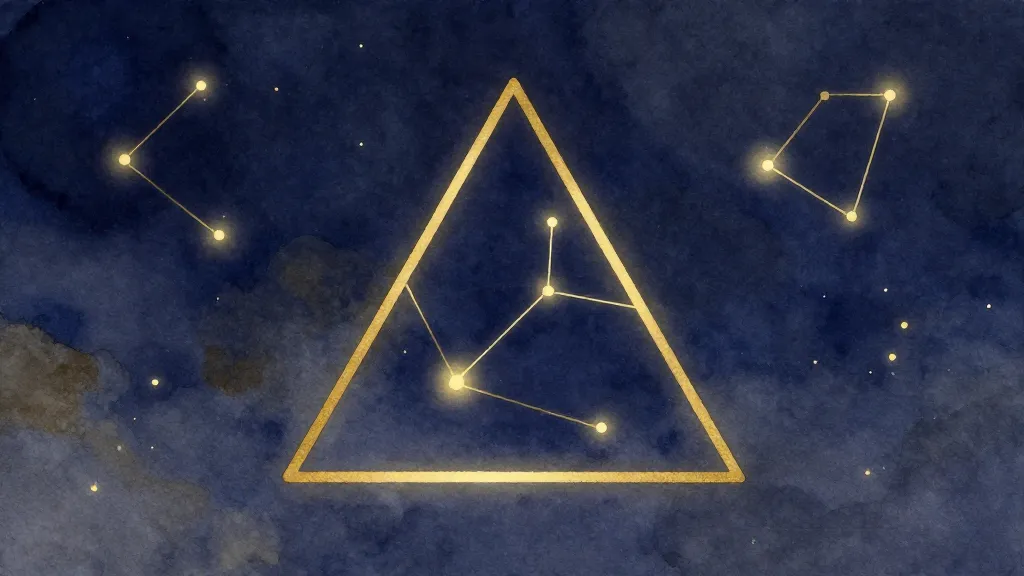
Have you ever wondered if the universe has a hidden language?
Long before computers or modern science, a man named Pythagoras believed he had found the key to everything. He didn't find it in a book: he found it in the sound of a hammer and the shape of a triangle. He started a movement that changed how we see philosophy, mathematics, and the very nature of the universe.
Imagine you are standing on a dusty road in ancient Greece over 2,500 years ago. The air smells of sea salt and olive trees. In the distance, you hear the rhythmic clink-clink-clink of a blacksmith’s shop.
Most people walk past without thinking. But one man stops. He notices that when different hammers hit the anvil, they make different musical notes. He wonders: why?
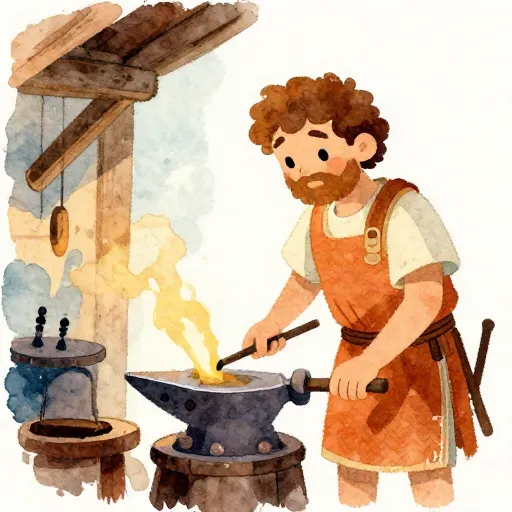
Imagine Pythagoras standing outside the forge. He notices that a heavy hammer makes a low, deep thud, while a lighter hammer makes a high, bright ring. He realizes that the weight of the hammer and the sound it makes are connected by math. This was the first time anyone realized that a physical feeling (sound) could be measured by a number (weight).
This man was Pythagoras. He was born on the island of Samos, a place of sailors and traders. But Pythagoras was a traveler of a different kind: a traveler of the mind.
He spent his youth visiting Egypt and Babylon, learning secrets from ancient priests. He wanted to know how the world was put together. Eventually, he moved to Croton, a city in what is now Italy, to start a very strange school.
The Secret School of Numbers
Pythagoras didn't just teach math like you learn in school today. To him, math was a way to understand the soul. His students were part of a secret brotherhood.
They lived together, shared all their money, and spent years in total silence just to learn how to listen. They believed that if you were quiet enough, you could hear the secrets of the world.

Finn says:
"Wait, if they had to be silent for five years, how did they ask for a snack? Maybe they had to do math problems with their fingers to communicate!"
At the heart of everything they studied was one big idea: Everything is Number. To us, numbers are just tools for counting snacks or measuring height. But to Pythagoras, numbers were the "bricks" of reality.
He saw numbers in the petals of a flower and the curve of a seashell. He believed that numbers were not just symbols, but actual living things that gave the world its shape.

Pythagoras loved triangular numbers. You can make one right now! Take some coins or pebbles. Place one on top. Then place two below it. Then three below those. You've made a triangle! Keep going: 1, 3, 6, 10, 15. Can you find the next number in the sequence? This pattern shows how numbers can create shapes.
The Music of the Spheres
One of the most beautiful ideas Pythagoras ever had came from music. He experimented with a instrument called a monochord, which was just a single string stretched over a piece of wood.
He discovered that if you divide the string exactly in half, it produces a note exactly one octave higher. If you divide it into a ratio of 3 to 2, you get a perfect harmony.
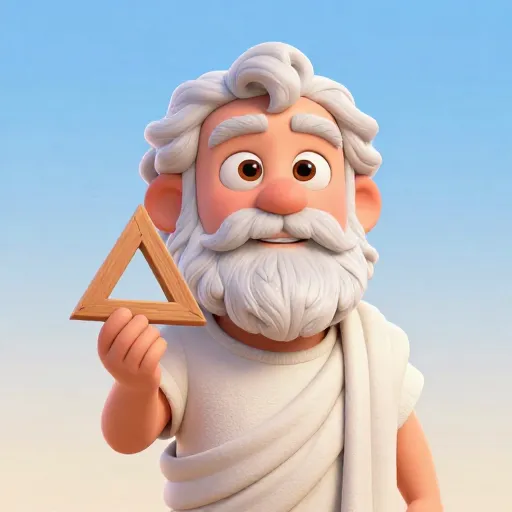
There is geometry in the humming of the strings, there is music in the spacing of the spheres.
This was a massive discovery. It meant that beauty wasn't an accident. Beauty was mathematical. If music followed these rules, Pythagoras wondered, did the rest of the world follow them too?
He looked up at the night sky and made a bold guess. He proposed the Harmony of the Spheres: the idea that planets and stars make music as they move through space.
We might not be able to hear it with our ears, but Pythagoras believed our souls could feel it. He thought the whole universe was a giant, humming piece of music.

Mira says:
"I like the idea that the stars are making music. It makes the night sky feel less like empty space and more like a giant concert that's always playing."
The Magic of the Triangle
You might have heard of the Pythagorean Theorem. It is his most famous contribution to school textbooks, but for him, it was a piece of cosmic truth.
He realized that in a right-angled triangle, the area of the square on the long side is equal to the sum of the areas of the squares on the two shorter sides. This isn't just a rule for homework: it’s a law that works every single time, everywhere in the world.
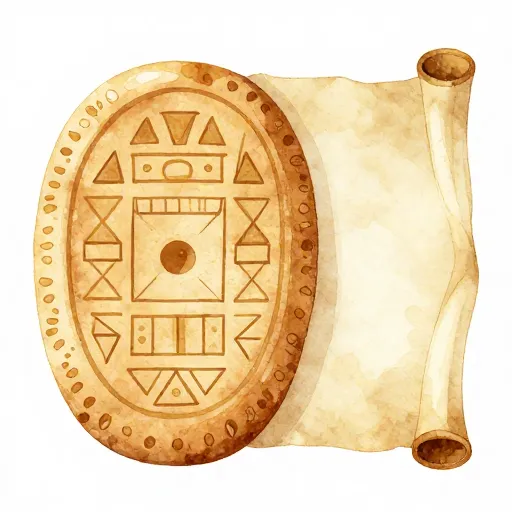
Pythagoras didn't actually 'invent' the theorem that bears his name. People in Babylon and India had used this math for hundreds of years before he was born. However, he was likely the first person to prove why it works every single time, turning a practical trick into a universal truth.
For the Pythagoreans, the most sacred shape was the Tetractys. This was a triangle made of ten dots arranged in four rows. It represented the way the world grows from a single point into a solid object.
They even took oaths by this shape. It was more than math: it was a map of how everything begins and ends.

The world is limited, and it is governed by a harmony that can be understood through number.
A Different Way of Living
The Pythagorean school was very unusual for its time. Unlike most ancient Greek schools, they welcomed women as equals. One of the most famous was Theano, who may have been Pythagoras’s wife and a brilliant philosopher herself.
They also lived by very strict, and sometimes very weird, rules. They were vegetarians because Pythagoras believed in the soul.
He taught a concept called transmigration: the idea that when a person dies, their soul moves into another body, perhaps even an animal. Because of this, he treated all living things with a deep, quiet respect.
Some historians see Pythagoras as the father of science. He used experiments and logic to find the rules of nature, moving away from myths and toward proof.
Others see him as a religious leader. His school had secret rituals, believed in reincarnation, and followed strange rules that felt more like magic than math.
One of the strangest rules was about beans. The Pythagoreans were forbidden from eating them, or even touching them! Some say it was because beans looked like tiny embryos, while others thought they held the breath of life.
This mix of genius math and mysterious rules made many people in the city of Croton suspicious. Eventually, the school was attacked, and the followers were forced to scatter. But their ideas were already out in the world.
The Secret That Broke the Rules
Even though Pythagoras loved numbers, one of his students discovered a number that terrified the school. It was the discovery of irrational numbers.
Up until then, the Pythagoreans believed every number could be written as a simple fraction. But when they tried to measure the diagonal of a square, they found a number that went on forever without repeating (like the square root of 2).
This threatened their idea that the world was perfectly neat and orderly. Legend says they were so upset by this "messy" number that they tried to keep it a secret from the public.

The Pythagoreans were obsessed with the number 10. They called it the 'perfect number' because it is the sum of the first four numbers (1+2+3+4). They believed the universe had 10 bodies moving through space, including a 'Counter-Earth' that we could never see!
Through the Ages
Pythagoras didn't leave any books behind. Everything we know about him comes from his students and the people who lived hundreds of years later. Yet, his influence is everywhere.
The Journey of the Numbers
His belief that the universe is written in the language of mathematics is the foundation of modern physics. When NASA sends a rocket to Mars, they are using the same logic Pythagoras used to study his triangles.

The knowledge at which geometry aims is knowledge of the eternal.
Today, we don't follow the rules about beans or live in secret silent brotherhoods. But every time we use a formula to build a bridge or listen to the harmony in a song, we are participating in the world Pythagoras imagined.
He showed us that if we look closely enough at the simple things, like a string or a shadow, we might find a pattern that connects us to the stars.
Finn says:
"It's cool that a guy from so long ago is still helping us reach the planets. It's like his thoughts are a bridge that lasted thousands of years."
Something to Think About
If everything in the world is made of numbers, does that mean your life is a kind of music?
Think about the patterns in your day or the rhythm of your breath. There is no right or wrong answer: only the wonder of the connection.
Questions About Philosophy
Did Pythagoras really hate beans?
Was Pythagoras a wizard?
How did he die?
The Pattern Continues
Pythagoras taught us that the world isn't just a collection of random objects. It is a system of patterns and relationships. Whether you are solving a math problem or just listening to your favorite song, you are walking the path he started in that dusty blacksmith shop so long ago.
