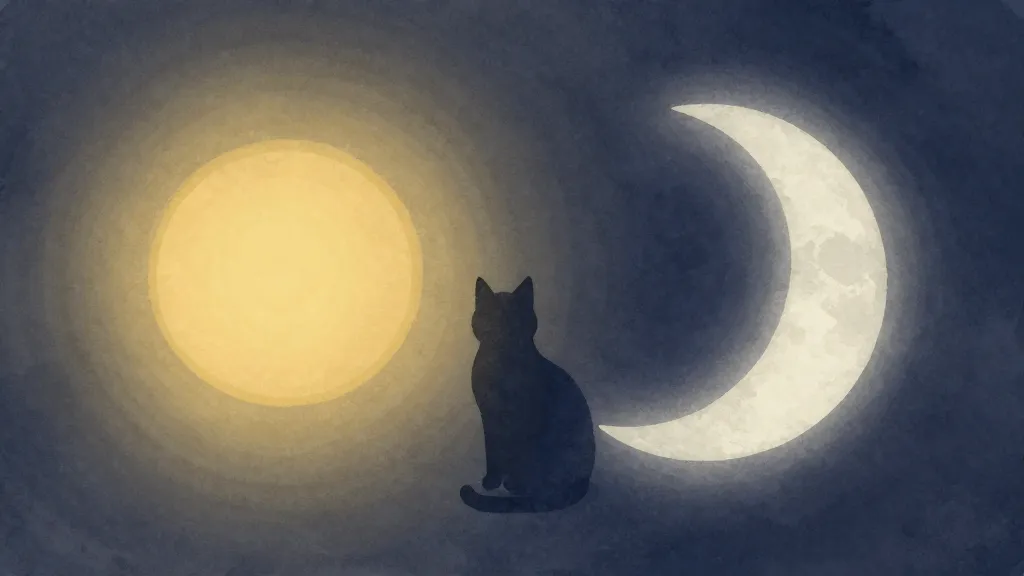
Imagine a box sitting on a table in front of you. Inside, there is a cat. Is that cat happy or grumpy? Is it awake or asleep?
Usually, things are just one thing at a time. But in 1935, a scientist named Erwin Schrödinger came up with a thought experiment that suggested a cat could be two opposite things at the exact same moment. This puzzle is called Schrodinger's Cat, and it helps us explore the strange rules of quantum physics and how we know what is actually true.
Imagine you are walking through the cobblestone streets of Vienna or Berlin in the early 1930s. Scientists were gathering in cozy cafes and grand universities to talk about the very nature of reality.
At the center of it all was a man with round glasses and a messy pile of hair named Erwin Schrödinger. He wasn't just interested in how things moved, but in what things were made of when you looked closer than anyone had ever looked before.
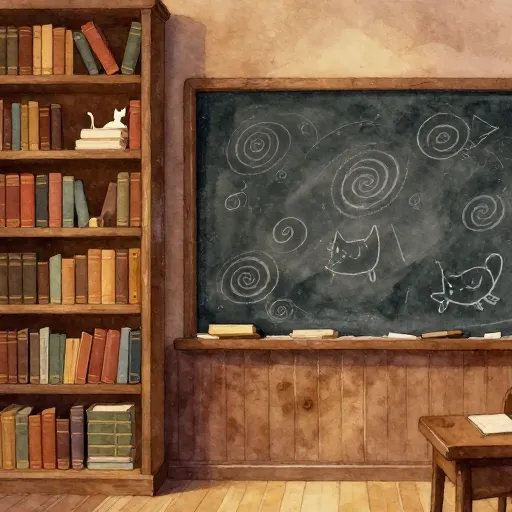
Imagine a room filled with chalkboards and the smell of old books. Scientists are arguing so loudly that the tea in their cups is shaking. They are trying to draw pictures of things they can't see, like the tiny bits of energy that make up light.
At this time, scientists were discovering that the tiny particles that make up our world, like atoms, do not follow the same rules as basketballs or bicycles.
When you throw a ball, you know exactly where it is. But when you look at an atom, it seems to be in many places at once until you actually catch it in your sight.

Finn says:
"So if I'm not looking at my bedroom, does that mean my toys could be having a dance party and sitting perfectly still at the same time?"
This strange idea is called superposition. It is the belief that a tiny particle exists in every possible state at the same time until someone observes it.
Schrödinger found this idea very difficult to believe. He thought it sounded a bit like magic, and he wanted to show everyone how strange it would be if we applied those tiny rules to the big world we live in.

One can even set up quite ridiculous cases. A cat is penned up in a steel chamber.
To explain his point, he didn't use a laboratory with bubbling tubes. Instead, he used his imagination to create a story about a cat in a box.
In this story, a cat is placed inside a steel box that is completely sealed. No one can see inside, and no sound can get out. Inside the box with the cat, there is a tiny bit of radioactive material and a special machine.
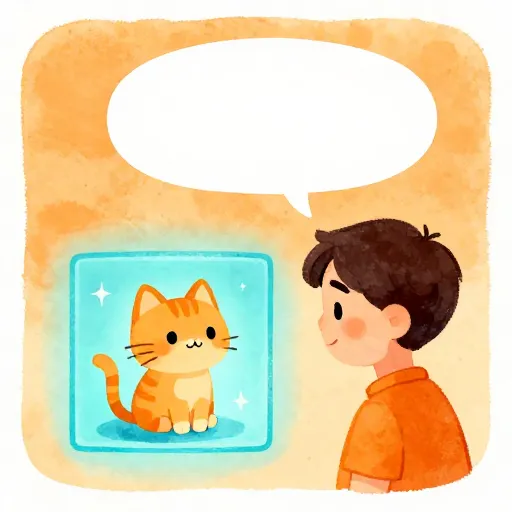
Erwin Schrödinger didn't actually have a cat in a box! This was entirely a 'thought experiment,' which means he did the whole thing inside his head to test an idea.
This machine is like a tiny hammer waiting to drop. If just one atom of the material breaks apart, the hammer will fall and release a vial of sleeping gas.
Because of the rules of the tiny world, that atom is in a state of superposition. It has both broken apart and stayed together at the same time. This is where the story gets very weird.

Mira says:
"It's like a coin spinning on a table. While it's spinning fast, it's not heads or tails. It's a blurry mix of both until it stops."
If the atom is both broken and not broken, then the hammer has both fallen and not fallen. This means the gas has been released, but also hasn't been released.
Following this logic, Schrödinger said that the cat must be both asleep and awake, or even dead and alive, at the exact same time. The cat stays in this double state as long as the box remains closed.
Reality is fixed. The cat is either awake or asleep, and we just don't know which one until we look.
Reality is flexible. The cat is actually both things at once, and our act of looking creates the result.
Schrödinger didn't actually want to hurt cats, and he didn't really believe a cat could be two things at once. He was trying to point out a paradox, which is a situation that seems to lead to a conclusion that makes no sense.
He wanted to show that the way we talk about atoms must be missing something important. If atoms can be in two states at once, but cats cannot, where does the magic stop?
I like to think the moon is there even if I am not looking at it.
This led to a huge debate in the world of science. On one side was Albert Einstein, who agreed with Schrödinger that the world should make sense even when we aren't looking.
On the other side was Niels Bohr, who believed that the act of looking, or observation, is what actually creates reality. To Bohr, the cat really was both things at once until you opened the lid.
Take a coin and spin it on a flat table. While it is spinning, can you say for sure if it is heads or tails? For a few seconds, it is a 'superposition' of both! The moment you clap your hand down to stop it, you are the 'observer' who decides the outcome.
Think about a gift wrapped in shiny paper. Before you open it, is it a Lego set or a pair of socks?
In your mind, it could be either. In the quantum world, the scientists were arguing that it is actually both until the moment the paper is ripped away. The act of opening the box is what forces the universe to pick just one answer.
Through the Ages
Over the years, this cat in a box became one of the most famous symbols in history. It moved out of the science labs and into movies, comic books, and even cartoons.
Even though Schrödinger meant it as a joke to show how silly the theory was, many modern scientists now think he accidentally described how the universe actually works. They call this the Copenhagen Interpretation.
Finn says:
"I wonder if the cat knows which one it is. Does it feel like a blurry ghost, or does it only feel like one thing?"
Today, we use these strange rules to build quantum computers. These are computers that can solve problems much faster than normal ones because their parts can be in two states at once, just like the cat.
Instead of just being a 1 or a 0, the parts of a quantum computer can be both. This allows them to explore thousands of answers at the same time, which is very useful for making new medicines or keeping secrets safe.

If you think you understand quantum mechanics, you don't understand quantum mechanics.
We still don't have a perfect answer to Schrödinger's puzzle. Some people believe in the Many Worlds Theory, which says that when you open the box, the universe splits in two.
In one universe, you find a happy cat. In another universe, a different version of you finds a grumpy cat. This means every time a choice is made, a whole new world is born.
Today, scientists have successfully put tiny objects, like molecules made of 60 atoms, into a state of 'superposition' just like Schrödinger's cat. They haven't tried it with a real cat yet, though!
Schrödinger’s cat teaches us that the world is much more mysterious than it looks. It reminds us that being curious is more important than having all the answers.
Sometimes, the most interesting things in life are the ones we haven't quite figured out yet. It's okay to sit with the mystery of the box and wonder what might be happening inside.
Something to Think About
If you were the cat inside the box, would you feel like you were two things at once, or would you only feel like yourself?
There is no right answer to this question. Even the greatest scientists in history are still debating how it feels to be part of the quantum world.
Questions About Philosophy
Was a real cat ever used in this experiment?
Can humans be in two places at once?
Why is it always a cat?
The Box is Still Closed
The next time you look at a closed door or a wrapped present, remember Schrödinger and his cat. The world is full of possibilities that exist all at once until we take a peek. Keeping that sense of wonder alive is what makes science and philosophy so exciting.
