
Have you ever felt like your day was a giant remote control that everyone else was holding?
Maybe the weather ruined your soccer game, or a friend said something mean, or you dropped your favorite ice cream cone. Stoicism is an ancient school of thought that helps us decide which things are worth our energy and which things we can simply let go.
Imagine you are standing in the middle of a busy marketplace in Athens, Greece, over two thousand years ago. The air smells of roasted meat and dusty stone, and the sound of people arguing about the price of olives fills your ears.
In the corner of this market, under a beautiful covered walkway decorated with colorful paintings, a group of people is gathered. They are not there to buy or sell anything. They are there to talk about how to live a good life.
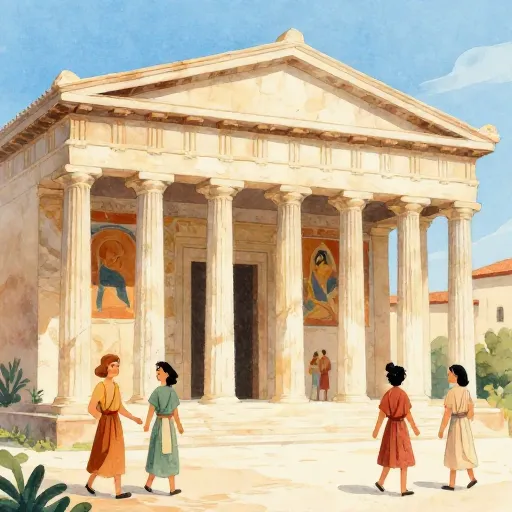
Imagine the Stoa Poikile, or 'Painted Porch.' It wasn't a closed-off classroom with desks. It was an open-air gallery with massive pillars and bright paintings of heroic battles on the walls. People from all over the world would stop by to listen, from rich merchants to people with no money at all. The philosophy was out in the open, for everyone.
This covered walkway was called a Stoa, which is where the name Stoicism comes from. The man leading the group was named Zeno. He had lost everything he owned in a shipwreck, but instead of spending the rest of his life being miserable, he started asking a very interesting question:
If everything you own can be taken away in a single storm, what is the one thing that stays with you forever?
The Great Filter
The Stoics believed that our minds are like a filter. The world throws all sorts of things at us: rain, grumpy teachers, surprise parties, and broken toys. These things are just "events."
People are disturbed not by things, but by the views which they take of them.
They don't have a feeling attached to them until they pass through our filter. The Stoics called this the Dichotomy of Control. It sounds like a big, fancy phrase, but it is actually a very simple tool for your brain.

Mira says:
"It's like playing a video game! I can't control if the game is hard, but I can control how much I practice and whether I throw the controller when I lose."
Think of it like a circle drawn in the sand. Inside the circle are the things you can control: your thoughts, your choices, and how you treat other people. Outside the circle is everything else: the weather, what other people think of you, and whether your team wins the game.
- Inside the circle: Your effort
- Inside the circle: Your kindness
- Outside the circle: The traffic
- Outside the circle: A sudden rainstorm
Next time you feel upset, grab a piece of paper and draw a big circle. Label the inside 'MY CHOICE' and the outside 'NOT MY CHOICE.' Write down what is bothering you. If it goes outside the circle, imagine yourself blowing it away like a dandelion seed. If it stays inside, ask yourself: 'What is one small thing I can do about this right now?'
Meet the Stoic Team
Stoicism wasn't just for people in robes long ago. It was used by people from every walk of life. This is what makes it so special: the ideas work whether you are the most powerful person in the world or someone with almost nothing at all.
First, there was Marcus Aurelius. He was the Emperor of Rome, which meant he was basically the most powerful person on Earth. He had to lead armies and run a massive empire, which was very stressful.

Finn says:
"Wait, so even the most powerful person in the world felt like they needed to write notes to themselves to stay calm? That makes me feel a lot better about getting frustrated with my homework."
To keep himself calm, he wrote a private journal that he never thought anyone else would read. Today, we call it Meditations. In it, he reminded himself every morning to be patient and kind, even when people were being difficult.

The happiness of your life depends upon the quality of your thoughts.
Then there was Epictetus. His life was the exact opposite of the Emperor's. He was born into slavery and had a permanent injury that made it hard for him to walk.
Yet, Epictetus was one of the happiest and freest people in Rome. Why? Because he realized that while someone could control his body, no one could ever control his mind. He taught that true freedom is knowing that your character belongs only to you.
The Four Pillars of Character
To the Stoics, living a good life wasn't about being famous or rich. It was about practicing four specific qualities, which they called Virtues. You can think of these as the four legs of a very sturdy table.
- Wisdom: Learning to tell the difference between what we can change and what we can't.
- Justice: Treating everyone fairly and being a good member of your community.
- Courage: Doing the right thing even when you are scared or when it is hard.
- Temperance: Having self-control and not letting your desires or your temper boss you around.
The best way to be happy is to avoid all pain and seek out things that feel good, like delicious food and comfort.
The best way to be happy is to build a strong character, because you can be happy even when things are difficult or uncomfortable.
When you practice these four things, you build what the Stoics called an Inner Citadel. A citadel is a strong fortress. When your mind is a fortress, a mean comment or a bad grade might knock on the door, but it can't break inside and ruin your day.
The Myth of the Robot
Sometimes people think being "stoic" means you never cry, never get angry, and never laugh. They think Stoics want to be like robots. But that is a big misunderstanding!
Mira says:
"I think I get it. It's not about having no feelings, it's about not letting your feelings decide who you are. Like, I can feel sad without being a 'sad person.'"
Stoics actually felt things very deeply. They just didn't want to be slaves to their feelings. They wanted to have Eudaimonia, which is a Greek word for a deep, steady kind of happiness that comes from knowing you are doing your best.

The word 'Stoic' today is often used to describe someone who hides their feelings, but the original Stoics actually loved friendship and community. They even came up with the word Cosmopolitan, which means 'citizen of the world.' They believed we are all part of one big human family.
Instead of letting anger drive the car, a Stoic lets their reason sit in the driver's seat. They might feel the anger sitting in the back, but they don't let it take the wheel and crash the car.
Traveling Through Time
Stoicism didn't disappear when the Roman Empire fell. It has been a secret weapon for thinkers, leaders, and even astronauts for hundreds of years.
Stoicism Through the Ages
When George Washington was leading the American Revolution, he used Stoic ideas to keep his cool during the hardest winters. Today, many psychologists use Stoic techniques to help people who feel very anxious or sad.
One of the most famous Stoic exercises is called Premeditatio Malorum, which is just a fancy way of saying "thinking ahead about what could go wrong."
Marcus Aurelius wrote his 'Meditations' while he was living in a tent on the edge of a battlefield during a war. He didn't have a quiet library or a cozy chair. He practiced Stoicism in the middle of the messiest, hardest parts of his life.
By imagining a problem before it happens, you take away its power to surprise you. If you imagine it might rain during your picnic, you aren't shocked when the clouds roll in. You just reach for your umbrella and keep smiling.
We suffer more often in imagination than in reality.
Your Own Painted Porch
You don't need to live in Ancient Greece to be a Stoic. You just need to be curious about how your own mind works. You are the architect of your own Inner Citadel, and every time you choose how to respond to a challenge, you are laying another brick.
It takes practice, just like learning an instrument or a sport. Some days the waves will feel too big, and that's okay. The goal isn't to be perfect: it's to keep showing up to the Stoa and asking the big questions.
Something to Think About
If you were building your own 'Inner Citadel' today, what would the walls be made of?
There are no wrong answers here. Some people might build theirs out of humor, others out of silence, and others out of big, brave actions. What helps you feel most like yourself?
Questions About Philosophy
Is Stoicism about not having any feelings?
Why is it called Stoicism?
How can an 8-year-old practice Stoicism?
The Adventure of the Mind
Stoicism isn't a set of rules you have to follow: it is a set of tools you can use. Some tools might fit your life perfectly right now, and others might be things you save for later. The most important thing Zeno and Marcus Aurelius taught us is that even when the world is loud and confusing, you have a quiet place inside yourself that belongs only to you. Keep exploring it!