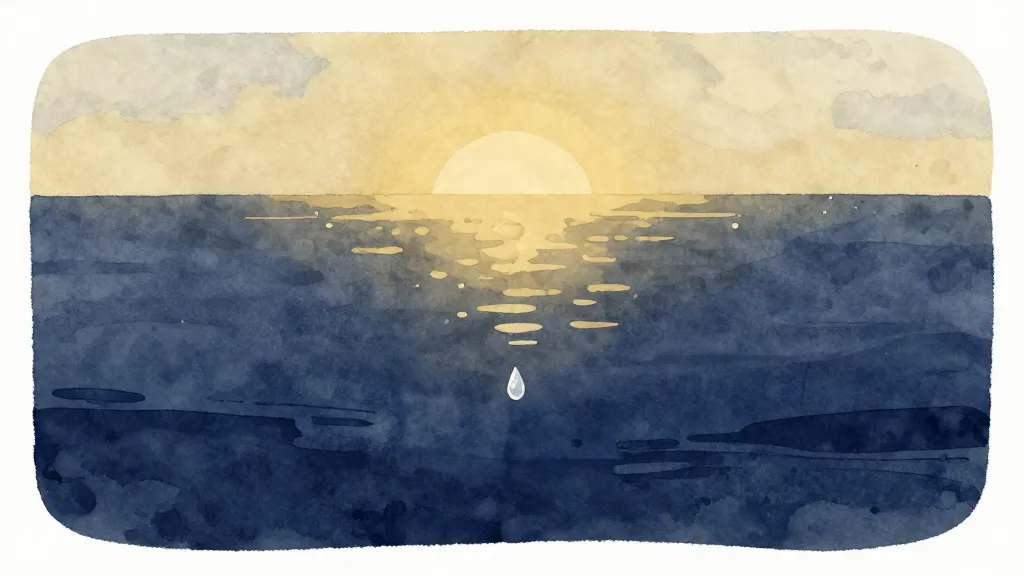
Have you ever looked at a drop of water and realized it has the exact same 'stuff' in it as the entire ocean?
This is the heart of Vedanta, one of the oldest and deepest traditions of Indian philosophy. It invites us to look past what our eyes see to find a hidden connection between everything in the universe.
Imagine you are sitting in a lush green forest in India three thousand years ago. The air is warm, and the sound of a nearby river hums in the background. Around you, students sit in a circle on the ground, listening to a teacher share secrets about the nature of the world.
These ancient teachings were called the Upanishads. They form the foundation of Vedanta, a word that literally means the end or the peak of knowledge. The people who came up with these ideas weren't interested in just memorizing facts, they wanted to solve the biggest mystery of all: who are we?
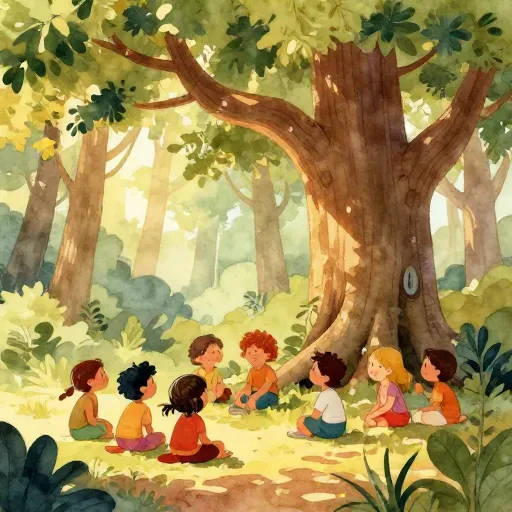
Imagine a forest where the trees are so thick they block out the midday sun. This was the 'Aranyaka' or forest-academy. There were no whiteboards or iPads here: students learned by listening to the rhythm of their teacher's voice and chanting together until the ideas felt like a part of their own breath.
At the time, most people were focused on outer rituals, like making offerings to the gods. But the thinkers of Vedanta started looking inward. They wondered if the same power that makes the stars shine also lives inside a human heart.
They didn't just want to believe in something; they wanted to experience it. They believed that if you look closely enough at yourself, you will find something that never changes, even as your body grows older and your thoughts fly by like birds.

Finn says:
"If my thoughts are always changing like birds in the sky, who is the person watching the birds? Is there a 'me' that stays still while the rest of me moves?"
The Big Idea: Brahman and Atman
To understand Vedanta, you have to meet the two main characters of this story. The first is Brahman. This isn't a person or a god with a face, but rather a name for the infinite, unchanging reality that makes up everything in existence.
Think of Brahman like the electricity that powers every lightbulb in your house. The bulbs might look different: some are round, some are long, some are bright, and some are dim. But the energy inside them is exactly the same.
That which is the finest essence: this whole world has that as its soul. That is Reality. That is Atman. That art thou.
The second character is Atman. This is the word for your individual self, the 'you' that is looking out through your eyes right now. Vedanta asks a daring question: what if Atman and Brahman are actually the same thing?
This idea is called Non-duality, or Advaita. It suggests that while you feel like a separate person, you are actually a part of the whole universe. It is like a wave thinking it is separate from the sea, until it realizes it is made of nothing but ocean water.
Take a glass of water and stir in a spoonful of salt. After a minute, the salt disappears! You can't see it, but if you taste any part of the water, the salt is there. Vedanta says the 'Self' is like that salt: hidden, but present in every single part of life.
The Magic Show of Maya
If we are all actually one big cosmic energy, why does it feel like we are separate? Why do I feel like 'me' and you feel like 'you'? Vedantic thinkers have a word for this too: Maya.
Maya is often described as a kind of cosmic magic or an illusion. It is the power that makes the one look like many. Imagine you are watching a movie on a screen: you see car chases, mountains, and people talking, but if you walk up and touch the screen, it is just flat light.

Mira says:
"It's like when I play a video game. I feel like the character on the screen, but I'm actually the person holding the controller. The character is Maya, but I'm the real one!"
The world around us is real in its own way, but Maya is the 'veil' that hides the deeper truth. We get so caught up in the 'movie' of our daily lives, like what we ate for lunch or who won the game, that we forget we are the light on the screen.
Vedanta doesn't say the world is a lie, but it says the world is 'changing.' Anything that changes, like a cloud or a dream, isn't the final truth. The final truth is the thing that stays the same while the changes happen.
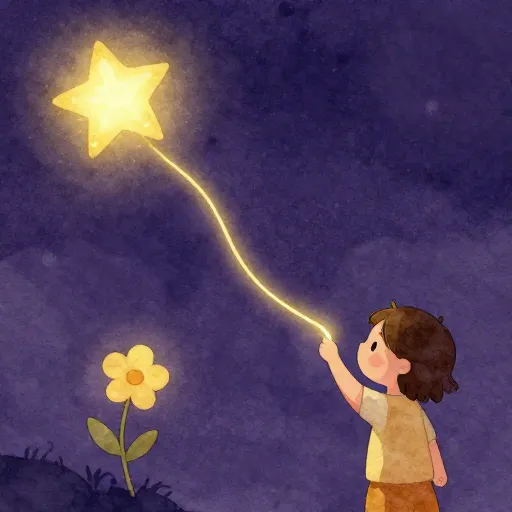
The word 'Yoga' actually comes from this philosophy! It means 'to yoke' or 'to join.' The physical poses people do today were originally designed to help the body stay still so the mind could realize its connection to the whole universe.
Adi Shankara and the Rope-Snake
Around 1,200 years ago, a brilliant philosopher named Adi Shankara walked across India to explain these ideas. He used famous stories to help people understand how Maya works. One of his favorites was the story of the rope and the snake.
Imagine you are walking down a path at twilight. You see a coiled shape on the ground and jump back in fear, shouting, 'A snake!' Your heart beats fast, and you feel terrified. But then, a friend shines a lantern on the ground, and you see it was just a coiled rope all along.
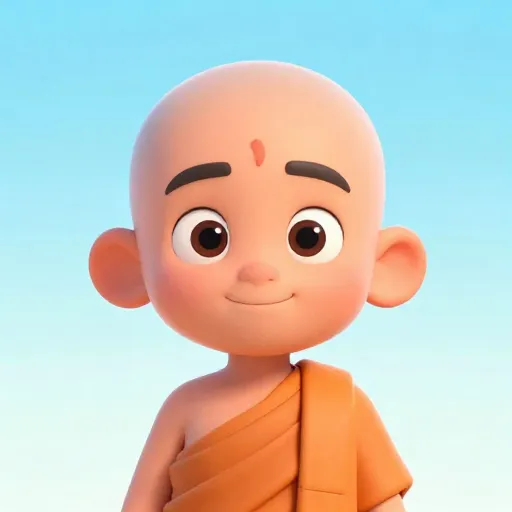
Just as the sun's reflection in different pots of water appears to be many, so the one Self appears to be many in different bodies.
The 'snake' was never there, but your fear was real. Shankara argued that we live our lives reacting to 'snakes' (problems and separations) that are actually just 'ropes' (Brahman) seen in the dark. Once you 'shine the light' of wisdom, the fear disappears.
Shankara helped organize Vedanta into a system called Advaita Vedanta. He was like a master detective, using logic to prove that our feelings of being alone or small are just misunderstandings of who we really are.
We are exactly the same as the Divine. There is no difference at all between the drop and the ocean.
We are connected to the Divine, but we are still individual. The drop is made of ocean water, but the drop is not the whole ocean.
Through the Ages
Vedanta didn't stay hidden in the forests of India. It traveled across oceans and through time, changing how people thought about science, religion, and themselves.
Through the Ages
In the late 1800s, a monk named Swami Vivekananda traveled from India to Chicago for a big meeting of world religions. He didn't start his speech with 'I have the truth.' Instead, he called the audience 'Sisters and Brothers of America.'
He wanted to show that Vedanta isn't just for people in India; it is a universal map for the human mind. He believed that every person has a spark of the divine inside them, and the goal of life is to let that spark become a flame.
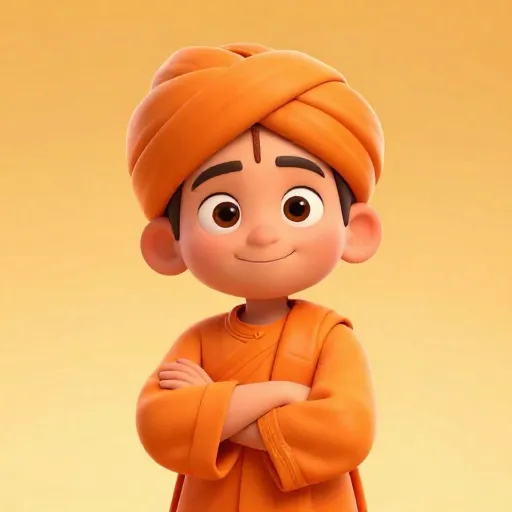
The ocean can be without the wave, but the wave cannot be without the ocean.
Why Does It Matter Today?
Today, many people find that Vedanta fits surprisingly well with modern science. Some physicists look at the smallest particles of matter and realize they are mostly empty space and energy, much like what the ancient forest-dwellers described.
It also changes how we treat other people. If you truly believe that the other person is a different 'version' of you, it becomes much harder to be mean or selfish. If we are all leaves on the same tree, why would one leaf fight another?
Mira says:
"If everyone has the same 'energy' inside them, then being kind to someone else is actually like being kind to myself. We're all just helping our own big self out."
Vedanta doesn't ask you to stop being you. It doesn't want you to stop playing, learning, or having fun. It just offers a quiet background music to your life, reminding you that no matter what happens, you are part of something vast, safe, and eternal.
Instead of being a small person in a big world, Vedanta suggests you might be the whole world experiencing itself through a small person. It is a thought that can make the world feel a lot less lonely and a lot more like home.
Many famous scientists, like Erwin Schrödinger (who helped invent quantum physics), studied Vedanta. He found that the idea of everything being interconnected helped him understand how the smallest parts of the universe behave!
Something to Think About
If you are the ocean and not just the wave, how does that change how you feel when something small goes wrong today?
There isn't a right or wrong way to feel about this. Some people feel very big and brave, while others feel quiet and peaceful. What comes to your mind?
Questions About Philosophy
Is Vedanta a religion?
Does Vedanta say the world isn't real?
How can I 'do' Vedanta?
The Wave and the Sea
The next time you look in the mirror, remember the story of the salt and the water. You are a unique individual with your own name, hobbies, and dreams, but according to Vedanta, you are also the entire universe looking at itself. That is a mystery worth wondering about every single day.