
Close your eyes for a moment. Can you feel the weight of your feet on the floor, the hum of the fridge, and the quiet voice in your head wondering when this article will start?
That 'feeling' of being alive and aware is what philosophers call Consciousness. It is one of the biggest mysteries in the world, and even though we all have it, nobody can quite explain how it works or why the Mind exists at all.
Right now, your brain is busy. It is turning light into shapes, vibrations into sounds, and symbols on a screen into ideas. But there is a difference between a computer processing data and you reading a story.
A computer doesn't 'feel' anything when it works. You, however, have an inner world: a private, invisible theater where you experience the brightness of yellow, the sting of a papercut, or the excitement of a birthday. This 'inner-ness' is the core of being human.
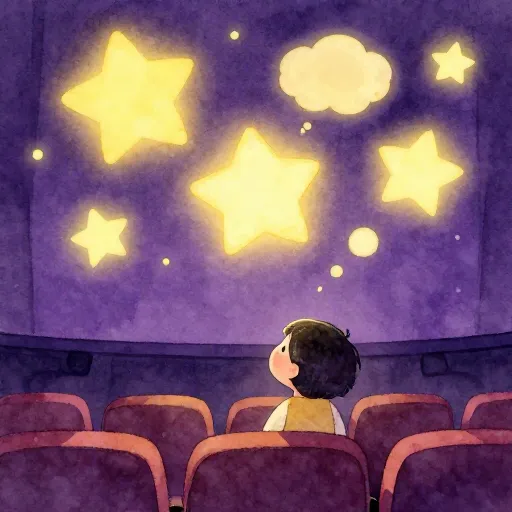
Imagine your mind is a giant, glowing stage. Every thought you have is an actor walking across the stage. Every feeling is a colored light shining down from the rafters. You are the only person in the audience, watching the show happen every single second of the day.
Scientists and philosophers have been trying to map this inner world for thousands of years. They want to know where the 'you' inside your head actually lives. Is it just a bunch of electricity in your brain, or is it something else entirely?
The Man Who Doubted Everything
In the winter of 1619, a French philosopher named René Descartes climbed into a large wooden stove to keep warm. While he sat there, he began to think about what he could know for sure. He realized he could be dreaming, or even being tricked by a powerful ghost.
He realized that he could doubt almost everything about the world around him. He could doubt his hands, the trees outside, and even the ground. But there was one thing he could not doubt.

Finn says:
"If Descartes was right and the mind is separate from the body, does that mean my thoughts could exist without my brain? That's kind of spooky but also pretty cool."
He couldn't doubt that he was thinking. Because he was thinking, he knew that he must exist. This led him to a very famous idea: that the Mind and the body are two different things.
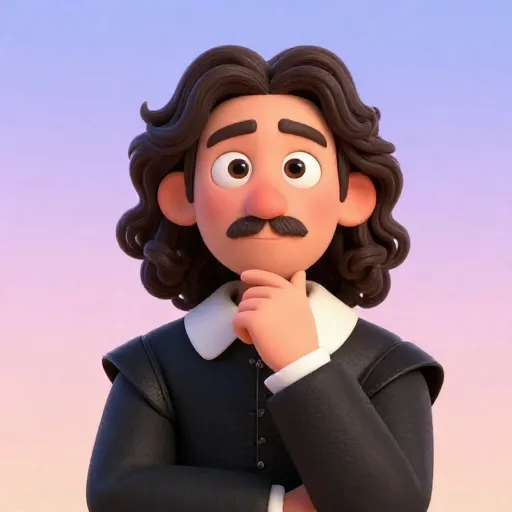
I think, therefore I am.
Descartes believed the body was like a complicated machine, but the mind was something special and non-physical. He thought the two met in a tiny part of the brain called the pineal gland. Today, most scientists disagree with that part, but the mystery of how a physical brain creates a non-physical thought remains.
The Hard Problem
Imagine you are eating a sour lemon. A scientist could look at your brain and see exactly which neurons are firing. They could measure the chemicals and the electrical signals moving through your nerves.
But that scientist can't see the 'sourness' itself. They can't feel the sharp, puckering sensation that you are feeling. This is what philosophers call Qualia, the individual instances of subjective, conscious experience.
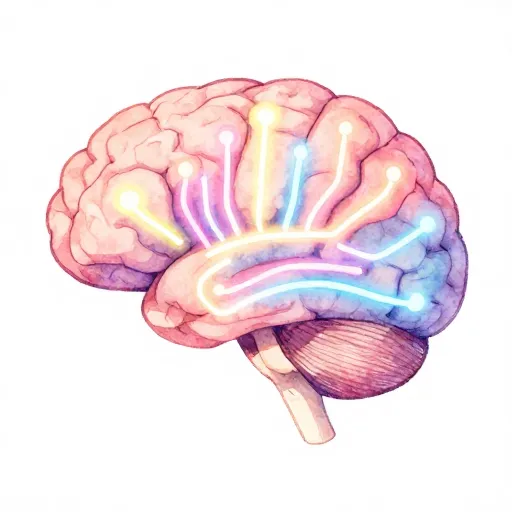
Scientists have discovered that even when you are doing absolutely nothing, your brain is incredibly active. This is called the 'Default Mode Network.' It's like your brain has a screensaver that stays busy dreaming and thinking about the past and future whenever you stop focusing on a task.
In the 1990s, a philosopher named David Chalmers called this the 'Hard Problem.' The 'easy' part of consciousness is explaining how the brain reacts to things. The 'hard' part is explaining why it feels like something to be you.
If we built a robot that looked exactly like you and acted exactly like you, would it feel 'you-ness' inside? Or would it just be a very clever machine with the lights turned off?

Mira says:
"I think the 'Hard Problem' is like trying to describe the color blue to someone who has never seen it. You can talk about light waves all day, but you can't give them the 'feeling' of blue."
The Stream of Thought
Another way to think about consciousness is to imagine a river. This was an idea from William James, an American thinker who lived about 150 years ago. He said consciousness doesn't come in pieces or bits.
Instead, it flows. Your thoughts about breakfast lead into thoughts about your shoes, which lead into a memory of a song, which lead into a worry about a math test. It is a constant Subjectivity that never truly stops while you are awake.
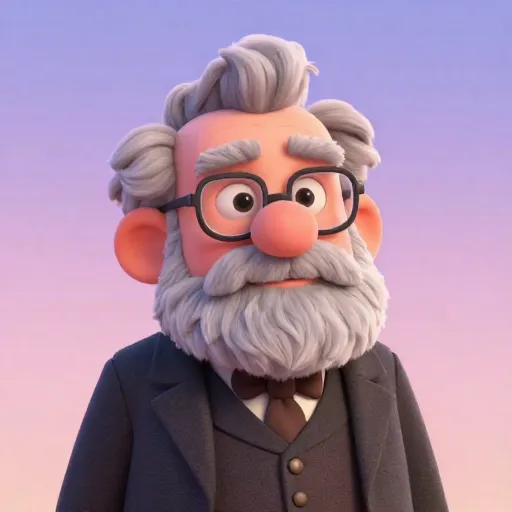
Consciousness, then, does not appear to itself chopped up in bits... It is nothing jointed; it flows.
Because this stream is always moving, you are never exactly the same person from one second to the next. Your consciousness is always being updated by new smells, sights, and feelings. You are the pilot of this stream, but sometimes the stream carries you away.
Try to go 30 seconds without having a single thought. No words, no pictures, no 'I'm doing it!' in your head. It's almost impossible! This shows how the 'stream' of consciousness is always pushing forward, whether you want it to or not.
The History of the Mystery
People haven't always thought about the mind in the same way. In different times and places, people looked for the 'self' in very different locations. Sometimes they thought it was in the heart, or even the breath.
Through the Ages
In Ancient Egypt, when people died, the priests would carefully save the heart because they thought it was the seat of intelligence. They often threw the brain away! It took a long time for humans to realize that the gray, squishy stuff inside our skulls was the headquarters for our thoughts.
Do Animals Have It Too?
If consciousness is the feeling of 'being there,' do dogs have it? What about ants? Or a tree? This is a question about Sentience, the capacity to feel and perceive things.
Most people agree that a dog feels happy when it sees a leash. But what about a bat? A philosopher named Thomas Nagel once wrote a famous essay called 'What Is It Like to Be a Bat?'

An organism has conscious mental states if and only if there is something that it is like to be that organism.
Nagel argued that even if we knew everything about a bat’s brain and how it uses sonar to 'see' in the dark, we still wouldn't know what it feels like to be a bat. Their experience of the world is a secret we can never fully join.
Finn says:
"I wonder if my cat thinks in 'Meow' or if she just has feelings like 'Hungry' and 'Sunlight.' Maybe consciousness doesn't need words at all."
The Two Sides of the Brain
Some of the strangest clues about consciousness come from doctors who work with the brain. The brain is split into two halves, or hemispheres. Usually, they talk to each other through a bridge of fibers.
Sometimes, for medical reasons, that bridge is cut. When this happens, it can seem like there are two different 'people' living in the same head! One side might like one color, while the other side prefers another.
They believe consciousness is just what the brain does. If you understand every neuron and chemical, you understand the mind. It's like the software on a computer.
They believe the mind is a separate 'thing' from the brain. The brain might be the radio, but the mind is the signal coming from somewhere else entirely.
This makes us wonder: is consciousness one single thing, or is it a team effort? Perhaps your 'self' is actually a collection of many different parts of the brain all working together so smoothly that it feels like one person.
Waking and Sleeping
We usually think of consciousness as being 'awake.' But what happens when we sleep? When you dream, you are still having experiences. You see things, feel fear, and move around, even though your body is still.
This is called an Altered State of consciousness. It shows that your mind can create a whole world without any help from your eyes or ears. It’s like the theater is running a movie while the audience is asleep.
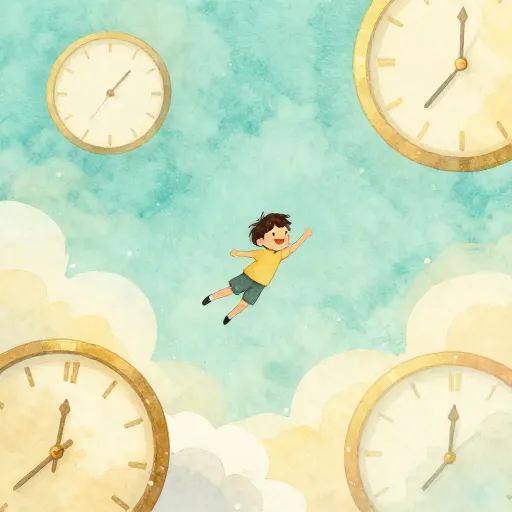
There is a rare condition called 'lucid dreaming' where people become conscious while they are dreaming. They realize they are in a dream and can sometimes even control what happens, like flying or changing the scenery!
In the end, consciousness is the one thing you can never escape, but also the one thing you can never show to someone else. You can describe your feelings, but nobody else can ever truly step inside your invisible theater.
Something to Think About
If you could swap consciousness with your best friend for one hour, what do you think would be the biggest surprise about 'being' them?
There's no way to know for sure, which is what makes this a perfect mystery to discuss with a friend or parent.
Questions About Philosophy
Where in the brain is consciousness?
Are babies conscious?
Will robots ever be conscious?
The Mystery Continues
Consciousness is the ultimate 'Big Idea' because you are using it right now to think about itself. It is like a flashlight trying to turn around and see where its own light comes from. Whether you think of it as a soul, a stream, or a complex biological computer, the fact that you can wonder about it at all is the most amazing part of being you.
