Have you ever felt a sharp, hot sting in your chest and found yourself shouting, "That's not fair!"?
That feeling is your inner compass pointing toward one of the biggest ideas in human history: justice. It is a word we use for the way we try to make the world right, involving everything from laws and ethics to the way you share a snack with a friend.
Imagine you are standing in a dusty courtroom in ancient Egypt, three thousand years ago. The air is thick with the scent of incense, and the walls are covered in colorful carvings of gods and goddesses.
You aren't there to see a judge in a wig, but to see if a heart is as light as a feather. To the ancient Egyptians, justice was not just a set of rules written in a book: it was a physical weight that kept the entire universe from falling into chaos.
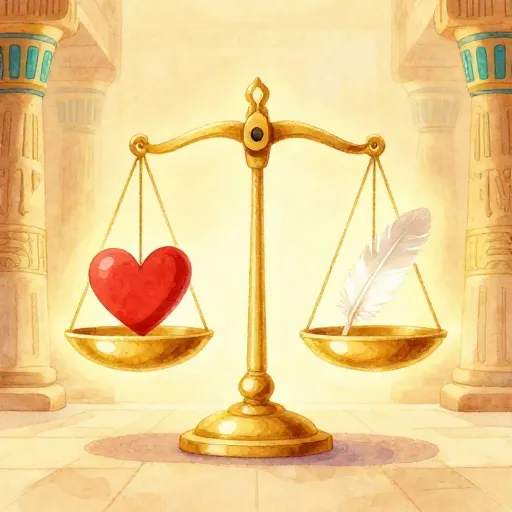
Imagine the Hall of Ma'at. A giant scale stands in the center. On one side is the heart of a person who has passed away. On the other side sits a single, tiny white ostrich feather. If the heart is heavy with bad deeds, it tips the scale. If the heart is light and full of kindness, it stays perfectly balanced with the feather.
They called this idea Ma'at. It was the belief that the sun rose, the Nile river flooded, and people stayed healthy because everything was in its proper balance.
If someone was greedy or cruel, they weren't just breaking a rule: they were tipping the scales of the whole world. Justice was the act of putting things back where they belonged.

Finn says:
"So if justice is like harmony, does that mean if one person is treated badly, the whole 'song' of the city sounds out of tune?"
As time moved on, the question of justice moved from the stars and the gods down to the streets and the markets. In ancient Greece, a philosopher named Plato spent his whole life trying to figure out what a "just" person looked like.
He thought that justice was a kind of inner harmony. Just as a band sounds terrible if the drummer and the singer aren't in sync, Plato thought a city only worked if everyone did the job they were best at and treated others with respect.
Justice is the constant and perpetual will to render to each his due.
Plato’s student, Aristotle, took it a step further. He looked at the way people traded grain or argued over land.
He realized that justice often comes down to two things: giving people what they deserve based on their hard work, and making sure that if someone is hurt, they get something back to make them whole again. He called this "rectificatory" justice, which is a very long word for fixing what is broken.
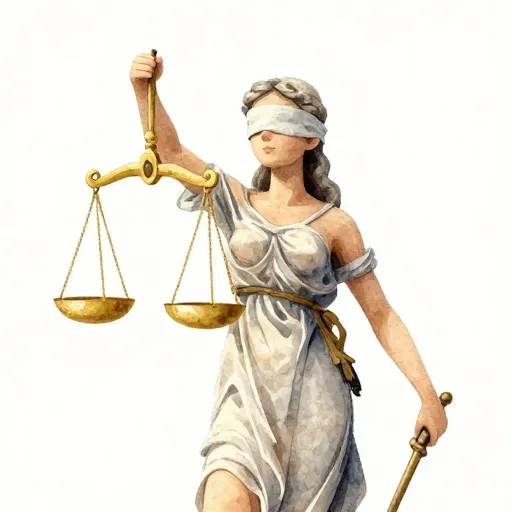
You've probably seen statues of 'Lady Justice' holding scales and a sword. But did you know she wasn't always blindfolded? In ancient times, she kept her eyes open. It wasn't until about 500 years ago that artists added the blindfold to show that justice should be 'blind' to how rich or powerful a person is.
But who gets to decide what is broken? For a long time, kings and queens decided what was just.
If the king said it was fair to take your cow, then it was fair. But thinkers like John Locke started to wonder if there was a bigger set of rules, a social contract that everyone agreed to just by living together.
This contract says that we give up a little bit of our total freedom (like the freedom to drive as fast as we want) so that everyone can be safe. This led to the idea of human rights, the belief that every person has a certain worth that no king can take away.

Mira says:
"It's interesting that the 'social contract' isn't a piece of paper you sign. We sign it just by choosing to be kind to our neighbors."
In the 1970s, a philosopher named John Rawls came up with one of the most famous ways to test if a rule is truly just. He called it the "Veil of Ignorance."
Imagine you are helping to design a brand-new society, but there is a catch: you don't know who you will be in that society. You might be rich, or you might be poor. You might be very healthy, or you might have a disability.
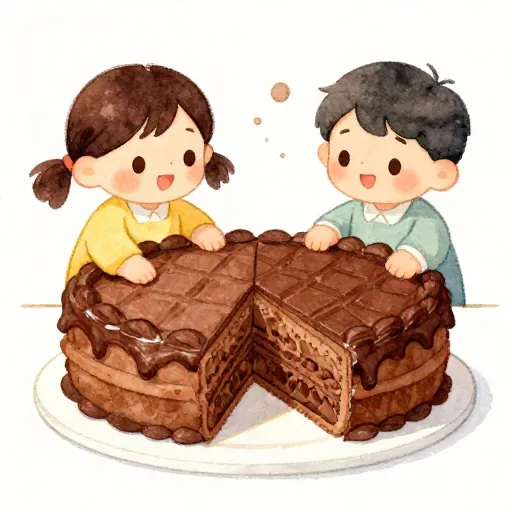
Next time you have to share a treat with a friend, try the 'One Divides, One Chooses' rule. One person cuts the cake or divides the stickers into two piles, but the other person gets to pick their pile first. Watch how carefully the first person tries to make the piles perfectly equal!
If you didn't know which "slice" of life you would get, what kind of rules would you make? Rawls argued that you would probably make rules that are fair for everyone, just in case you ended up at the bottom.
This shifted the idea of justice from merit (getting what you earn) to fairness (making sure the game isn't rigged). It asks us to look at the world through the eyes of the person who has the least.

The principles of justice are chosen behind a veil of ignorance.
Sometimes, justice is about more than just rules: it is about how we fix a community after something bad happens. For a long time, the only answer was punishment.
If you did something wrong, you were locked away. But many cultures, from the Navajo Nation to modern schools, practice something called restitution or restorative justice.
Instead of just asking "What rule did you break?" they ask "Who was hurt, and what do they need to feel better?" This kind of justice focuses on healing the relationship between people rather than just following a recipe for punishment.
Focuses on the person who broke the rule. The main question is: 'What punishment do they deserve for what they did?'
Focuses on the person who was hurt. The main question is: 'How can we fix the harm and help everyone move forward?'
There is also a big difference between equality and equity. Imagine three kids trying to see over a tall fence to watch a baseball game.
If you give them all the same size box to stand on, that is equality. But if the tallest kid can already see, and the shortest kid still can't see with the box, the problem isn't solved.
Equity means giving the shortest kid two boxes and the tallest kid none, so that everyone can actually see the game. Justice often requires us to give people different things so they can have the same opportunities.
Finn says:
"What if what feels just to me feels totally unfair to someone else? Who gets to be the referee then?"
Injustice anywhere is a threat to justice everywhere.
Today, we are still arguing about what justice looks like. We talk about climate justice, making sure the people who didn't cause pollution don't suffer the most from it.
We talk about universal rights, the idea that every child on Earth deserves food, safety, and a school, no matter where they were born. These ideas are like a long conversation that started in ancient Egypt and is still happening in your classroom today.
The Journey of Justice
Justice is not a destination we reach and then stop. It is more like a garden that needs to be weeded and watered every single day.
It requires us to be brave enough to admit when we are wrong and curious enough to listen to people whose lives are different from ours. When we seek justice, we are really seeking a world where everyone feels like they belong.
The person who works the hardest or has the most talent should get the biggest reward. It is about what you earn.
The person who has the least should be helped first so they have what they need to survive. It is about what you require.
Something to Think About
If you were the only person on a deserted island, would justice still exist?
Think about whether justice is something that lives inside you, or if it's something that only happens when two or more people are together. There is no right or wrong answer, just different ways of seeing the world.
Questions About Philosophy
Is justice the same thing as the law?
Why is justice often shown as a pair of scales?
How can kids practice justice?
The Never-Ending Scale
The next time you feel that 'it's not fair' spark, don't ignore it. It is your invitation to join the thousands of years of human history spent trying to balance the scales. Whether you are dividing a snack or thinking about the future of the planet, you are helping to write the next chapter of what justice means.