Is kindness just being 'nice,' or is it something much bigger?
For thousands of years, humans have wondered why we help each other even when it costs us something. This deep mystery is what we call kindness, a concept that connects our ancient ancestors to the way we treat our friends on the playground today.
Imagine you are standing in a dusty street in Ancient Rome nearly two thousand years ago. The air smells of baked bread and woodsmoke, and the sound of iron carriage wheels rattles against the stones. In this busy city, a powerful man named Marcus Aurelius sits down to write in his private journal.
He is the Emperor, the most powerful person in the world, but he is writing about how to stay calm and gentle. He believes that every human being is part of a giant, living body. To him, being unkind to someone else is like a hand trying to hit the foot of the same person.
Kindness is invincible, provided it is sincere.
Marcus Aurelius was part of a group called the Stoics. They spent a lot of time thinking about what makes a person 'good.' They realized that kindness was not just a polite habit you used at dinner parties. For them, it was a fundamental law of nature that kept the world from falling apart.
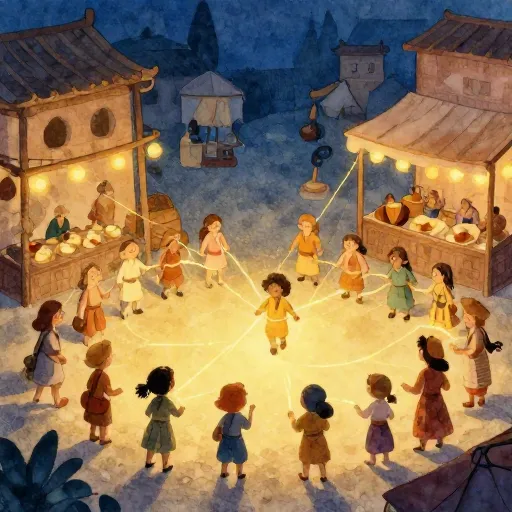
Imagine a giant invisible web connecting every person in your city. Every time someone helps another person, a thread in the web glows bright gold. When Marcus Aurelius looked at Rome, he didn't just see buildings: he saw these glowing connections keeping the city alive.
If we look closely at the word itself, we find a secret clue about what it really means. The word kindness comes from the Old English word cynne, which means 'kin' or 'family.' When you are kind to someone, you are essentially treating them like they are your own family.
This was a big idea because it meant people had to expand their circle. Instead of only caring for their brothers and sisters, they started trying to see the whole world as their kin. This is why many people in history have called kindness a 'universal' language.

Finn says:
"If kindness means treating people like family, does that mean I have to be kind even to people I don't really like? That sounds a bit exhausting!"
Long before the Romans, a teacher in Ancient China named Confucius was asking similar questions. He lived during a time of great war and chaos, where people were often cruel to each other to survive. Confucius wanted to find a way to make society stable and peaceful again.
He taught a concept called Ren, which is often translated as 'human-heartedness.' He believed that we are not truly human until we learn how to care for others. Ren is the feeling you get when you see someone trip and you instinctively want to catch them.
Forget injuries, never forget kindnesses.
Confucius talked about something called the 'Silver Rule.' You might have heard of the Golden Rule, which says to treat others how you want to be treated. The Silver Rule is slightly different: 'Do not do to others what you would not want them to do to you.'
It sounds like a small change, but it is very powerful. It asks us to stop and imagine how someone else feels. This ability to feel what another person feels is called empathy, and it is the fuel that makes kindness run.
The word 'empathy' is actually quite new! It was only created about 100 years ago to describe the feeling of 'creeping into someone else's skin' to see the world through their eyes. Before that, people usually just called it 'sympathy' or 'fellow-feeling.'
But is kindness always easy? Sometimes, being kind feels like the hardest thing in the world. Think about a time when a friend was mean to you, and you had to decide how to react. Your brain might have wanted to be mean back to protect yourself.
Philosophers have debated for centuries whether humans are naturally kind or naturally selfish. Some, like Thomas Hobbes, thought people were naturally 'nasty and brutish.' Others, like Jean-Jacques Rousseau, believed humans were born good but were changed by the world around them.
Some people believe that every kind act is actually a way to make ourselves feel good or get a reward later.
Others believe humans have a 'natural compass' that points toward helping others just because it's the right thing to do.
Modern science has stepped into this debate with some surprising answers. Biologists have found that kindness is not just a 'nice' thing we invented. It is actually a survival strategy that has been programmed into our DNA over millions of years.
Charles Darwin, the scientist famous for 'survival of the fittest,' noticed something interesting about animals. He saw that the groups of animals that survived the best were often the ones that cooperated. They shared food, protected each other's babies, and warned each other of danger.

Mira says:
"I read that some vampire bats share their food with bats that didn't find any. It's cool to think that kindness is a way of looking out for everyone's future, not just our own."
This kind of behavior is called altruism, which is acting to help someone else even if it doesn't benefit you right away. In the animal kingdom, we see this everywhere. Ants work together to build huge cities, and dolphins help injured members of their pod stay at the surface to breathe.
Scientists believe humans evolved to be kind because it made our tribes stronger. A tribe where everyone shared their meat and looked after the sick was much more likely to survive a harsh winter than a tribe where everyone was selfish. Kindness was our superpower.
Try the 'Kindness Echo' this week. When someone is kind to you, don't just say thanks: pass it on to a completely different person within one hour. See if you can notice how far one single act of kindness can travel through your classroom or home.
Through the Ages
As time went on, people started to realize that kindness has different layers. There is 'polite kindness,' like saying thank you or holding a door. Then there is 'deep kindness,' which involves seeing someone's struggle and staying with them, even when it is uncomfortable.
Adam Phillips, a modern thinker who writes about psychology, suggests that kindness is actually a form of imagination. To be kind, you have to imagine what it is like to be someone else. You have to step out of your own head and into theirs for a moment.

Kindness is an act of the imagination.
He argues that we are sometimes afraid of kindness because it makes us 'vulnerable.' When you are kind to someone, you are showing them that you care. This can be scary because they might not care back, or they might hurt your feelings.
However, Phillips and other psychologists believe that this vulnerability is where our greatest strength comes from. By being kind, we create a bridge between ourselves and other people. Without those bridges, the world would be a very lonely and quiet place.
Mira says:
"It's like kindness is a secret bridge. We can't see it, but we can feel it when we walk across it to reach someone else."
Kindness can also be a form of resistance. In history, when things were very dark or unfair, some people chose to be kind as a way of saying 'no' to cruelty. They helped people who were being treated badly, even when it was dangerous for them to do so.
This is often called 'radical kindness.' It isn't about being 'nice' to keep the peace. It is about standing up for someone because you recognize their worth as a fellow human being. It takes a lot of courage to be kind when everyone else is being loud or angry.

Scientists have found that when we are kind, our brains release a chemical called oxytocin. It's often called the 'cuddle hormone' because it makes us feel safe, warm, and connected to the people around us. Being kind actually makes your heart healthier!
When you think about your own life, you might notice that kindness isn't always a grand gesture. It is usually found in small, quiet moments. It is the way you listen when a friend is sad, or the way you share your favorite markers even when you don't want to.
These small acts are like the 'cynne' or kin-building we talked about earlier. Every time you are kind, you are telling the world that we are all connected. You are practicing the ancient art of being human, just like the Stoics and Confucius did thousands of years ago.
Something to Think About
If you were the only person left on a beautiful island, would it still be possible to be kind?
There is no 'right' answer to this. You might think about being kind to animals, to the island itself, or even to yourself. What do you think?
Questions About Philosophy
What is the difference between being nice and being kind?
Can animals really be kind?
Is it possible to be too kind?
The Never-Ending Ripple
Kindness is a bit of a mystery because the more you give away, the more you seem to have. It is an ancient human tradition that you carry forward every single day. As you go about your week, keep your eyes open for those invisible bridges you can build. You might find that the world feels a little smaller, and a lot warmer, when you do.
