Have you ever noticed how busy it is inside your own head?
While we often think of yoga as a series of balance poses and stretches, it began thousands of years ago in Ancient India as a deep Philosophy designed to solve a specific problem: the 'monkey mind' that never seems to stop chatting. By exploring the Yoga Sutras and the relationship between our bodies and our thoughts, we can begin to see ourselves as the quiet observer of our own lives.
Imagine you are standing on the banks of a wide, slow river in Northern India five thousand years ago. The air is humid, and the sound of the water mixing with the calls of tropical birds creates a steady hum.
In this place, long before the invention of the internet or even books as we know them, people were asking very modern questions. They wondered: why do I feel restless? Why does my mind jump from one worry to another? How can I find a sense of peace that doesn't go away when things get difficult?
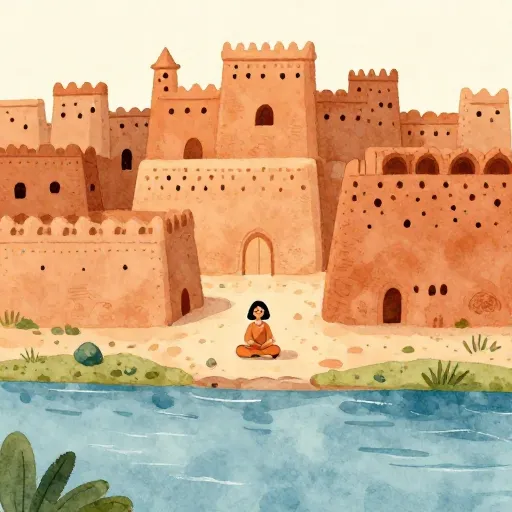
Imagine a city made of mud bricks called Mohenjo-Daro. There are no cars, only the sound of wooden wheels on dirt. In the center of the city, a person sits perfectly still in a cross-legged position while everyone else rushes by to the market. Archaeologists found tiny stone seals showing people in this exact pose from 4,500 years ago!
These early thinkers lived in a world where the boundary between the wild forest and the growing cities was thin. They watched how the wind moved through the trees and how the seasons changed, and they realized that their own inner worlds were just as complex and wild.
They developed a system called Yoga Philosophy, which comes from the Sanskrit word 'yuj,' meaning to join or to yoke. The idea was to link the body and the mind together so they wouldn't pull in different directions like two stubborn oxen.
The Ancient Roots
To understand Yoga, we first have to look at an even older school of thought called Samkhya. This philosophy taught that the universe is made of two main things: the stuff we can touch and see, and the awareness that watches it all happen.
They called the 'stuff' Prakriti and the 'awareness' Purusha. Think of it like a movie theater: Prakriti is the movie playing on the screen with all the action and noise, while Purusha is the quiet person sitting in the dark seat, simply watching.

Finn says:
"So wait, if my thoughts are like a movie, does that mean the 'real me' is just the audience? That feels a bit lonely, but also kind of relaxing. I don't have to be the monsters in the movie anymore!"
Yoga took this idea and turned it into a practical guide. If the 'movie' of our lives is too loud or scary, how do we remember that we are actually the person sitting safely in the seat? This is where a thinker named Patanjali comes into the story.
About 1,600 years ago, Patanjali gathered all the scattered ideas about yoga and wrote them down in a collection of short, punchy sentences called the Yoga Sutras. He didn't invent yoga, but he was like the master editor who organized the manual.
Yoga is the stilling of the fluctuations of the mind.
The Spinning Mind
Patanjali's most famous definition of yoga is that it is the 'stilling of the turnings of the mind.' He used the term Chitta Vritti, which translates to 'mind-whirls.'
Think about a lake. When the water is calm, you can see all the way to the bottom, and the surface reflects the mountains perfectly. But if you throw a handful of pebbles into the water, the ripples make it impossible to see clearly.
Next time you feel overwhelmed, imagine your mind is a snow globe that someone just shook up. All the glitter is your thoughts. Instead of trying to grab the glitter, just sit still and watch it. What happens to the glitter when you stop moving the globe?
Our thoughts are those pebbles. One pebble might be 'I'm hungry,' another might be 'I'm worried about my math test,' and another might be 'That person was mean to me yesterday.'
Yoga philosophy suggests that we often mistake the ripples for the lake itself. We think we are our worries or our hunger. The goal of yoga is to let the ripples settle so we can see the clear, deep water underneath.
The Eight-Fold Path
Patanjali didn't just tell people to be still: he gave them a map. This map is called Ashtanga, which means 'eight limbs.' It is like a tree with eight branches that all need to grow for the tree to be healthy.
- Yamas and Niyamas: These are the roots, focusing on how we treat others and ourselves, like being honest and being kind.
- Asana: This is the branch most people know today: the physical poses that keep the body strong and steady.
- Pranayama: This is the study of Breath, using it as a bridge between the body and the mind.
- Pratyahara: This is the practice of turning your attention inward, like closing the curtains on a busy street.

Mira says:
"I noticed that when I'm really nervous for a dance recital, I feel like I'm floating outside my body. Maybe the breath part of yoga is like a string that ties me back down so I don't drift away."
The final three limbs involve deeper and deeper levels of concentration. They lead to a state called Samadhi, where the observer and the thing being observed feel like they have become one.
Most people today spend a lot of time on the branch of Asana (the poses). However, in the original philosophy, the only reason to do the poses was to make the body comfortable enough to sit still for a very long time without getting a leg cramp or a sore back.

For the first few thousand years of yoga history, there were no 'Yoga Studios.' Most yogis were forest-dwellers who gave up their possessions to live in caves or under trees to study the mind.
The Bridge of Breath
Why is the breath so important in this philosophy? The ancient yogis noticed something fascinating: you can't always control your thoughts, but you can usually control your breath.
If you are scared, your breath gets short and shallow. If you are relaxed, it becomes deep and slow. Yoga philosophy teaches that this works both ways. By manually slowing down your breath, you are sending a signal to your mind that it is safe to stop 'whirling.'

Yoga does not just change the way we see things, it transforms the person who sees.
This is why yoga is often called a 'science of the self.' It is an experiment you run on your own body. You don't have to believe in it like a story: you are encouraged to try it and see if the ripples in your mind actually start to settle.
Through the Ages
Yoga Through the Ages
For a long time, yoga was a secret passed down from teacher to student in the forests of India. It wasn't something you did in a gym with a colorful mat. In fact, for centuries, there were only a handful of poses, mostly sitting cross-legged.
Around the year 1400, a new style called Hatha Yoga became popular. These practitioners believed that the body was a temple that needed to be perfectly tuned. They invented many of the active poses we see today, like the 'Downward Dog' or the 'Warrior' pose.
The goal of yoga is to master the body. If you can do a handstand or a difficult stretch, you are successfully doing yoga because you have shown discipline over your muscles.
The body is just a tool to get to the mind. Even if you can't touch your toes, you are doing yoga if you are being mindful of your breath and staying present in the moment.
In the late 1800s, yoga began to travel across the oceans. A teacher named Swami Vivekananda visited Chicago and spoke to a huge crowd of people who had never heard of Indian philosophy before. He told them that every person has a 'divine light' inside them, and yoga was simply a way to let that light shine through the clouds of the mind.
Living the Philosophy
You don't have to be on a mat to 'do' yoga philosophy. According to the Bhagavad Gita, one of the most important books in Indian history, yoga is simply 'skill in action.'
This means doing whatever you are doing: washing the dishes, playing soccer, or doing homework: with your full attention. It means not letting your mind wander off to the past or the future, but staying right here in the present moment.
Yoga is skill in action.
Finn says:
"If yoga is 'skill in action,' could I be doing yoga while I'm playing my favorite video game? I'm super focused then, and I totally forget about everything else!"
When you are fully present, you aren't fighting with yourself. You aren't wishing you were somewhere else. You are like a master musician who is so focused on the music that they forget they are even playing an instrument. That 'flow' is a type of yoga.
The word 'Asana' (pose) literally means 'seat.' Originally, there was only one pose: sitting! All the hundreds of poses we have today were developed much later to help keep the body healthy for that one important seat.
The Mystery of the Self
Yoga philosophy leaves us with a very big, very interesting mystery. If we aren't our thoughts, and we aren't our changing emotions, then who are we really?
The ancient teachers didn't give a simple answer. They said that the 'True Self' is something that cannot be described with words. It can only be experienced in the silence between two thoughts.
This might sound a bit spooky or confusing, but it is also very hopeful. It means that no matter how messy or loud your life feels on the surface, there is always a part of you that is calm, quiet, and completely untouched by the chaos.
Something to Think About
If you could take one thing from your mind and 'still' it for five minutes, what would it be?
There is no right or wrong answer here. Maybe it's a song stuck in your head, a worry about school, or just the feeling of being in a hurry. What would your 'lake' look like if that one ripple disappeared?
Questions About Philosophy
Do I have to be flexible to do yoga philosophy?
Is yoga a religion?
Why do people say 'Namaste' at the end of yoga?
The Lake is Always There
The next time your mind feels like a stormy sea, remember the ancient thinkers by the river. They didn't try to stop the wind: they just learned how to be the person watching the waves. Yoga isn't about becoming someone else: it's about finally meeting the quiet person who has been sitting inside you all along.