Have you ever looked at a ladybug for so long that you forgot your own name, the time of day, and what you were supposed to be doing for lunch?
That feeling of being totally, 100 percent 'there' is at the heart of Zen Philosophy. It is a way of looking at the world that started with Buddhism but grew into its own unique path, focusing on mindfulness and the mystery of the present moment.
Imagine a monk sitting perfectly still in a cave, staring at a wall for nine years. According to legend, this was a man named Bodhidharma. He had traveled all the way from India to China about 1,500 years ago.
He didn't come to bring big books or complicated rules. He came to show people how to find enlightenment by simply looking directly at their own minds. This was the beginning of what we now call Zen.
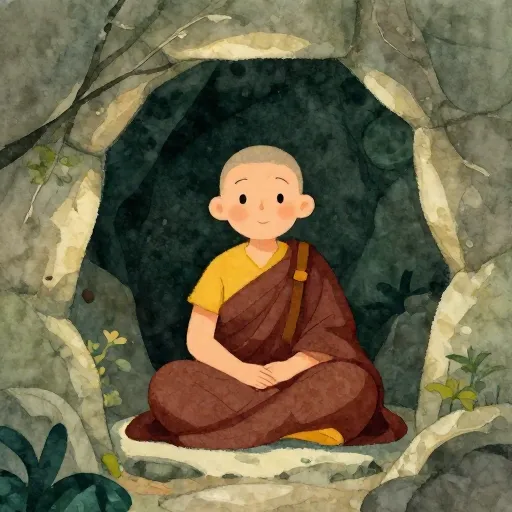
Imagine a silent, mossy forest in China 1,500 years ago. The air is damp and smells like pine. Inside a small stone cave, a man sits so still that birds might mistake him for a statue. He isn't waiting for something to happen: he is just watching the light change on the wall.
Zen is a bit of a rebel in the world of philosophy. Most philosophies use a lot of words to explain how the universe works. Zen, however, is often very quiet. It suggests that words are sometimes like a fence that keeps us from actually touching the grass.
The Finger and the Moon
There is a famous Zen story about a finger pointing at the moon. The teacher tells the student to look at the moon, but the student keeps staring at the teacher's finger. The teacher sighs because the finger is only a tool.
In Zen, words and books are the 'finger.' The 'moon' is the actual experience of living, breathing, and being alive. If you spend all your time reading about the moon, you might forget to actually look up at the night sky.

A special transmission outside the scriptures; no dependence upon words and letters.
This is why Zen can seem a bit strange at first. It uses stories and puzzles to trip up our thinking brains. It wants us to stop 'thinking about' things and start 'witnessing' them.

Finn says:
"If words are just like a finger pointing at the moon, what happens if I close my eyes? Can I still feel the moonlight without needing to see the finger at all?"
When Zen moved from India to China, it mixed with an older Chinese way of thinking called Taoism. Taoism is all about following the 'flow' of nature. Because of this, Zen became very interested in the everyday world: gardening, drinking tea, and even cleaning the floor.
The Art of Just Sitting
By the 1200s, a Japanese monk named Dogen brought these ideas to Japan. He founded a school of Zen called Soto, which focused on something called Zazen. This literally means 'just sitting.'
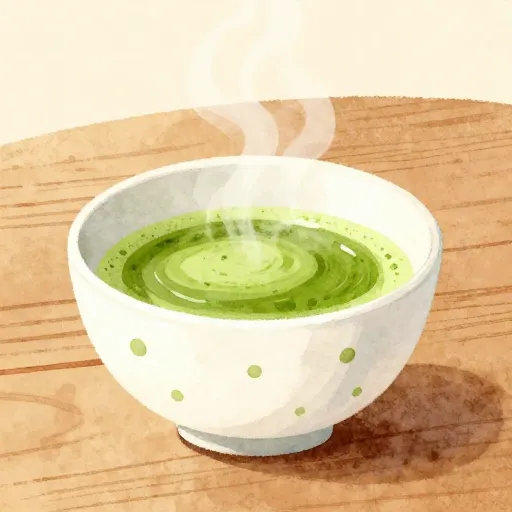
Zen monks in Japan were the ones who turned tea-drinking into an art form! They used the caffeine in green tea to help them stay awake during long hours of meditation. They realized that every step: boiling the water, whisking the tea, and holding the bowl: could be a form of Zen.
In Zazen, you don't try to think about anything special. You don't try to become a superhero or a genius. You just sit and notice your breath going in and out. Dogen believed that sitting like this was already a way of being 'awake.'
Many people think meditation is about clearing your mind so it's totally empty. Zen teachers say it's more like a clear blue sky. Clouds (which are like your thoughts) might float by, but they don't change the sky itself. You just let the clouds go without chasing them.

Mira says:
"It reminds me of how I feel when I'm really deep into a Lego project. I'm not thinking about being happy or sad, I'm just... being the person who builds."
Riddles with No Answers
While some Zen students practiced 'just sitting,' others practiced with Kōans. These are riddles or stories that don't make any sense to the logical part of your brain. A teacher might ask you: 'What is the sound of one hand clapping?'
Try the 'One Hand' riddle. Sit quietly and pretend you are going to clap, but stop before your hands touch. What does that 'almost clap' sound like? Don't look for an answer in your head. Just feel the air between your palms.
If you try to answer with a clever idea, the teacher will say no. If you try to explain the physics of sound, the teacher will say no. The goal isn't to find a 'correct' answer, but to exhaust your brain until you stop trying to solve life like a math problem.
When you finally stop trying to 'solve' the riddle, something interesting happens. You might feel a sudden spark of understanding, like a lightbulb turning on in a dark room. Zen calls this sudden flash Satori.

To study the Way is to study the self. To study the self is to forget the self.
Finding Beauty in the Broken
Zen philosophy also changed the way people looked at art and beauty. Have you ever felt bad because you dropped your favorite mug and it cracked? Or because your drawing had a smudge on it?
Zen introduces an idea called Wabi-sabi. This is the appreciation of things that are imperfect, old, or slightly broken. It says that a bowl with a crack has more 'soul' than a perfect one from a factory because the crack tells a story.
The goal of life is to improve yourself, fix your mistakes, and work hard to become perfect and successful.
The goal of life is to realize you are already enough. Even your mistakes and 'broken' parts are what make you a unique work of art.
There is even a Zen-inspired art form called Kintsugi. When a ceramic pot breaks, the artist puts it back together using gold glue. Instead of hiding the cracks, they make them shine. This reminds us that our own 'cracks' or mistakes are part of what makes us beautiful.
Finn says:
"I like the idea of Kintsugi. It means my scuffed-up knees from the playground are actually like golden repairs on my story!"
Zen Through the Ages
Zen didn't stay inside mountain temples forever. It traveled across oceans and through time, changing everything it touched. It influenced samurai warriors, who used Zen to stay calm in scary moments, and it influenced poets who wrote tiny three-line poems called haiku.
Through the Ages
In the 1950s and 60s, Zen became very popular in places like the United States and Europe. People were tired of being busy all the time. They were looking for a way to slow down. A teacher named Shunryu Suzuki helped people understand that you don't have to be a monk to have a 'Zen mind.'
The Beginner’s Mind
Suzuki talked about having a Beginner's Mind (or Shoshin). He said that in the beginner's mind, there are many possibilities, but in the expert's mind, there are few. When you are a beginner, everything is a surprise and a wonder.

In the beginner's mind there are many possibilities, but in the expert's mind there are few.
Imagine you are eating a strawberry. An 'expert' might think: 'I know what this tastes like. It has sugar and vitamin C.' But a 'beginner' tastes it as if it's the first strawberry in the history of the universe. They notice the tiny seeds, the cold juice, and the bright red color.
The next time you have to do a chore, like clearing the table or brushing your teeth, try to do it with 'Beginner's Mind.' Notice the weight of the plate, the sound of the water, or the tingle of the toothpaste as if you've never felt them before. Does the 'boring' chore feel different?
Zen isn't about learning a bunch of facts. It's about un-learning the habit of being bored. It's a reminder that the world is much bigger and more mysterious than the words we use to describe it.
Even when you are doing something 'boring' like tying your shoes or washing a dish, Zen suggests that those moments are just as important as the big, exciting ones. Because, after all, the present moment is the only place where you can actually be alive.
Something to Think About
If you stopped talking and thinking for just sixty seconds, what would the world sound like to you?
There is no 'right' way to hear the world. Some might hear the hum of a fridge, others might hear their own heartbeat, and some might hear nothing at all.
Questions About Philosophy
Is Zen a religion or a philosophy?
Do I have to sit still to do Zen?
Why are Zen stories so confusing?
The Gate With No Door
Zen is often called the 'Gateless Gate.' This means that the 'entrance' to a wiser way of living isn't hidden behind a locked door or a secret code. It is right here, in the next breath you take and the next thing you see. You don't have to go anywhere to find it: you just have to arrive where you already are.