If you want to walk to the door, you first have to walk halfway there. But before you get halfway, you have to walk a quarter of the way. And before that, an eighth.
Around 2,500 years ago, a man named Zeno of Elea used a series of thought experiments to argue that motion might be impossible. He created famous paradoxes that forced people to question the nature of infinity and the reality of the world we see every day.
Imagine you are standing on a dusty road in Southern Italy. The year is roughly 450 BCE. The sun is hot, and the air smells like salt from the nearby sea. This is Elea, a city full of merchants, sailors, and some of the world’s most stubborn thinkers.
Among them is Zeno. He is not interested in buying olives or shipping grain. He is interested in how the world works, or rather, why it might not work the way we think it does.
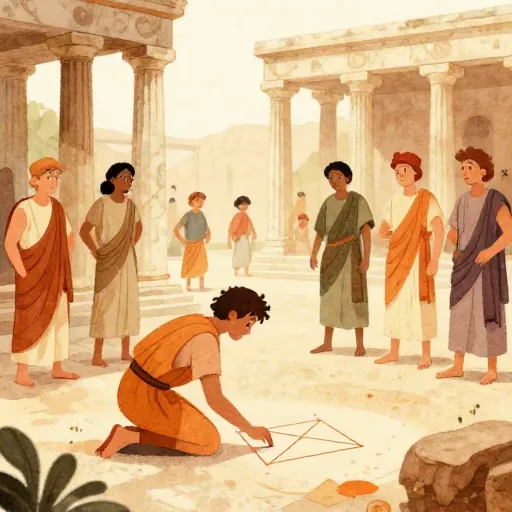
Imagine a marketplace in Ancient Greece. Philosophers in white robes are gathered under a marble porch. While everyone else is arguing about the price of fish, Zeno is drawing lines in the dirt, trying to prove that nobody is actually moving at all.
Zeno was a student of a philosopher named Parmenides. Parmenides had a strange idea. He believed that the universe was one single, unchanging thing. He thought that change and movement were just tricks our eyes play on us.
Zeno decided to help his teacher. He did not use tools or microscopes. He used the power of pure logic to create puzzles that seemed impossible to solve.
The Runner Who Never Starts
Let’s look at Zeno’s first puzzle. It is called the Dichotomy Paradox. Imagine a runner named Achilles. He is the fastest man in Greece. He wants to run from his starting line to a tree 100 meters away.

Mira says:
"This is like when I try to finish a chocolate bar by only eating half of what is left. I keep having a tiny piece, then a tinier piece, then a crumb. Does the bar ever actually disappear?"
Before Achilles can reach the tree, he must first reach the halfway point. That is 50 meters. That sounds easy enough for a champion runner.
But wait. Before he can reach the 50-meter mark, he must reach the halfway point of that distance. That is 25 meters. And before he reaches 25 meters, he must reach 12.5 meters.
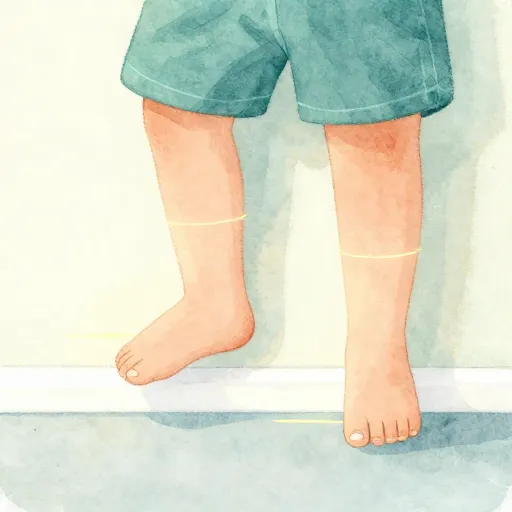
Try to walk toward a wall. Take a step that covers half the distance. Now take another step that covers half of what's left. Do it again. Will you ever actually touch the wall if you only ever move halfway toward it?
Every time Achilles tries to move, Zeno points out a smaller distance he has to cover first. There is always a halfway point. You can divide any distance in half, and then half again, forever.
If there are an infinite number of halfway points to cross, how can Achilles ever take his first step? To Zeno, it seemed that the runner would be stuck at the starting line forever, trapped by the math of his own journey.
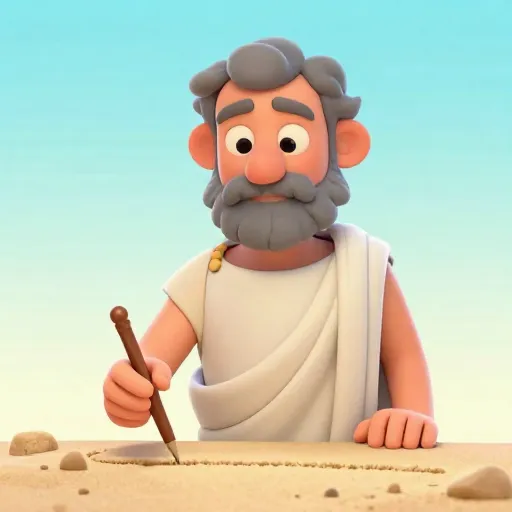
That which is in locomotion must arrive at the half-way stage before it arrives at the goal.
This is the heart of a paradox. A paradox is a statement that seems to lead to a logical contradiction. It feels like it should be true, but it also feels like it must be false.
Achilles and the Tortoise
Zeno’s most famous story is about a race. He imagined Achilles racing a slow, steady tortoise. Because Achilles is so much faster, he gives the tortoise a head start of 100 meters.
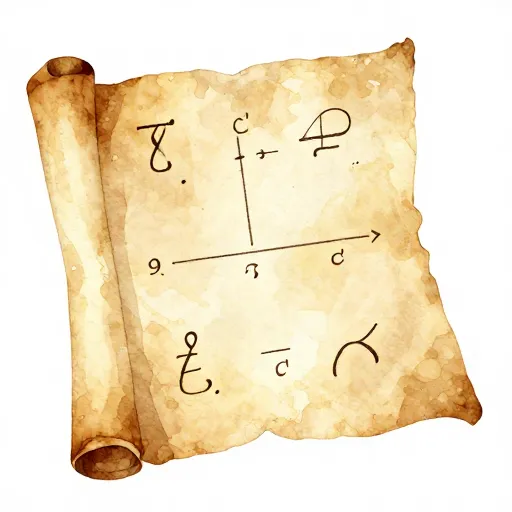
Zeno wrote over 40 different paradoxes, but most of them were lost over time. We only know about his most famous ones because other writers like Aristotle and Plato thought they were so annoying and brilliant that they had to write them down to argue with them!
The race begins. Achilles runs toward the spot where the tortoise started. But by the time he gets there, the tortoise has moved a little bit further ahead, perhaps just one meter.
Achilles runs to that new spot. But in the time it takes him to get there, the tortoise has moved again, maybe just a few centimeters. Achilles keeps running to where the tortoise just was, but the tortoise is always a tiny bit further ahead.
Finn says:
"Wait, if the gap is always getting smaller but never reaches zero, does that mean the tortoise is safe? It feels like there is a magical shield made of math protecting him!"
No matter how fast Achilles runs, he must always reach the point where the tortoise was. In that tiny slice of time, the tortoise will always have moved at least a microscopic distance forward.
According to Zeno’s logic, Achilles can get closer and closer, but he can never actually pass the tortoise. The gap between them can be divided into smaller and smaller pieces, but it never fully disappears.

The slower will never be overtaken by the quicker.
This feels wrong to us. We know that in the real world, a fast runner would zoom past a tortoise in seconds. So, where is the mistake? Is it in Zeno’s math, or is it in how we see the world?
The Frozen Arrow
Zeno had another puzzle called the Arrow Paradox. This one is even stranger. Imagine an arrow flying through the air. If you could take a photo of it at any single moment, what would you see?
In that one tiny instant, the arrow is in a specific place. It is not moving into the space it already occupied, and it is not yet in the space it is going to. For that one split second, the arrow is still.
Space is continuous. It is like a smooth slide. You can divide it into smaller and smaller pieces forever, but it is all one solid thing.
Space is discrete. It is like a Lego set. If you zoom in far enough, there is a smallest possible 'brick' of space that cannot be divided any further.
If time is made up of a bunch of tiny moments, and the arrow is still in every one of those moments, then when does it actually move? Zeno argued that the arrow is actually stationary at every point in its flight.
This challenges our idea of time. We think of time as a flowing river. But Zeno suggests it might be more like a movie reel, made of thousands of still pictures. If every picture is still, where does the motion come from?
Mira says:
"Maybe time isn't a line at all. Maybe it is like a flipbook. If I flip the pages fast enough, the drawing moves. But if I stop, it is just a bunch of drawings that are stuck."
Through the Ages
For centuries, people tried to beat Zeno. They knew they could walk across a room, but they could not explain why Zeno’s math said they could not. It took hundreds of years and new types of math to find an answer.
Through the Ages
Philosophers like Aristotle argued that Zeno was confusing two types of infinity. There is the infinity of the mind, and the infinity of the real world. In our heads, we can divide a meter forever. But in the real world, maybe space is not made of infinite points.
Later, mathematicians created calculus. This is a way of math that deals with things that get smaller and smaller. They showed that if you add up an infinite number of smaller and smaller pieces, you can actually get a finite, finished number.
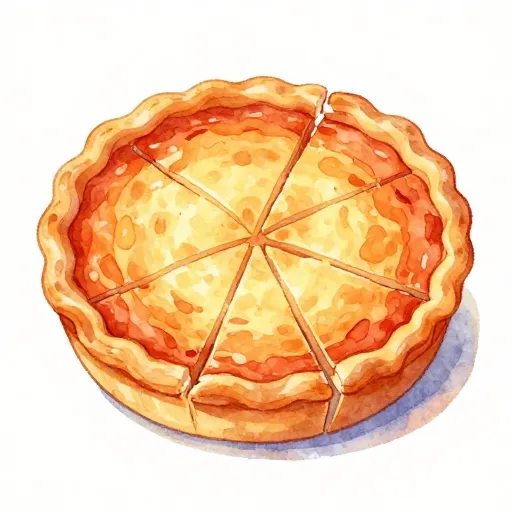
In math, if you add 1/2 + 1/4 + 1/8 + 1/16... and keep going forever, the total will never go above 1. It 'converges' exactly at 1. This is how modern math explains why Achilles can finally reach the tree!
Even with calculus, Zeno’s ideas still haunt us. Scientists today study quantum mechanics, which looks at the smallest possible parts of the universe. They still wonder: Is space a smooth slide, or is it made of tiny, jumpy blocks?
Zeno’s puzzles are not just about math. They are about how we trust our senses. He reminds us that the world might be far more mysterious than it looks when we are just walking down the street.
What the Tortoise said to Achilles is a mystery that never ends.
Zeno did not want to stop people from moving. He wanted them to stop and think. He wanted us to realize that even a simple walk across a garden is a miracle of logic and physics that we are still trying to fully understand.
Something to Think About
If you could freeze a single moment in time perfectly, would the world still be the same world, or would it be something else entirely?
There is no right answer to this. Think about what makes 'now' feel like 'now.' Is it because things are moving, or is 'now' just a single picture in your mind?
Questions About Philosophy
Did Zeno actually believe we couldn't move?
Is Zeno's paradox solved now?
Why is it called a 'paradox'?
The Wonder of the Small
Zeno's paradoxes invite us to look closer at the world than we ever have before. They show us that even a simple race or a flying arrow contains a mystery as big as the universe itself. The next time you take a step, remember: you are crossing an infinite number of points just to get to the other side of the room. And somehow, you do it every single day.
