
Have you ever wondered why you feel grumpy when you are hungry, or why it is hard to focus on a book when you feel lonely?
In the middle of the 20th century, a thinker named Abraham Maslow began to wonder about these same things, leading him to develop a theory of motivation. He wanted to understand the human potential and what makes people truly flourish, rather than just focusing on what makes them unhappy.
Imagine you are in Brooklyn, New York, in the early 1900s. The streets are loud with the sounds of horse-drawn wagons and the shouts of children playing.
Inside a quiet library, a young boy named Abe spends his days surrounded by books. He is the son of immigrants, and he feels a bit like an outsider, but the library is his sanctuary.
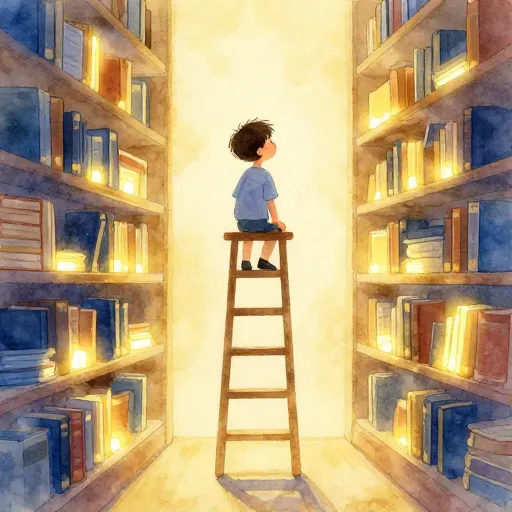
Imagine a giant library with ladders reaching all the way to the ceiling. Young Abe Maslow didn't have many friends, so he treated books like his best friends. He read everything he could find, trying to solve the mystery of why people act the way they do.
Abe grew up to be a psychologist, but he was different from the others of his time. Back then, most psychologists were interested in what was "wrong" with people or how to train them like laboratory animals.
Abe wanted to look at the people who were doing well: the explorers, the creators, and the kindest people he knew. He believed that every human being has a built-in drive to be the best version of themselves, a concept he called self-actualization.

Finn says:
"If everyone has a 'best version' of themselves inside, does that mean we're all like seeds waiting for the right soil to grow into trees?"
The Discovery of Needs
Maslow noticed that humans have certain requirements that must be met before they can focus on anything else. He called these our "needs," and he realized they seem to follow a specific order.
Think about it this way: if you were trying to build a beautiful sandcastle while a huge wave was about to crash over you, you wouldn't care about the castle's towers. You would care about getting to safety first.
What a man can be, he must be.
This idea became known as the Hierarchy of Needs. It is often shown as a pyramid, with the most basic survival needs at the bottom and the most complex psychological needs at the top.
Maslow believed that we are constantly moving up and down this ladder. When our bellies are full and we feel safe, our minds naturally start looking for friends and ways to learn new things.
Think about your morning today. Did you have a good breakfast? Did you sleep well? Notice how those 'bottom level' needs changed how you felt when you started your schoolwork or talked to your friends. If you feel 'off,' check your levels!
The Bottom of the Pyramid
The very first level is all about your body. These are physiological needs, like breathing, water, food, and sleep.
If you don't have these things, your brain won't let you think about much else. It is like a computer running low on battery: it starts shutting down programs to save power for the most important tasks.

Mira says:
"I noticed that when I'm really tired, I can't even decide which game I want to play. It's like my brain just wants to rest before it can do the fun stuff."
Once your body is taken care of, you move to the next level: security. This is not just about being safe from physical danger, but also feeling that the world is predictable and stable.
Kids often find security in routines, like knowing that dinner is at six o'clock or that a parent will be there to pick them up from school. When the world feels messy and unpredictable, it creates insecurity, which makes it hard to grow.
Finding Your Tribe
The third level is where things get social. Maslow called this "love and belongingness."
Humans are social animals, and we have a deep need to feel connected to others. This might mean having a best friend, being part of a sports team, or simply feeling like you belong in your family.
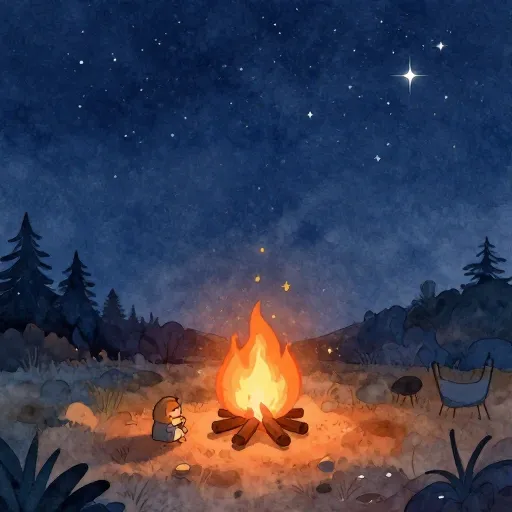
Maslow spent time living with the Siksika (Blackfoot) people in Canada. He was amazed by how they treated each other with such respect and how every person felt they belonged. This experience helped him realize that 'belonging' was a huge part of being human.
When we feel lonely or left out, it actually hurts. Our brains process being ignored in the same way they process a physical scrape on the knee, because belonging was once essential for survival in the wild.
Once we feel like we belong, we start to care about our esteem. This is the fourth level of the ladder, and it has two parts: how we see ourselves and how others see us.

If the only tool you have is a hammer, you tend to see every problem as a nail.
The View from the Top
At the very top of the ladder is self-actualization. This is the most mysterious and exciting part of Maslow's big idea.
It is the moment when you are doing exactly what you were meant to do. For some, it might be painting a masterpiece; for others, it might be solving a math problem or being a very kind friend.
Mira says:
"I think self-actualization sounds like being 'in the zone.' Like when you're drawing and the rest of the room just disappears."
Maslow also talked about peak experiences. These are moments of pure joy and wonder where you lose track of time and feel completely connected to the world around you.
Have you ever been so busy playing a game or reading a book that you didn't hear someone calling your name? That is a little bit like a peak experience.
Some people think you must follow the steps exactly: you can't be creative if you are hungry or worried about your house.
Others point out that many great artists and thinkers created their best work while they were poor or living through difficult times.
The Myth of the Pyramid
Here is a secret that many adults don't even know: Maslow never actually drew a pyramid in his famous paper!
He talked about these needs as being like a set of waves that overlap each other. You don't have to perfectly finish one level before you start feeling the needs of the next one.
Through the Ages: The Idea of Human Potential
Modern psychologists sometimes think of these needs more like a homeostasis system. This is a fancy word for a "balancing act," like a thermostat that keeps a room at just the right temperature.
Your mind is always checking: Am I hungry? Am I lonely? Am I proud of myself? It is a constant conversation between your body and your brain.

The story of the human race is the story of men and women selling themselves short.
Why This Matters Today
Maslow’s ideas changed how we think about schools, jobs, and even how parents talk to their children. Instead of just asking "Are you behaving?" people started asking "Are your needs being met?"
If a student is struggling in class, a Maslow-inspired teacher might ask if they had breakfast or if they feel safe at their desk before assuming the student just isn't trying hard enough.

The famous triangle diagram we see today was actually created by business consultants in the 1960s to help companies manage their workers. Maslow himself preferred to think of needs as a moving, fluid process.
It helps us be more compassionate. When we see someone acting mean or grumpy, we can wonder if they are simply stuck at a lower level of the ladder for a moment.
Maybe they are tired, or maybe they feel like they don't belong. Understanding these needs helps us look past the behavior to the person underneath.
Something to Think About
If you could add one more level to the very top of the ladder, what would it be?
There is no right or wrong answer. Maslow himself kept thinking about this until the end of his life, even adding a level called 'Transcendence' where you help others find their own potential.
Questions About Psychology
Does everyone have the same needs?
Can you be 'self-actualized' as a kid?
What happens if a need isn't met?
The Ladder is Yours to Climb
Abraham Maslow didn't give us a map with a single 'X' marks the spot. Instead, he gave us a way to check in with ourselves. Next time you feel frustrated or stuck, take a look at your own ladder. You might find that you just need a little bit of safety, a little more belonging, or a quiet moment to listen to the person you are becoming.