
Right now, as you read these words, there is a 'you' inside your head experiencing them.
This inner experience, the feeling of being alive and aware of the world, is what we call consciousness. It is one of the biggest mysteries in history, connecting the fields of philosophy, psychology, and neuroscience.
Imagine waking up on a cold morning in the year 1619. You are in a small room in Germany, and the only heat comes from a large porcelain stove.
Inside that room, a young soldier and mathematician named René Descartes is thinking. He isn't thinking about the war outside or what he will have for breakfast.
Close your eyes for ten seconds. Don't try to think of anything. Just notice the sounds around you, the weight of your body, and the 'darkness' behind your eyelids. That 'noticing' is you being conscious of your surroundings.
He is asking himself a very strange question: how do I know that anything is real? He realizes that his eyes could be tricked and his dreams could feel like real life.
But then he realizes something important. Even if everything he sees is a trick, there is still a 'him' there to be tricked.

Finn says:
"If I can't be sure my eyes are telling the truth, then maybe I'm actually a person from the future just playing a very realistic video game right now!"
Descartes decided that the most certain thing in the universe was his own mind. He called this the psyche, a word from Ancient Greece that originally meant 'breath' or 'soul'.
Today, we use the word consciousness to describe this 'light' inside us that turns on when we wake up. It is the reason you don't just act like a robot, but actually feel things.

I think, therefore I am.
When you bite into a sour lemon, your brain processes the chemical signals from your tongue. But there is also a 'feeling' of sourness that is hard to explain to a computer.
Philosophers have a special word for these private, personal feelings: qualia. Qualia are the 'what it is like' parts of being you, such as the redness of a rose or the itch of a sweater.

Imagine you are eating a strawberry. Your brain records the sweetness and the texture. But now imagine trying to describe that 'red' flavor to someone who has never tasted anything. That secret, unexplainable 'flavor' in your mind is what philosophers call qualia.
For a long time, people thought the mind and the body were two completely different things. This idea is called dualism, and it suggests that the mind is like a pilot and the body is like the airplane.
However, as we learned more about the brain, things got more complicated. We found that if a specific part of the brain is hurt, a person's personality or memories can change completely.

Mira says:
"It's like the brain is the sheet music and the mind is the actual song. You need the paper and the ink, but the music is something more than just the marks."
This led to a different idea called materialism. This is the belief that consciousness is something the brain creates, just like the stomach creates digestion or a fire creates heat.
Scientists began to study neuroscience, which is the map of how the brain's billions of cells, called neurons, talk to each other. They wanted to find the exact spot where the 'me' lives.
The mind and brain are two separate things. The mind is a 'soul' or spirit that uses the brain like a tool.
The mind is just what the brain does. When the brain stops working, the consciousness disappears, like a candle flame going out.
But even with the most powerful microscopes, we can't see a 'thought' or a 'feeling.' We only see electricity and chemicals moving around.
This gap between the physical brain and our inner feelings is famous. Some people call it the bridge that no one has finished building yet.

Consciousness... does not appear to itself chopped up in bits. It is nothing jointed: it flows.
In the late 1800s, a thinker named William James described consciousness as a river. He said our thoughts don't come in separate boxes, but flow together in a constant awareness.
He noticed that we can't really stop being conscious while we are awake. Even if you try to think of nothing, your mind will eventually wander to a sound, a memory, or a physical feeling.
A History of Thinking About Thinking
If consciousness is just something brains do, then what about other living things? This brings up the idea of sentience, which is the ability to feel and perceive the world.
We are fairly sure that dogs and cats are conscious because they show feelings like joy or fear. But what about a honeybee, or an octopus, or a tree?
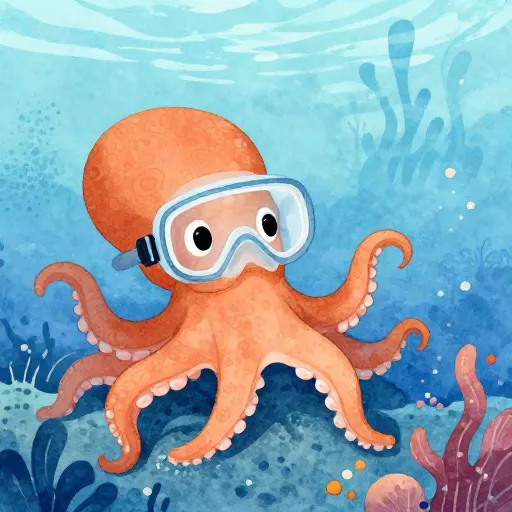
Octopuses are so smart and aware that they have been known to recognize human faces and even play pranks by squirting water at lights to turn them off!
An octopus has a very different kind of brain than a human. In fact, most of its neurons are in its arms, meaning its arms might 'think' for themselves.
If an octopus is conscious, its 'inner world' must be very different from ours. It might be like having eight different personalities all working together at once.

Why should physical processing give rise to a rich inner life at all?
In 1994, a philosopher named David Chalmers made a distinction that changed how we talk about this. He said there are 'easy problems' and one 'hard problem' of consciousness.
The 'easy' problems are things like how the brain remembers a phone number or how it moves your hand. These are hard to figure out, but we know they are about biology.
Finn says:
"I wonder if my dog's 'hard problem' is just wondering why I take so long to get his leash. Does he feel 'yellow' the same way I do?"
The 'hard problem' is why any of that physical stuff results in a feeling. Why doesn't the brain just do its job in the dark, without you having to 'be' there to watch it?
Some people think that consciousness might be everywhere, like gravity or light. This is an old idea called panpsychism, which suggests that everything has a tiny bit of 'mind' in it.
Imagine a robot that looks and acts exactly like a human. It can cry, laugh, and tell stories. If it tells you it feels sad, how would you know if it is actually 'feeling' sadness inside, or if it is just a very good computer program following rules?
Today, we are also asking if machines can be conscious. If we build a computer that is just as complex as a human brain, will it eventually 'wake up' and have feelings?
Some computer scientists think consciousness is just a type of data processing. Others think you need a living, breathing body to truly experience the world.
There is no final answer yet, and that is what makes it so interesting. We are all explorers of our own inner space, every single day.
Something to Think About
If you could trade minds with your best friend for one hour, do you think the world would look and feel exactly the same, or would their 'inner theater' be totally different from yours?
There is no way to prove this yet, so any possibility you imagine is a valid part of the mystery.
Questions About Psychology
Where is consciousness located in the brain?
Are we conscious when we are asleep?
Can animals talk to us about their consciousness?
The Never-Ending Story
Consciousness is the one mystery that we carry with us every second of our lives. Whether you are a scientist looking at neurons or a philosopher wondering about the soul, you are using your consciousness to study itself. It is the most personal thing you own, yet it is the thing we understand the least. Maybe the most important part isn't finding the answer, but simply noticing how amazing it is to be 'you'.