
Have you ever watched a movie where a character gets a paper cut, and for a split second, you actually felt a tiny sting in your own finger?
That strange, invisible connection is what we call empathy. It is a bridge built of perspective-taking and shared feelings that allows us to understand what it is like to be another person.
Imagine you are standing in a quiet art gallery in Germany in the year 1873. You are looking at a painting of a deep, dark forest.
As you stare at the tall, sturdy oaks, you might notice something odd happening. Your own back starts to feel a little straighter: almost as if you are trying to stand as tall as the trees in the picture.

Imagine you are looking at a photo of someone eating a sour lemon. Your mouth might start to water, and you might even squint your eyes. You aren't eating the lemon, but your body is 'feeling-into' the photo anyway!
A young philosopher named Robert Vischer noticed this exact feeling. He realized that humans don't just 'look' at things.
We actually 'feel ourselves into' them. He called this experience Einfühlung, which is a German word that literally means 'feeling-into.'

Finn says:
"So if I 'feel-into' a giant boulder, does my brain think I'm actually made of stone for a second? That's kind of awesome."
At first, people only used this word to talk about art and nature. They used it to describe why we feel sad when we see a drooping willow tree, or why we feel powerful when we look at a jagged mountain peak.
It took another thirty years before scientists realized that this 'feeling-into' didn't just happen with paintings. It happened between people, too.
The Invention of a Word
In 1909, a psychologist named Edward Titchener decided that English needed its own version of that German word. He took the Greek words 'en' (meaning 'in') and 'pathos' (meaning 'feeling') and mashed them together.
He came up with the word empathy. Before this, most people used the word sympathy instead.
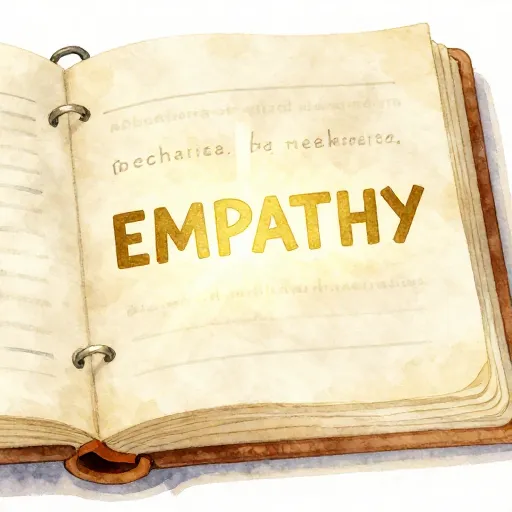
The word 'empathy' is only about 115 years old! Before that, humans had the feeling, but they didn't have this specific word to describe the 'bridge' between two people's minds.
While they sound similar, they are actually very different. Sympathy is like seeing someone in a deep, dark hole and saying, 'I am so sorry you are down there: that looks cold.'
Empathy is different. Empathy is climbing down into the hole, sitting next to the person, and saying, 'I know what it's like down here, and you are not alone.'

As we have no immediate experience of what other men feel, we can form no idea of the manner in which they are affected, but by conceiving what we ourselves should feel in the like situation.
The Secret Mirrors in Your Brain
For a long time, philosophers thought empathy was just a nice idea or a choice we made. But in the 1990s, a group of scientists in Italy discovered something that changed everything.
They were studying the brains of macaque monkeys. One day, a scientist walked into the lab holding an ice cream cone.
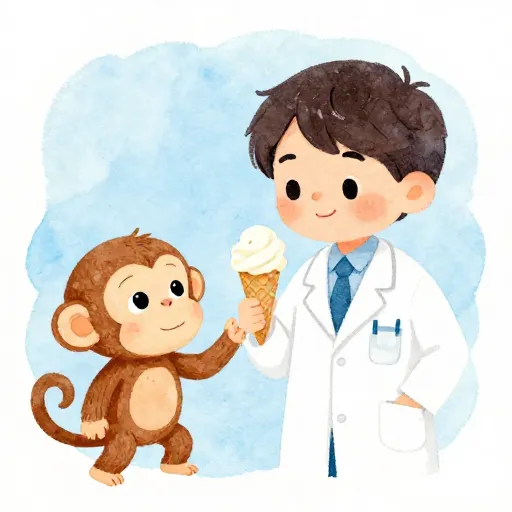
Mirror neurons were discovered by accident! Scientists were actually trying to study how monkeys move their hands, not how they feel. A stray ice cream cone in the lab changed the history of psychology forever.
As the monkey watched the scientist lift the ice cream to his mouth, something amazing happened. The monkey's brain buzzed in the exact same place it would buzz if the monkey were eating the ice cream himself!
These are called mirror neurons. They are special cells in your brain that fire both when you do something and when you see someone else doing that same thing.

Mira says:
"It's like our brains are all connected by invisible Wi-Fi signals that send 'feelings' back and forth without us even trying."
Because of these neurons, your brain is constantly 'simulating' the world around you. When you see a friend trip and fall, your brain runs a tiny 'fall down' program.
This is the biological foundation of empathy. It means your body is designed to understand other people's experiences from the inside out.
Two Ways to Step into Shoes
Psychologists generally agree that there are two main ways we experience this. The first is called affective empathy, which is the emotional part.
This is when you feel someone else's pain or joy in your own body. If your best friend is crying, you might feel a heavy lump in your own throat.
Next time you watch a movie, pick a character who isn't the lead. Try to imagine: What are they feeling right now? What are they worried about? Is their 'inside' world different from what they are showing on the 'outside'?
The second type is called cognitive empathy. This is the thinking part, where you use your brain to imagine what someone else might be thinking.
It is often called theory of mind. It allows you to realize that even if you like broccoli, your friend might really hate it: and you can understand why they are making a face.

To be with another in this [empathic] way means that for the time being, you lay aside your own views and values in order to enter another's world without prejudice.
The Choice of Care
Some thinkers, like Carol Gilligan, believe that empathy is more than just a feeling. She argues that empathy is the root of how we decide what is 'right' and 'wrong.'
In her view, being a good person isn't just about following a list of cold, hard rules. It is about staying connected to how our actions affect other people's lives.
Finn says:
"What if two people have totally different stories about the same thing? How do you empathize with both of them at once?"
This is sometimes called the Ethics of Care. It suggests that we have a responsibility to listen and understand each person's unique story before we judge them.
It is about realizing that every person you meet is the 'main character' of their own complicated life. When we use empathy, we are acknowledging that their story is just as real as ours.
Can You Have Too Much Empathy?
While empathy is a wonderful tool, it can also be very heavy. Sometimes, if we feel everyone's sadness all the time, we can get what scientists call empathy fatigue.
This is when your 'feeling-into' bucket gets too full. You might start to feel overwhelmed or even grumpy because you have taken on too much of the world's weight.
Some people think we should do what is right because of logical rules that apply to everyone, no matter how we feel.
Others think we should do what is right because we feel a connection to the person and want to protect their well-being.
This is why self-awareness is so important. To be truly empathic, you have to know where 'you' end and 'the other person' begins.
Think of it like being a lifeguard. You can't help someone who is struggling in the water if you fall in and start struggling yourself!
Empathy Through the Ages
The Goal of Compassion
Many people believe that the ultimate goal of empathy is to turn it into compassion. While empathy is 'feeling with' someone, compassion is the 'desire to help.'
Empathy helps us see the problem, but compassion gives us the energy to do something about it. It is the difference between feeling someone's cold hands and actually giving them your mittens.

The moral person is one who helps others... meeting one's obligations and responsibilities to others, if possible without sacrificing oneself.
In the end, empathy is a bit like a muscle. The more you practice 'feeling-into' different stories, people, and even animals, the stronger your connection to the world becomes.
It doesn't mean you will always agree with everyone. But it does mean you will always be curious about what it's like to be them.
Something to Think About
If you could 'feel-into' any animal or object for one hour, what would it be?
There are no right or wrong answers here. This is just an exercise for your 'feeling-into' imagination. Would you choose a soaring eagle, a deep-sea whale, or maybe an old, wise tree?
Questions About Psychology
Can you be born without empathy?
Is empathy the same as being nice?
Do animals have empathy?
The Infinite Bridge
Empathy is the closest thing we have to a telepathic superpower. It allows us to step out of our own small world and visit the vast, colorful worlds inside everyone else. Keep exploring, keep listening, and keep building those bridges.