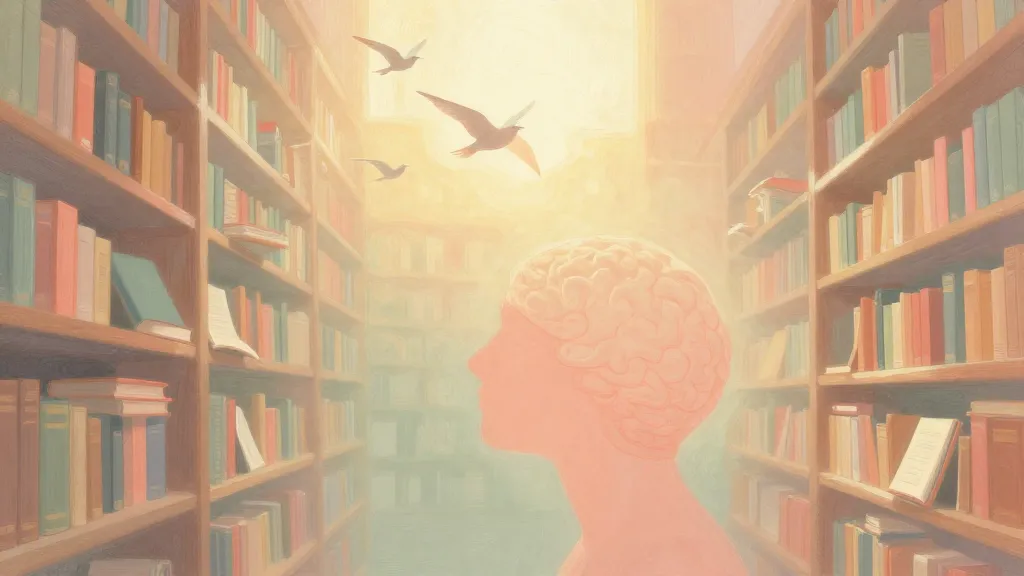
Have you ever wondered why you can remember the lyrics to your favorite song perfectly, but you can't remember where you left your shoes five minutes ago?
Memory is one of the greatest mysteries of the human brain. It is the process of encoding, keeping, and finding information that shapes everything from your earliest childhood dreams to the way you learn math today.
Imagine you are standing in a grand marble hall in Ancient Greece. The year is roughly 500 BCE, and a poet named Simonides of Ceos has just stepped outside a crowded banquet hall. Suddenly, the roof collapses: a disaster that leaves the guests unrecognizable.
Simonides discovered something incredible. He found that by closing his eyes and visualizing the room, he could remember exactly where every person had been sitting. This allowed him to identify everyone there. This was the birth of the Memory Palace, a technique people still use today to remember huge amounts of information.
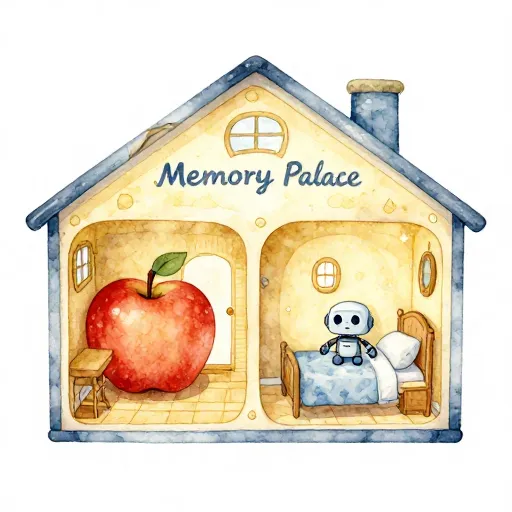
Imagine a giant house in your mind. Every room is filled with strange objects that help you remember something. To remember a list of words like 'Apple, Robot, Umbrella,' you might imagine an apple sitting on your front door, a robot sleeping in your bed, and an umbrella hanging from your shower. To remember the list, you just have to walk through your imaginary house!
This story tells us something vital about how our minds work. Memory is not just a random collection of facts. It is deeply tied to the places we go, the things we see, and the stories we tell ourselves. To understand memory, we have to look at it as a journey through time and space.
Finn says:
"If Simonides could remember the whole room just by closing his eyes, does that mean I could build a Memory Palace for my history homework? I'd put the French Revolution in the kitchen and the Vikings in the bathtub!"
The Three Stages of a Memory
Think of your memory like a very busy post office. For a package to reach its destination, it has to go through a specific process. If any step fails, the package: or the memory: is lost.
First comes Encoding. This is when your brain takes in information from the world through your eyes, ears, and nose. Your brain translates these sights and sounds into a special chemical language that it can understand and store for later.
Memory is the scribe of the soul.
After a memory is encoded, it moves into Storage. This is where the brain decides how long to keep the information. Some things are kept for only a few seconds, while others are tucked away for decades. The brain is very picky about what it decides to save.
Finally, there is Retrieval. This is the act of reaching into the "mental attic" and pulling the memory back out into the light. Sometimes it is easy, like remembering your own name. Other times, it feels like searching for a tiny needle in a very large haystack.
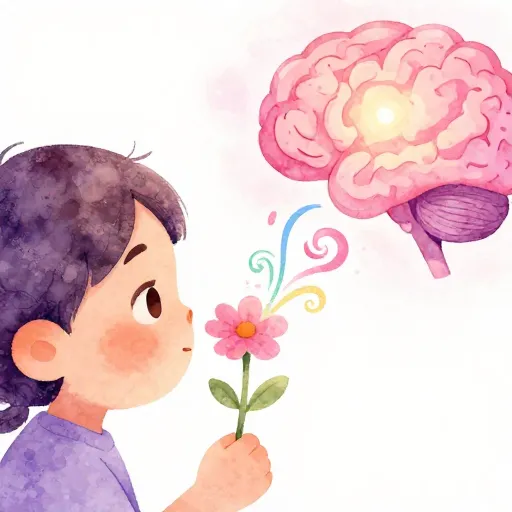
Smell is the only sense that bypasses the brain's main 'sorting station' and goes straight to the areas involved in memory and emotion. This is why the smell of a certain cookie or a specific rain-drenched sidewalk can suddenly blast you back to a memory from years ago!
The Brain's Seahorse
If we could peek inside your head, we wouldn't find a filing cabinet or a computer hard drive. Instead, we would find a complex web of Neurons, which are tiny nerve cells that talk to each other. When you learn something new, these cells reach out and touch each other at points called Synapses.
In the center of this web is a small, curved structure called the Hippocampus. It is named after the Greek word for seahorse because of its unusual shape. This is the part of your brain that acts like a librarian, helping to sort through new experiences and decide where they should go.
Mira says:
"It's strange to think that my 'seahorse' is working right now to save the sound of my mom's voice or the smell of breakfast. It's like a tiny librarian who never sleeps, constantly filing away my life into invisible folders."
Without your hippocampus, you would be stuck in the "now" forever. You would be able to have a conversation, but as soon as you walked out of the room, you would forget it ever happened. It is the bridge that connects your present self to your past self.
Every time you recall a memory, you are actually strengthening the physical path between those neurons. This is a concept called Neuroplasticity. It means your brain is literally changing its shape based on what you choose to remember and practice.
Can you beat the 'Rule of Seven'? Ask a friend to say seven random numbers. Try to repeat them back in order. Now try eight. Then nine. Notice how your brain starts to feel 'full' once you pass seven. That is the limit of your Working Memory workbench!
The Workbench and the Forest
Psychologists often divide memory into different "rooms." The first room is Sensory Memory, which lasts only a fraction of a second. It is the lingering glow of a sparkler or the echo of a loud noise that stays in your ears for just a moment.
If you pay Attention to that sensory information, it moves into your Working Memory. Think of this as a mental workbench. It is where you hold information while you are using it, like remembering the numbers of a math problem while you are solving it.
Left to itself, every mental content gradually loses its capacity to be revived.
Working memory is famously small. Most humans can only hold about seven items in their working memory at once. If you try to add an eighth item, one of the others usually falls off the workbench and disappears forever. This is why it is so hard to remember a long shopping list without writing it down.
If a memory is important enough, it travels to Long-Term Memory. This is like a vast forest where memories can live for a lifetime. To get there, the memory must go through a process called Consolidation, which often happens while you are fast asleep.
Some people used to think memory was like a perfect recording. If you could just find the right 'tape,' you could watch your 3rd birthday exactly as it happened, without any mistakes.
Most scientists now believe memory is like a sketch. Every time we remember, we redraw the lines. We might change the colors or the details based on how we feel today.
Why Do We Forget?
It might seem like forgetting is a mistake, but scientists believe it is actually a vital feature of the human mind. Imagine if you remembered every single leaf you saw on every tree during a walk. Your brain would be so cluttered with useless facts that you wouldn't be able to find the important stuff.
Forgetting is the brain's way of cleaning house. It helps us focus on what matters most. Hermann Ebbinghaus, a scientist who studied his own memory, discovered the "Forgetting Curve." He found that we forget most new information very quickly, usually within the first 24 hours, unless we make an effort to review it.
Mira says:
"Maybe forgetting isn't losing something. Maybe it's just making room for something new to grow. If I remembered every time I tripped over a rug, I'd be too afraid to ever walk again!"
Memory is also not a perfect recording like a video. Instead, it is more like a Lego set that you rebuild every time you think about it. Every time you pull a memory out of storage, your brain might change a few pieces, add a new color, or leave a part behind. This is why two people can remember the same event in very different ways.
Memory is not a reproduction, but a reconstruction.
This "rebuilding" process is what makes us human. It allows us to learn from our mistakes and imagine the future. Our memories are not just about the past: they are the tools we use to build the person we want to become tomorrow.
Through the Ages: Mapping the Mind
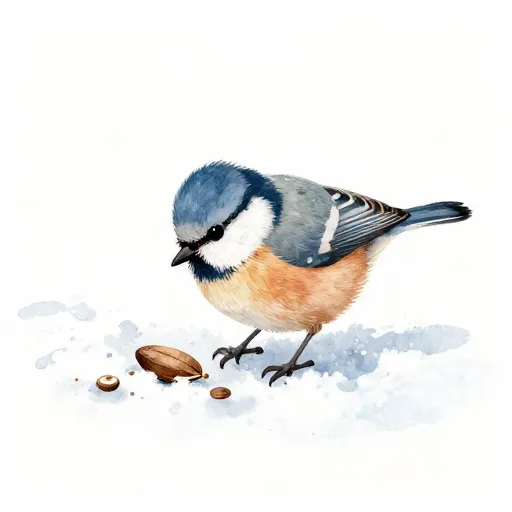
A Clark's Nutcracker (a type of bird) can hide up to 30,000 seeds in thousands of different locations across miles of forest, and it remembers exactly where almost all of them are months later! Compared to them, humans are actually quite forgetful.
Something to Think About
If you could choose one memory to keep forever, even if you forgot everything else, what would it be?
There is no right or wrong answer. Some people choose a big event, like a holiday, while others choose a tiny moment, like the feeling of a warm blanket. Your memory is uniquely yours.
Questions About Psychology
Why do I forget why I walked into a room?
Can I actually run out of space in my brain?
Does sleep really help my memory?
A Living Library
Memory is not just a record of what happened to you. It is a creative, living part of your mind that helps you understand the world. By learning how it works, you can start to treat your memory with more kindness: knowing when to trust it, when to help it, and when to let things go.