
Have you ever felt like there were three different people inside your head all arguing about what to do with a giant chocolate cake?
This inner tug-of-war is exactly what a doctor named Sigmund Freud/sigmund-freud-for-kids/) wanted to understand when he created the first modern map of psychology. He believed our minds are split into three parts: the Id, the Ego, and the Superego, each with its own job to do.
Imagine you are walking down a street in Vienna, Austria, about a hundred years ago. The year is 1923, and the air smells of roasted coffee and the coal smoke from passing steam trains. You stop in front of a grand building and walk up to the door of a man who spent his whole life listening to people's secrets.

Imagine a room filled with colorful Persian rugs, shelves of dusty books, and a soft velvet couch. This was Freud's office. He asked people to lie on the couch and just talk about whatever came into their heads, even the weird stuff. This was the first time anyone had tried to study the 'map' of a person's inner thoughts.
Inside, a doctor named Sigmund Freud is sitting in a room filled with ancient statues and heavy velvet curtains. He is trying to solve the biggest mystery in history: why do humans do the things they do? He realizes that our minds are not just one single thing, but a team of different characters who don't always get along.
He calls this new way of looking at the brain psychoanalysis, which is basically a fancy word for "untying the knots in the soul." To make sense of these knots, he gives the different parts of our personality names that we still use today.

Mira says:
"It's like having a whole theater company inside your head, but everyone is trying to perform a different play at the exact same time!"
The Id: The Wild Fire Inside
The first part of the team is the Id. Freud originally called this part "Das Es," which just means "The It." Think of the Id as a tiny, hungry, excited baby that lives inside your brain from the moment you are born.
The Id doesn't care about rules, and it definitely doesn't care about waiting. It operates on what Freud called the pleasure principle, which is the idea that if something feels good, we should have it right this second. It is the source of all our basic instinct energy, like hunger, thirst, and the urge to jump in a muddy puddle.

The ego is not master in its own house.
When you are a toddler, your Id is basically the boss of everything. If you want a toy, you grab it: if you are tired, you cry: if you see a cookie, you eat it. The Id is like a wild fire: it provides the heat and the energy that keeps us moving, but without a fireplace to hold it, it can get a bit out of control.

Freud didn't use Latin words like 'Id' or 'Ego' at first. In his native German, he used simple words: 'Das Es' (The It), 'Das Ich' (The I), and 'Das Über-Ich' (The Above-I). It was only when his books were translated into English that they were given the scientific-sounding Latin names we use today!
The Superego: The Librarian of Rules
As you grow up, you start to realize that you aren't the only person in the world. You learn that there are rules at home, laws in the city, and feelings that belong to other people. This is when the Superego starts to develop, which Freud called "Das Über-Ich" or the "Above-I."
If the Id is a wild fire, the Superego is like a very strict librarian or a royal judge. It stores every "should" and "shouldn't" you have ever learned from your parents, teachers, and heroes. Its job is morality, which means deciding what is right and what is wrong.

Finn says:
"What if my Id wants to be a space explorer but my Superego says I have to stay home and clean my room? How does the Ego even choose?"
The Superego wants you to be perfect. It tells you to share your toys, to finish your homework, and to always say "please" and "thank you." While that sounds helpful, the Superego can sometimes be a bit of a bully, making you feel guilty even when you haven't done anything truly bad.
The Superego is like a protective shield. It helps us fit in, stay safe, and be kind to others by reminding us of the rules of the world.
The Superego is like an annoying critic who never stops complaining. It can make us feel bad about ourselves even when we are trying our best.
The Ego: The Pilot in the Storm
Now, imagine the Id is shouting "I want cake now!" and the Superego is whispering "You must eat your broccoli and be a perfect student!" Who decides what actually happens? That is the job of the Ego, or "Das Ich" (The I).
The Ego is the only part of the mind that is fully in touch with reality. It is the negotiator, the translator, and the pilot. Its job is to listen to the screaming Id and the bossy Superego and find a way to make them both happy without causing a disaster.

The ego represents what may be called reason and common sense, in contrast to the id, which contains the passions.
If you want that cake, the Ego doesn't just grab it (like the Id) or hide the cake (like the Superego). Instead, the Ego makes a plan: "I will eat my dinner first, and then I will ask for a small slice of cake." The Ego deals with negotiation, trying to balance what we want with what is possible in the real world.
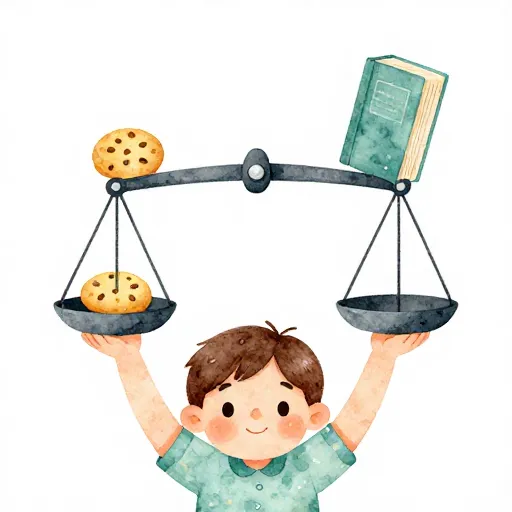
Next time you really want something (like a new game or an extra snack), stop for five seconds. Can you hear the Id saying 'Now!'? Can you hear the Superego saying 'Wait!'? Try to be the Ego: say out loud, 'I hear you both, and here is the plan.' See if it makes the 'argument' in your head feel any quieter.
The Iceberg of the Mind
Freud believed that most of this drama happens in the unconscious part of our minds. He compared the human mind to an iceberg floating in the ocean. The part you see above the water is the conscious mind, where you are aware of your thoughts.
But the biggest part of the iceberg is hidden underwater. This is where the Id hides, along with all the memories and feelings you don't even know you have. The Ego and Superego have parts that stick up into the light, but they also have deep roots in the dark water below.
Mira says:
"I like the idea that we are deeper than we look. It means there is always something new to discover about ourselves, like a secret room in a house."
Because so much is happening underwater, we sometimes feel things like anger or sadness without knowing why. We might feel a conflict between our parts that makes us feel wiggly or nervous. Freud thought that by talking about these feelings, we could bring a little more of the iceberg up into the sunlight.

The more you are able to accept your own messy feelings, the more interesting your life becomes.
How Ideas Travel Through Time
Freud's map of the mind changed the way we think about ourselves forever. Before him, people mostly thought that humans were completely logical and always knew why they did things. Freud showed us that we are much more mysterious and complicated than we look on the surface.
Through the Ages: Mapping the Mind
The Three-Way Tug-of-War
Having an Id, Ego, and Superego isn't about being "good" or "bad." It is about balance. If your Superego is too strong, you might become too scared to ever try new things or make mistakes. If your Id is too strong, you might hurt people's feelings or get into trouble because you didn't think before acting.
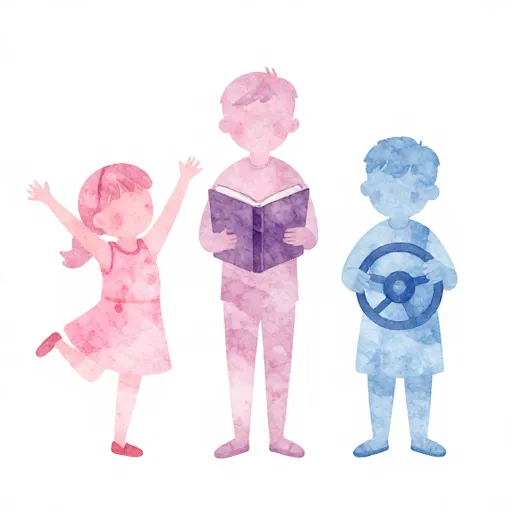
Have you ever seen a cartoon where a character has a little angel on one shoulder and a little devil on the other? That's a simplified version of Freud's idea! The devil is the Id (wanting things), the angel is the Superego (the rules), and the character in the middle is the Ego (the one who has to choose).
The goal is to have a strong Ego. A strong Ego is like a great captain of a ship: it respects the power of the ocean (the Id) and follows the map (the Superego), but it is the one actually steering the wheel. It accepts that life is a bit messy and that we won't always get it right.
When you feel that inner argument starting, take a second to listen. Which part is talking? Is it the wild energy of the Id, the strict voice of the Superego, or the calm planning of the Ego? Just noticing them can help the Ego do its job a little bit better.
Something to Think About
If you could give each of your three parts a nickname and an outfit, what would they look like today?
There are no right or wrong answers here. Your mind is a unique world that only you truly know, and your Id, Ego, and Superego are your own personal team.
Questions About Psychology
Are the Id, Ego, and Superego actual physical parts of my brain?
Can I get rid of my Id if it causes too much trouble?
Is the Ego always the good guy?
A Lifetime of Discovery
Learning about your inner team is a journey that never really ends. As you grow, your Superego will gain new rules, your Id will find new things to love, and your Ego will become a more experienced pilot. The next time you feel a bit confused about why you did something, just remember: you're just a complex human with a very busy team working behind the scenes. And that is exactly what makes you so interesting.