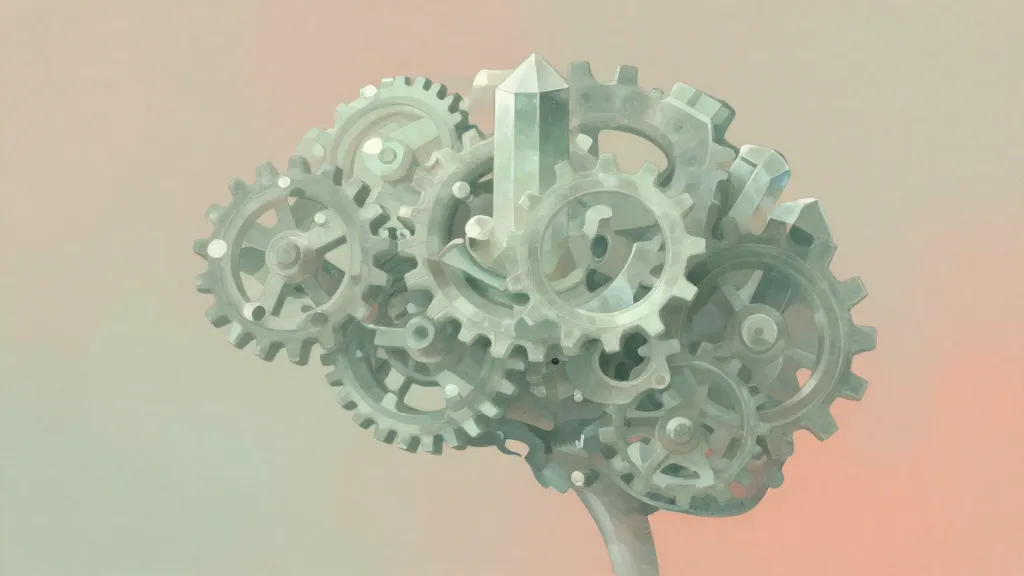
Have you ever wondered why a three year old thinks the moon is following them, or why a ten year old suddenly understands how to play a complex strategy game?
To answer these questions, we look to Jean Piaget, a Swiss thinker who realized that children aren't just 'miniature adults.' He discovered that as we grow, our minds go through a series of cognitive development stages, changing the very way we understand the world around us.
Imagine a boy standing by a cold, clear lake in Switzerland over a hundred years ago. He is not playing tag or skipping stones: he is staring at a snail. This boy, Jean Piaget, was so curious about how living things adapted to their world that he published his first scientific paper about an albino sparrow when he was only ten years old.
By the time he was a teenager, he was already a world expert on mollusks. But Piaget soon began to wonder about a different kind of adaptation. He became fascinated by how the human mind adjusts to new information, much like a snail adjusts to a new environment.
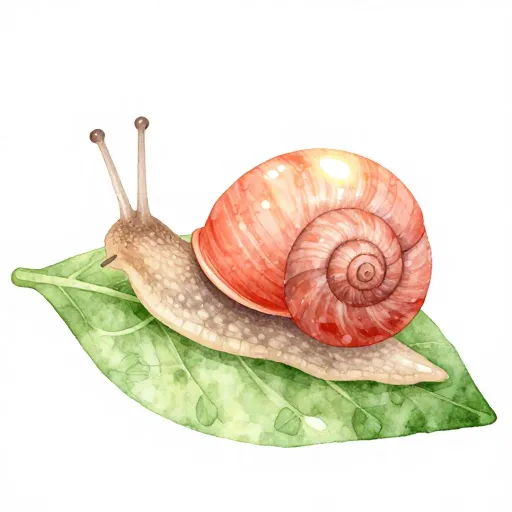
Before he became a psychologist, Jean Piaget was a world-famous expert on snails! He loved how their shells changed shape depending on whether they lived in calm water or rough waves. He later realized that human minds change shape to fit their 'environment' too.
In the 1920s, Piaget moved to Paris to work at a school for boys. His job was to help grade the first intelligence tests, which were meant to measure how smart children were. But Piaget found the right answers boring: he became obsessed with the wrong ones.
He noticed that children of the same age often made the exact same mistakes. This suggested that they weren't just 'less smart' than adults: they were using a different kind of logic entirely.

Mira says:
"That’s so interesting: Piaget didn't care if the kids were 'right.' He cared about the specific path their thoughts took to get to the 'wrong' answer!"
Piaget realized that children are like little scientists. They don't just sit back and wait for teachers to fill their heads with facts. Instead, they are constantly building their own theories about how the world works through their experiences.
To describe this building process, Piaget used the word schema. Think of a schema as a mental file folder or a building block in your brain that holds everything you know about a specific thing, like 'dogs' or 'gravity.'

Intelligence is what you use when you don't know what to do.
When you encounter something new, your brain tries to fit it into an existing folder. Piaget called this assimilation. If you have a folder for 'dogs' and you see a poodle for the first time, you easily tuck that poodle into your dog folder.
But what happens when you see something that doesn't fit? Imagine seeing a cow for the first time and shouting 'Big dog!' Your brain has tried to assimilate the cow into your dog folder, but it doesn't quite work.
Can you think of a time your 'schema' was wrong? Maybe you thought all spicy food was red, until you tried a green jalapeño. That moment of 'Wait, what?' is the feeling of accommodation happening in your brain!
To fix this, you have to create a new folder or change your old one. Piaget called this accommodation. You realize that cows are different: they moo, they are huge, and they don't live in houses. Your mind has literally changed its shape to make room for a new idea.
Piaget believed that this constant dance between assimilation and accommodation is how we learn. It is a process of finding equilibration, which is a fancy word for mental balance. When we are confused, we are out of balance, and our brains work hard to build new structures to make sense of the world again.
Finn says:
"So learning isn't just adding facts like LEGO bricks? It’s more like the whole LEGO castle has to be rebuilt every time we learn something huge?"
Piaget didn't think this growth happened smoothly, like a tree getting taller. He thought it happened in leaps, like a staircase. He identified four major stages of development that every human passes through as they grow.
The first is the sensorimotor stage, which lasts from birth to about age two. In this stage, babies learn entirely through their senses and their movements. They touch, kick, and taste everything to see what happens.
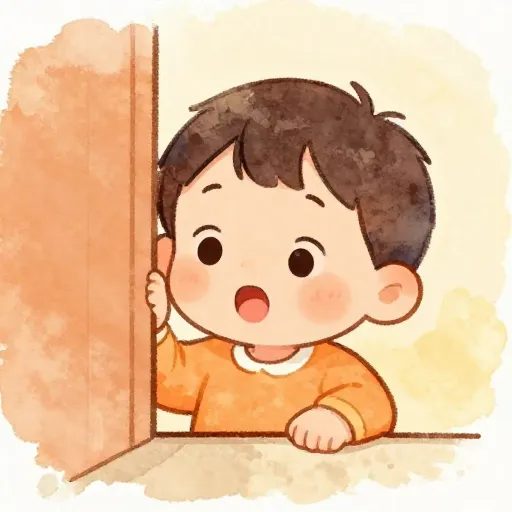
Imagine you are a one year old playing peek-a-boo. When your dad covers his face with his hands, you don't just think he's hiding: you think he has vanished into thin air! When he moves his hands, it's like a magic trick every single time.
One of the biggest discoveries a baby makes is object permanence. Before this, if you hide a ball under a blanket, the baby thinks the ball has literally stopped existing. By the end of this stage, they realize that things still exist even when they can't see them.
Next comes the preoperational stage, roughly from ages two to seven. This is the age of symbols and pretend play. A stick can be a sword, and a cardboard box can be a spaceship. However, Piaget noticed that children in this stage are often egocentric.
The child is the active builder of his own structures of knowledge.
This doesn't mean they are selfish: it means they find it hard to imagine that other people see the world differently than they do. If they are looking at a mountain from one side, they assume you see exactly what they see from the other side.
If you have two identical rows of five coins, but you spread one row out so it's longer, a five year old will say the longer row has 'more' coins.
An eight year old will count them or simply see that nothing was added, and tell you they are exactly the same.
Around age seven, children enter the concrete operational stage. This is when logic starts to kick in. You begin to understand conservation, which is the idea that the amount of something stays the same even if its shape changes.
If you pour a glass of water into a tall, thin tube, a five year old might think there is now 'more' water. But a nine year old knows it's the same amount. You are now able to perform mental 'operations' on real, concrete objects in front of you.
Mira says:
"I remember when I used to think the wind was following me. I guess I was just in a different stage of building my world-map!"
Finally, around age twelve, we enter the formal operational stage. This is where we learn to think about things that aren't there: abstract ideas like justice, infinity, or 'what if' scenarios. You can solve problems in your head without needing to see the objects.
Piaget’s ideas changed everything about how we teach. Before him, many people thought children were just empty jars to be filled with information. After Piaget, teachers realized that children need to explore, touch, and experiment to build their own knowledge.
The Growth of an Idea
However, not everyone agreed with Piaget on everything. Some later thinkers, like Lev Vygotsky, argued that Piaget focused too much on the child working alone. Vygotsky believed that language and our culture play a much bigger role in how we think.
Others found that children can often do things much earlier than Piaget thought. If you change the way a question is asked, a four year old might show much more logic than Piaget's experiments suggested. The 'stairs' of development might be more like a messy ramp.
Piaget often used his own three children, Lucienne, Laurent, and Jacqueline, as his 'test subjects.' He spent years carefully watching them play and talk in their home in Switzerland to develop his theories.
Even so, Piaget’s work remains a foundation of how we understand the human experience. He showed us that childhood is a unique time of life with its own special kind of brilliance. He taught us to respect the way a child sees the world, even when it looks 'wrong' to an adult.
The principal goal of education in the schools should be creating men and women who are capable of doing new things, not simply repeating what other generations have done.
Next time you find yourself stuck on a hard problem or confused by a new idea, remember Jean Piaget. You are just in the middle of accommodation. Your mind is stretching, creating new folders, and preparing to jump to the next step of the staircase.
Something to Think About
What is something you understand now that you couldn't have understood three years ago?
Think about how your mind has changed. Is it just that you know more facts, or do you think about the world in a different way? There is no right or wrong answer: your mind is its own evolving world.
Questions About Psychology
Was Piaget right about everything?
Why did Piaget call it 'Genetic Epistemology'?
How can I use Piaget's ideas in my own life?
The Adventure of Thinking
Jean Piaget spent his whole life being surprised by the way children think. He reminded us that being 'wrong' isn't a mistake: it is a necessary step on the way to a bigger, clearer way of seeing the world. As you grow, your mind will continue to stretch and fold in ways you can't even imagine yet.
