
Have you ever wondered why you feel a sudden 'zap' of worry when you lose sight of your grown-up in a crowded shop?
This feeling isn't a mistake: it is actually a biological superpower. A British doctor named John Bowlby discovered that our need for a secure base is just as important as our need for food and water. His work on attachment theory changed the way the world thinks about families, hospitals, and how children grow up.
Imagine a cold, gray afternoon in London over a hundred years ago. A small boy named John is sitting in a nursery with his five brothers and sisters.
In those days, wealthy British families thought it was bad for children to be 'spoiled.' This meant John only got to see his mother for exactly one hour every tea time.
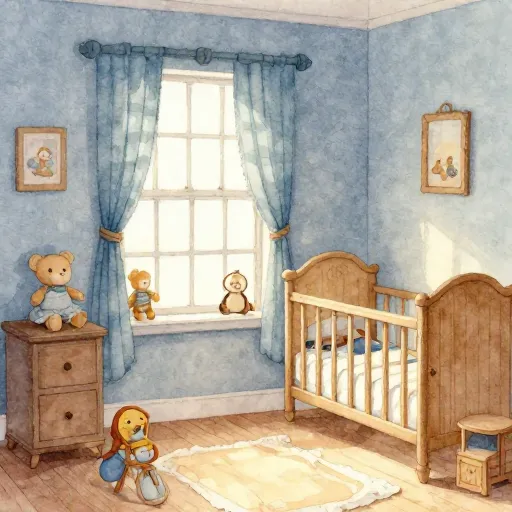
Imagine a big, drafty Victorian house with high ceilings. While the grown-ups are downstairs having fancy dinners, the children live almost entirely in the 'nursery' upstairs. It was a world where kids were expected to be 'seen and not heard.'
The rest of the day, he was with a nanny. When his favorite nanny left the family when he was four, John felt a deep, quiet sadness.
He didn't have a word for it then, but he never forgot how much it hurt to lose someone who felt like home. This early experience stayed with him as he grew up and became a doctor.
The Mystery of the Missing Bond
When John Bowlby started working as a psychiatrist, most experts believed something very different from what we know today. They thought babies only loved their mothers because the mothers provided milk.

Finn says:
"So the 'cupboard love' people thought kids were like vending machines? You put in a snack and get out a happy human? That doesn't seem right at all."
They called this 'cupboard love.' The idea was that if you fed a baby, the baby would be happy, no matter who was holding the bottle.
John didn't believe this. He watched children who had plenty of food but no steady grown-up to love them, and he saw that they were often very sad or sickly.

The propensity to make strong emotional bonds to particular individuals [is] a basic component of human nature.
He noticed that when children were separated from their parents, they went through three clear stages. First, they would protest and cry loudly.
Next, they would go through a stage of despair, where they became very quiet and still. Finally, they would seem to 'detach' and act like they didn't care anymore.
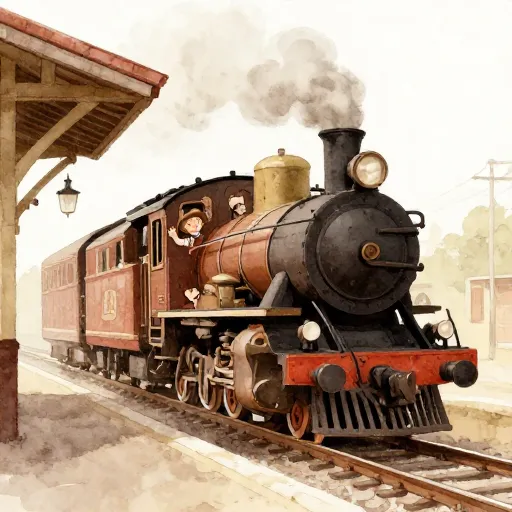
During World War II, many children in London were sent to the countryside to stay safe from bombs. While they were physically safe, John Bowlby noticed that being away from their parents caused them a different kind of pain, which he called 'separation anxiety.'
Learning from the Birds
To prove his ideas, John looked at the animal kingdom. He was fascinated by a scientist named Konrad Lorenz who studied geese.
When baby geese hatch, they follow the first moving thing they see. Usually, this is their mother, and they stay glued to her side for safety.

Mira says:
"It's interesting that we share this with animals. It makes me think that being close to the people we love isn't just a want: it's a deep, biological need."
John realized humans do something similar, even if we don't follow our parents in a straight line like goslings. We have an inner attachment behavioral system that keeps us close to our protectors.
This isn't just a 'nice feeling.' It is an evolutionary tool designed to keep us alive.
Think about your own 'Secure Base.' Who are the people that make you feel like you can handle anything? Draw a picture of yourself as an explorer, and draw your safe people as the lighthouse or the home base that keeps your light charged.
The Secure Base
John’s most famous idea is called the secure base. Think of it like a base camp for a mountain climber.
If a climber knows their base camp is safe, with warm food and a sturdy tent, they feel brave enough to climb the highest peaks. They can take risks because they know they have a safe place to return to.

Life is best organized as a series of daring ventures from a secure base.
When a child has a secure attachment, they feel free to explore, learn, and try new things. They know that if they get hurt or scared, their 'base' will be there to catch them.
This builds what John called an internal working model. This is like a mental map of how relationships work that we carry inside us forever.
Children only need food, warmth, and discipline. Don't hug them too much or they will become weak and spoiled.
Children need 'proximity' and love to survive. A child who feels safe is actually the one who grows up to be the most independent.
Changing the World
Before John Bowlby, hospitals were very strict. Parents were often only allowed to visit their sick children for one hour a week!
John fought to change this. He showed the world that a child's emotional needs are just as vital as their medicine.
Mira says:
"Imagine being in the hospital and not being able to see your parents. I'm so glad John spoke up to make things more gentle for kids."
He argued that separating children from their families caused a kind of 'invisible wound' that took a long time to heal. Slowly, hospitals and schools began to change the way they treated families because of his work.
The Story of Attachment
Why it Matters Today
John Bowlby didn't think parents had to be perfect. In fact, he knew that relationships are full of 'ruptures' and 'repairs.'
A rupture is when something goes wrong: like a parent getting grumpy or a child feeling misunderstood. A repair is when they come back together and make things right.

What cannot be spoken to the mother cannot be told to the self.
John taught us that it is the pattern of being there for each other that counts. Even when we are apart, that invisible thread of attachment keeps us connected.
It is what allows us to grow up, move away, and eventually become a secure base for someone else.
John Bowlby loved the outdoors! He spent his summers in a small house in Scotland called 'The Summerhouse,' where he did much of his best thinking while looking out at the ocean. He believed nature was a great place to feel connected to the world.
Something to Think About
What does your 'secure base' look like for you?
Maybe it's a person, a specific room in your house, or even a favorite pet. There are no right or wrong answers: everyone's map of safety is unique to them.
Questions About Psychology
What is attachment theory in simple words?
Does having an attachment mean I'm clingy?
Can you have more than one secure base?
The Thread That Holds
John Bowlby spent his whole life trying to prove that love isn't just a luxury: it's a necessity. Because of him, we know that our feelings matter and that staying close to our favorite people is what helps us grow tall. Next time you feel that 'zap' of needing a hug, remember: that's just your biological compass working exactly the way it's supposed to.
