
Have you ever wondered why you choose to be 'good'?
Is it because you want a gold star, or because you are afraid of getting in trouble? Lawrence Kohlberg was a scientist of the mind who believed that our moral development happens in stages, just like learning to walk or talk. He spent his life studying justice and how children grow into adults who can think for themselves about what is truly fair.
Imagine it is 1958 in the city of Chicago. The streets are filled with big, heavy cars and the sound of jazz music. Inside a quiet university building, a young man named Lawrence Kohlberg is asking people very strange questions.
He is not interested in whether people know their math facts or their history dates. He wants to know how they decide what is right and what is wrong. Kohlberg was a man who had seen some of the hardest parts of history, including World War II, and he was curious about why some people follow rules even when they are cruel, while others stand up for what is fair.

Imagine you are sitting in a wooden chair across from a researcher. He doesn't want to know your name or your grades. He shows you a picture of a man standing outside a pharmacy at night. He asks: 'If this man breaks the window to save someone he loves, is he a hero or a criminal?' Your heart beats a little faster because you realize there might not be a single right answer.
Kohlberg was a deep thinker who loved the ideas of Jean Piaget, a scientist who studied how children learn. Piaget noticed that kids do not just know less than adults: they actually think in a completely different way.
Kohlberg took this idea and applied it to the world of ethics. He believed that as our brains grow, our ability to think about fairness grows too. It is not just about being 'well-behaved' but about understanding the reasons behind our choices.

The child is a philosopher. He is a thinker about the social world.
To figure this out, Kohlberg created a series of stories called moral dilemmas. These are tricky situations where there is no easy answer. The most famous one is known as the Heinz Dilemma.
In this story, a man named Heinz has a wife who is very sick. A druggist in town has a special medicine that could save her, but he is charging ten times more than it costs to make. Heinz tries to raise the money but can only get half of it. The druggist refuses to lower the price or let Heinz pay later.

Finn says:
"Wait, so if Heinz steals, he’s a thief. But if he doesn’t, he’s letting his wife get sicker? That’s a total lose-lose situation! How are you supposed to choose?"
So, Heinz gets desperate. He breaks into the store and steals the medicine for his wife. Kohlberg would tell this story to kids and adults and then ask: Should Heinz have done that? Why or why not?
He did not really care if they said 'yes' or 'no' to the stealing. What he cared about were the reasons they gave. He realized that people’s answers changed as they got older and more thoughtful.

Think about the last time you followed a rule. Was it because you didn't want to get in trouble (Level 1)? Was it because you wanted to be a 'good kid' (Level 2)? Or was it because you truly believed the rule was fair for everyone (Level 3)? Try to spot these three levels in the stories you read or the movies you watch!
Kohlberg organized these different ways of thinking into three big levels. The first level is called Pre-conventional morality. This is how many young children think about the world, but even adults sometimes think this way when they are in a rush or feeling selfish.
At this stage, right and wrong are all about 'me.' A child might say Heinz should not steal because he will go to jail and jail is scary. Or they might say he should steal because he will be happy if his wife lives.

Mira says:
"It reminds me of when my little brother only cleans his room so he can play video games. He’s not being 'clean,' he’s just avoiding the 'no-screen' rule!"
In this first level, the focus is on avoiding punishment or getting a reward. It is a bit like a game: you follow the rules so the referee does not blow the whistle on you. You are not thinking about whether the rules are fair: you are just thinking about staying out of trouble.
As we grow up, we usually move into the second level, which Kohlberg called Conventional morality. This level is all about fitting into society and being a 'good' person in the eyes of others.

Right action tends to be defined in terms of general individual rights and standards which have been critically examined and agreed upon by the whole society.
In the Conventional level, we start to care about what our family, friends, and neighbors think. If you asked someone at this stage about Heinz, they might say he should steal the medicine because a 'good husband' would do anything for his wife.
They might also say he should not steal because stealing is against the law, and if everyone broke the law, society would fall apart. At this stage, we value order and social harmony. We want to be part of the group, and the group has rules that keep us safe.
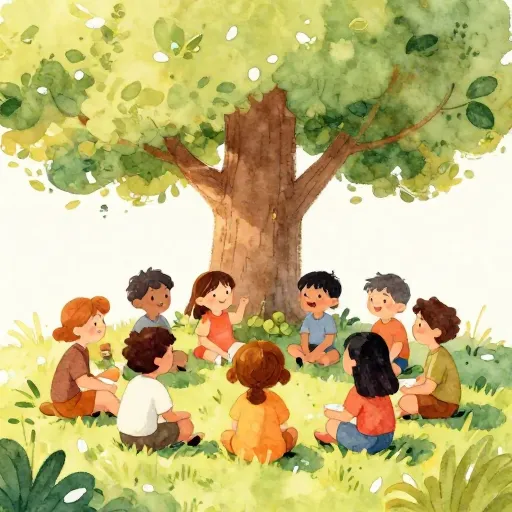
Kohlberg once spent time on a 'Kibbutz' in Israel. This is a special kind of community where everyone shares everything and makes decisions together. Seeing how people worked together without bosses or strict punishments helped inspire his ideas about 'Just Communities.'
The final level is the most complex one: Post-conventional morality. Kohlberg thought only a small number of people reach this stage and stay there all the time. This is where you start to look at laws and social rules as things that can be changed if they are not actually fair.
Someone at this stage might say that while stealing is usually wrong, the right to a human life is more important than a store owner's right to make money. They are looking at universal principles like justice, dignity, and equality.
Mira says:
"So the highest stage isn't just about following the law, it's about following your conscience? That sounds brave, but also a little bit scary."
This kind of thinking is what leads people to protest against laws they think are cruel. It is the kind of thinking used by leaders like Martin Luther King Jr. or Rosa Parks. They believed that just because something is a 'rule' does not mean it is 'right.'
Kohlberg’s work was groundbreaking, but not everyone agreed with him. One of his students, Carol Gilligan, noticed something interesting. She felt that Kohlberg’s stages were mostly based on how boys and men think about 'rules' and 'justice.'
Morality is like a ladder of logic. We move from thinking about ourselves to thinking about universal rules of justice that apply to everyone equally.
Morality is like a web of connections. We should make choices based on how they affect our relationships and how much we care for the people involved.
Gilligan suggested that many people, especially girls and women, might focus more on care and relationships. Instead of asking 'What is the rule?', they might ask 'Who will be hurt?' or 'How can we keep everyone connected?'
This opened up a huge debate in psychology. Is being 'moral' about following a logical map of justice, or is it about the warmth of our hearts and our care for one another? Today, many psychologists think it is a bit of both.
The Growth of an Idea
Kohlberg did not just want to write books about these ideas: he wanted to see them in action. He helped start 'Just Community' schools where students and teachers had equal votes on school rules.
He believed that the only way to become a more moral person was to practice. You have to talk about hard problems, listen to people you disagree with, and feel the weight of making a choice. Morality, for Kohlberg, was a muscle that needed exercise.

The aim of education is growth or development, both intellectual and moral.
When we look back at Kohlberg’s life, we see a man who was deeply curious about the human soul. He did not think children were 'empty vessels' to be filled with rules. He thought children were little philosophers, constantly trying to make sense of the world.
It is okay if you do not know the answer to the Heinz Dilemma right away. In fact, that is the point. The 'not knowing' is where the thinking happens. It is where you start to wonder what kind of person you want to be.
Kohlberg's ideas are still used today to help train police officers, doctors, and even people who design Artificial Intelligence (AI)! When we teach a robot how to make a 'fair' choice, we often look back at Kohlberg's stages for guidance.
Thinking about right and wrong can feel heavy sometimes, like trying to carry a big stack of books. But it can also feel like an adventure. Every time you stop to think before you act, you are taking a step on that winding path Kohlberg described.
Something to Think About
If you had to create one rule that everyone in the world must follow, what would it be?
There is no single correct answer here. Your rule might be based on logic, on care, or on something else entirely. Think about why you chose it and who it might help - or hurt.
Questions About Psychology
Does everyone reach the highest stage of moral development?
Can you go backward in the stages?
Why did Kohlberg only use stories about dilemmas?
The Journey Continues
Lawrence Kohlberg showed us that growing up isn't just about getting taller or faster: it's about the way our minds expand to hold bigger ideas of fairness. Whether you agree with his stages or prefer Carol Gilligan's focus on care, the most important thing is that you keep asking 'Why?' Every time you question a rule or think about someone else's feelings, you are doing the work of a philosopher.
