
Have you ever walked into a room and completely forgotten why you went there, only to remember the second you walked back out?
This strange glitch in your day is a tiny window into your unconscious mind, a vast part of your brain that works behind the scenes. While you focus on school or games, your subconscious is busy sorting memories, managing feelings, and even dreaming up stories without you even noticing.
Imagine you are standing on the deck of a ship in the middle of the North Atlantic. The air is cold, the water is dark, and ahead of you looms a massive iceberg.
You can see the jagged white peak clearly against the sky, but you know that beneath the waves, there is a mountain of ice five times larger than what you can see. This is the Iceberg Metaphor, a famous way to describe how our brains work.
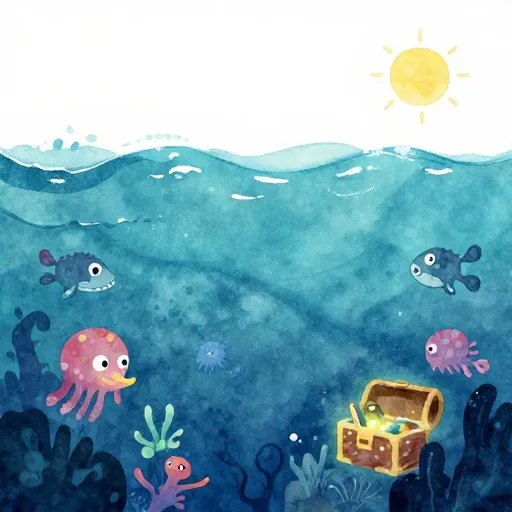
Imagine your mind is a giant ocean. Your 'conscious' thoughts are the waves on the surface, catching the sun. But deep below, in the 'unconscious' layers, there are glowing fish, sunken shipwrecks, and mysterious currents that move the water above without ever being seen.
The part above the water is your conscious mind. This is the part of you that is reading these words, deciding what to have for lunch, or solving a math problem.
It is the part of your brain that you can 'hear' talking to you in your head. It feels like 'you,' but psychologists believe it is only a small fraction of who you really are.
The Doctor in the Velvet Room
To understand where these ideas came from, we have to travel back to Vienna, Austria, in the late 1800s. The city was full of horse-drawn carriages, grand opera houses, and scientists trying to map the human body.
In a house at Berggasse 19, a doctor named Sigmund Freud was realizing something revolutionary. He noticed that many of his patients had fears or habits they couldn't explain, almost as if someone else was pulling the strings inside their heads.
Finn says:
"Wait, so Freud thought our brains were like old houses with secret basements? I wonder if my brain has a secret room just for all the LEGOs I've lost!"
Freud developed a method called psychoanalysis. He invited people to sit on a comfortable velvet couch and talk about whatever came to mind, a technique he called free association.
He believed that if people talked without filtering their thoughts, the 'hidden' part of their mind would eventually start to show itself. He was looking for the keys to the basement of the human brain.

The mind is like an iceberg, it floats with one-seventh of its bulk above water.
The Basement of the Brain
Think of your unconscious mind as a giant, messy, but very efficient basement. Every time something happens to you that is too confusing, too scary, or even just too boring to deal with right now, your brain 'tucks it away' downstairs.
This process is sometimes called repression. It isn't a bad thing: it is actually a way your brain protects you so you can keep focusing on what is happening right now.
Try a game of 'Free Association.' Have a friend say a word, and you say the very first thing that pops into your head without thinking. If they say 'Apple,' you might say 'Tree' or you might say 'Worm!' The faster you go, the more you are letting your unconscious mind take the lead.
But just because something is in the basement doesn't mean it's gone. Sometimes, these hidden thoughts try to sneak back upstairs.
They might come out as a 'slip of the tongue,' where you say one word when you meant another, or as a sudden feeling of being grumpy without knowing why. Freud thought even our funniest jokes were actually little messages from our unconscious mind.
The Language of Dreams
One of the most exciting ways we see the unconscious mind is through dream analysis. When you sleep, your conscious mind takes a break, and the basement door swings wide open.
Freud called dreams 'the royal road to the unconscious.' He believed that everything in a dream: from a flying purple cat to a giant clock: was a symbol for something your hidden mind was trying to tell you.

Mira says:
"It's like our dreams are movies written by a director who only speaks in riddles and symbols. Maybe the flying cat isn't just a cat, but a feeling of being free."
Not everyone agreed with Freud about what was in the basement. One of his students, Carl Jung, thought the unconscious was much more than just a place for hidden fears.
Jung believed the unconscious was a source of great creativity and wisdom. He thought we all share a collective unconscious, a sort of 'cloud storage' for human stories and symbols that every person is born with.
In each of us there is another whom we do not know.
Shared Stories and Archetypes
Jung noticed that people all over the world, even if they lived thousands of miles apart, told stories with the same kinds of characters. He called these archetypes.
Think about the stories you know. There is almost always a 'Hero,' a 'Wise Teacher,' or a 'Trickster.' Jung believed these characters exist in our unconscious mind before we even hear our first fairy tale.
Picture a library that contains every dream ever dreamt and every story ever told. Carl Jung thought we are all born with a 'library card' to this place. When you feel a sudden connection to a hero in a movie, it's because you already recognize them from the library in your mind.
Jung also talked about the 'Shadow.' This isn't the shadow you see on the ground on a sunny day.
It is the part of your personality that you don't like to show others, like your jealousy or your anger. Jung believed that if we learn to 'befriend' our shadow instead of hiding it in the basement, we become much stronger and more honest people.
Mapping the Hidden Mind
The Importance of Privacy
As time went on, other thinkers like Donald Winnicott looked at how kids use their unconscious minds. Winnicott was a doctor who loved watching how babies and children played.
He realized that a big part of the unconscious mind is about having a private space that belongs only to you. He thought it was important for kids to have a 'hidden' self that nobody else could fully see or control.

It is a joy to be hidden, and disaster not to be found.
This hidden self is where your best ideas come from. When you are daydreaming or 'zoning out,' your unconscious mind is playing with ideas, mixing them together like a laboratory.
That 'Aha!' moment you get when you suddenly solve a puzzle? That is your unconscious mind finishing a job it started hours ago while you were busy doing something else.
Is It Real?
Today, scientists use big machines like MRI scanners to look at the brain while it works. They have found that Freud and Jung were right about one big thing: most of what our brain does happens 'under the hood.'
We call this intuition or 'gut feelings.' Your brain is constantly scanning the world for patterns, even when you aren't paying attention. It might tell you to trust someone or warn you that a situation feels 'off' before you can even explain why.
The unconscious is like a computer program running in the background. It's just neurons firing to help us survive and react quickly to danger.
The unconscious is like a poet or an artist. It uses dreams and feelings to help us understand the meaning of our lives and who we are meant to be.
Finn says:
"If my brain is doing all this work without me, does that mean I'm a team? Like, there's 'Me' and then there's 'Hidden Me' working the controls?"
Sometimes, the unconscious mind can feel a little bit spooky. It can feel like there is a stranger living inside your head who knows things you don't.
But most psychologists today see the unconscious as a helpful partner. It manages your breathing, reminds you of the lyrics to your favorite song, and keeps your imagination running while you sleep. It is the part of you that keeps life interesting.

Your brain processes about 11 million bits of information every second, but your conscious mind can only handle about 40 to 50 bits. That means your unconscious mind is doing 99.9% of the work right now!
Living With Your Hidden Self
So, how do you get along with a part of your mind you can't see? The best way is to be curious about yourself.
When you have a weird dream or a sudden feeling, instead of ignoring it, you can ask, 'I wonder why my brain thought of that?' You don't always need a perfect answer. Sometimes just noticing the mystery is enough.
Something to Think About
If you could send a letter to your unconscious mind today, what would you ask it?
There are no right or wrong answers here. Your unconscious mind is the most private place in the world, and only you get to decide what it feels like to live there.
Questions About Psychology
Can I control my unconscious mind?
Is the unconscious mind the same as the 'subconscious'?
Why does my unconscious mind make me have nightmares?
The Never-Ending Discovery
The next time you have a sudden idea, a strange dream, or a feeling you can't quite name, remember that you are exploring a vast inner wilderness. You don't have to map the whole thing at once. Part of the wonder of being human is knowing that there is always something new to discover about yourself, hidden just beneath the surface.