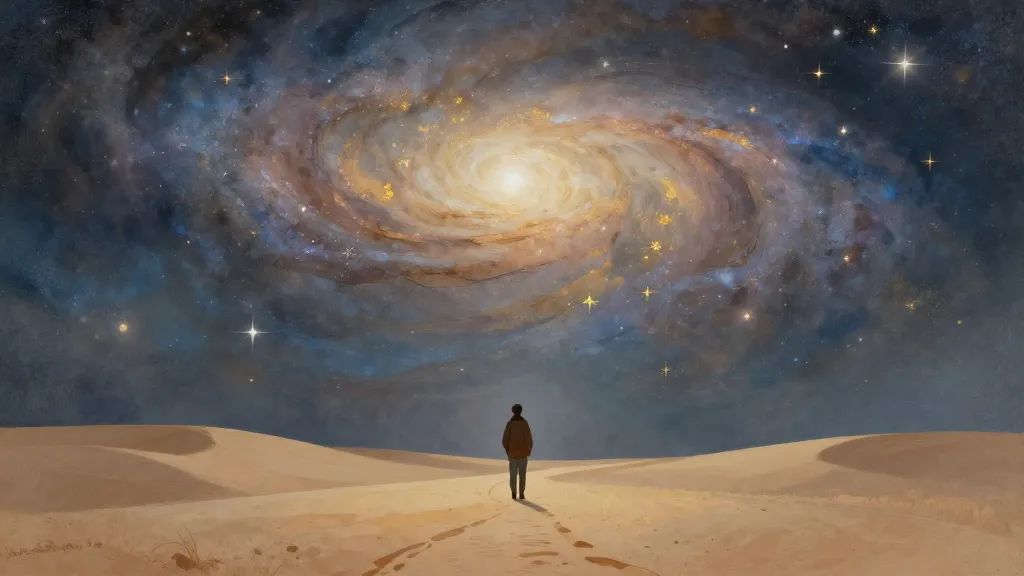
Have you ever had a feeling that there was something more to the world than what you could see right in front of you?
Thousands of years ago, a man named Abraham lived in a busy city filled with statues of many different gods. He became the first Patriarch, a word meaning a founding father, by deciding to follow a single, invisible voice into the unknown. This journey created the foundation for Monotheism, the belief in one God, which eventually linked three of the world's largest religions together.
The World of the Ziggurat
To understand Abraham, we have to travel back about 4,000 years to a place called Mesopotamia. This region was known as the Fertile Crescent because it was a green, lush arc of land between two great rivers. Abraham grew up in a city called Ur, which was a marvel of the ancient world.
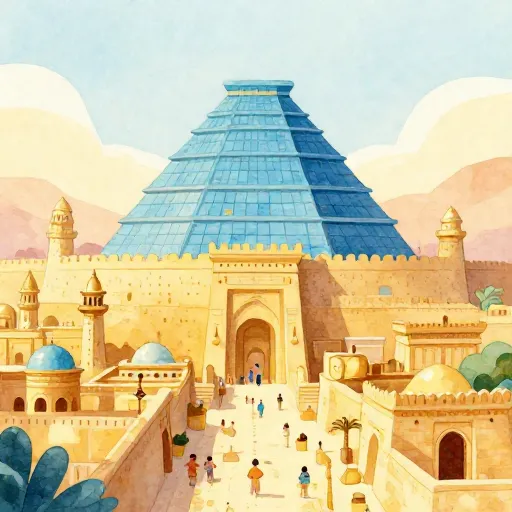
Imagine standing in the middle of Ur. You see brick houses with flat roofs, merchants shouting about the price of dates, and the smell of roasting lamb in the air. High above you, the blue-tiled Ziggurat of Nanna glows in the sun, looking like a giant staircase leading straight into the clouds.
In Ur, life was loud and colorful. People traded grain, woven rugs, and shimmering copper. Towering over the city was a massive, stepped pyramid called a ziggurat. The people of Ur believed that many different gods lived in the sky, the rivers, and the wind.
Abraham’s father, Terah, was said to be a maker of idols. These were small statues representing these many gods. People bought them to keep in their homes, believing the statues could bring good luck or protect their families from storms.

Finn says:
"If everyone around Abraham believed in the statues, was he scared to be the only one who didn't? It's hard to be the first person to change their mind!"
As Abraham grew up, he began to wonder if a piece of wood or stone could really be a god. He looked at the sun, but saw that it set at night. He looked at the moon, but saw that it faded when the sun rose. He started to think there must be something even bigger behind all of it.
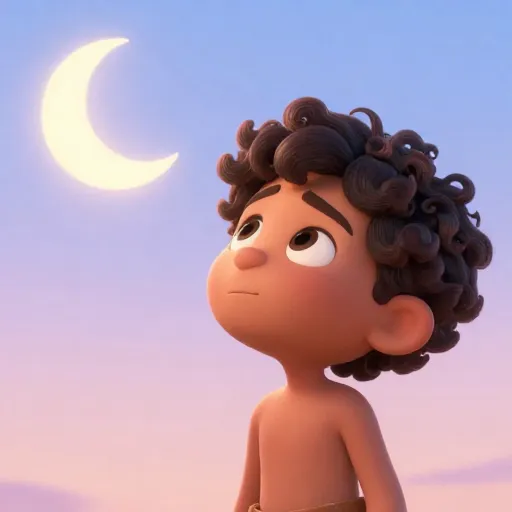
When the sun sank, he saw the stars and said, 'This is my Lord!' But when they set, he said, 'I love not those that set.'
The Great Disruption
There is a famous story about Abraham in the Midrash, which is a collection of ancient Jewish stories that help explain the deeper meaning of history. In this story, Abraham is left alone in his father's idol shop. Instead of selling the statues, he takes a hammer and breaks all of them except the biggest one.
When his father returns and asks what happened, Abraham points to the large statue. He says the statues got into a fight over a bowl of flour, and the big one won. His father is angry and says, "That is impossible! These are just statues!"
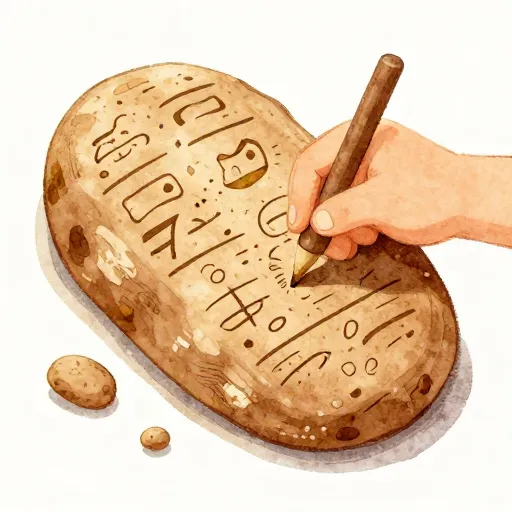
In ancient times, names usually meant something special. Abraham's original name was 'Abram,' which meant 'Exalted Father.' Later, his name was changed to 'Abraham,' which sounds like the Hebrew words for 'Father of a Multitude.'
Abraham’s point was simple but world-changing. If the statues couldn't move or speak, why were people praying to them? This was a radical way of thinking. It was the birth of a new kind of relationship between humans and the divine.
Abraham began to hear a voice that didn't come from a statue. It was an internal calling. This voice told him to leave his home, his family, and everything he knew to go to a new land.

Mira says:
"I think Abraham realized that the statues were too small. He wanted a God that was as big as the whole universe, not just something that fits on a shelf."
Walking Into the Mapless Blue
Leaving home today is a big deal, but in the ancient world, it was almost unthinkable. Your city was your safety. Outside the walls were deserts, wild animals, and strangers. Yet, Abraham packed his tents, gathered his family, and began to walk toward a place called Canaan.
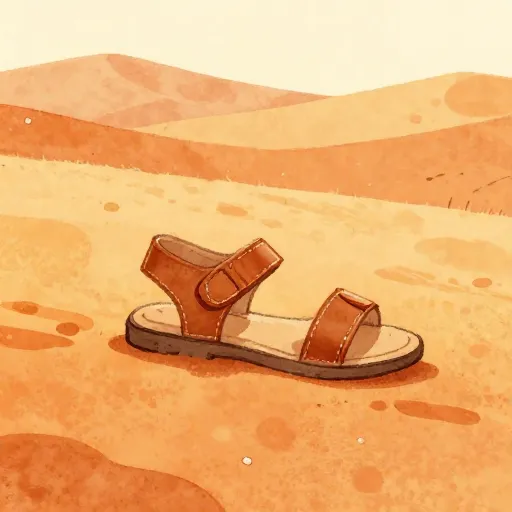
Abraham’s journey was hundreds of miles long on foot. Try walking around your local park or even your house. For every 10 steps you take, imagine that represents one day of Abraham's journey through the dusty, rocky desert. How many 'days' would it take you to get to the grocery store?
Abraham didn't have a map or a GPS. He was practicing a very high form of trust. In many traditions, Abraham is called a Prophet, someone who communicates with God. But he was also a pioneer, someone willing to be a stranger in a new place for the sake of an idea.
This journey wasn't just about moving from one city to another. It was a journey of the mind. Abraham was moving away from the idea that gods were things you could hold, and toward the idea that God was a presence that traveled with you.
Abraham made the garden of his soul so beautiful that the fire of the world could not burn him.
The Promise of the Stars
One night, while camping under the desert sky, Abraham felt discouraged. He was old, and he and his wife, Sarah, had no children. He wondered how his ideas would live on if he had no family to teach them to.
The story says that God led him outside and said, "Look up at the heavens and count the stars, if indeed you can count them. So shall your offspring be." This was the Covenant, a sacred and serious agreement between Abraham and God.
Some people think Abraham had faith because he felt a strong, quiet sense of peace in his heart that told him he was doing the right thing.
Others believe Abraham's faith was shown by his feet: he didn't just feel something, he actually moved his whole life based on what he believed.
Abraham believed the promise, even though it seemed impossible. Eventually, he did have children. Through his son Isaac and his son Ishmael, his family grew just as the promise said it would. Today, billions of people in Judaism, Christianity, and Islam see themselves as part of that starry family tree.
Because of this, Abraham is often called the "Father of Many Nations." His life shows that a single person’s courage to think differently can change the course of history for thousands of years.
Finn says:
"I wonder if Abraham ever looked at the stars and felt overwhelmed. Having a 'family as big as the stars' sounds like a lot of people to keep track of!"
The Open Tent
Abraham wasn't just known for his big ideas: he was also known for how he treated people. There is a beautiful tradition that Abraham’s tent was open on all four sides. This way, if a traveler was coming from the north, south, east, or west, they wouldn't have to look for the door.
This is the concept of Hospitality. In the desert, helping a stranger isn't just being polite: it is a matter of life and death. Abraham would run to meet guests, offer them water to wash their feet, and prepare a feast before he even knew who they were.

Abraham is a 'bridge' figure. He is a central character in the Torah (Judaism), the Bible (Christianity), and the Quran (Islam). Even though these religions have many differences, they all look back at Abraham as their common grandfather.
This kindness is a key part of his legacy. It suggests that if you believe in one God who created everyone, then every stranger you meet is actually a distant relative. Helping others became a way of honoring the creator.

Faith is the courage to live with uncertainty. Abraham began his journey with no idea where he was going.
Through the Ages
A Legacy of Questioning
Abraham’s story is still told today because it touches on things we all feel. We all have moments where we feel like the "only one" who thinks a certain way. We all have to decide when to stay comfortable and when to go on a journey toward something better.
Abraham didn't leave us a book of rules or a giant monument of stone. He left us a story about a man who listened, who walked, and who looked at the stars. He showed us that faith isn't about having all the answers, but about being willing to ask the biggest questions.
Something to Think About
What would you be willing to leave behind for a big idea?
Abraham left his home, his city, and his safety because he believed in something he couldn't see. Think about the things that are most important to you: your ideas, your friends, or your favorite places. There is no right or wrong answer, but it's interesting to think about what makes an idea worth a long journey.
Questions About Religion
Did Abraham actually exist?
Why did Abraham have two names?
How did he talk to God?
The Journey Continues
Abraham’s life was the start of a massive conversation about God, family, and kindness that is still happening today. By looking at his story, we learn that being a 'Big Thinker' often starts with the simple act of looking up at the stars and asking: Why? We hope you keep asking your own big questions as you explore the world.
