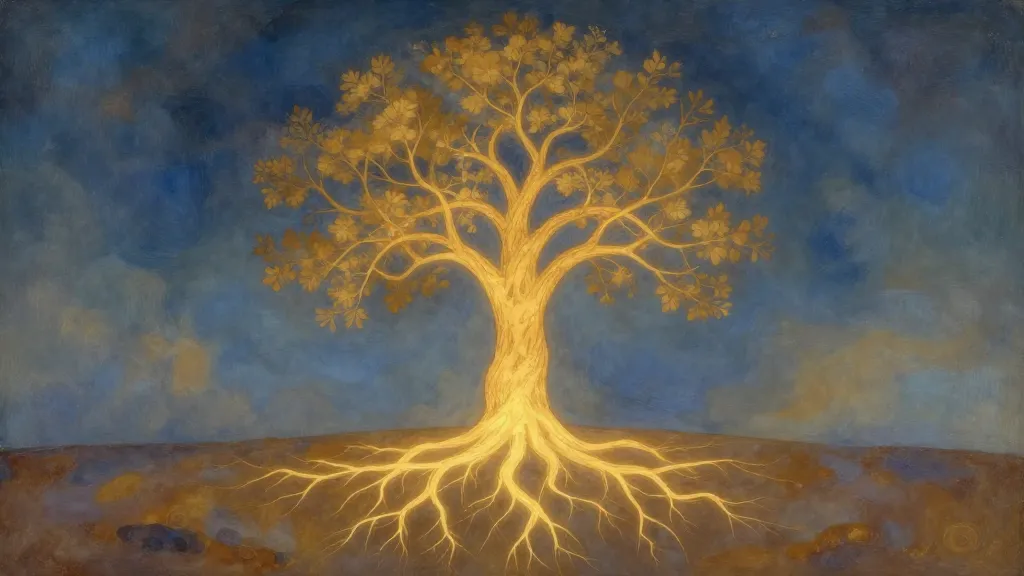
What if the world wasn't just made of rocks and trees, but was actually a giant conversation that has been going on for thousands of years?
Across the vast continent of Africa, thousands of different cultures have used Oral Tradition to keep their history alive. These stories of gods, spirits, and clever animals are more than just fairy tales: they are a form of Cosmology, a way of understanding how the universe works and where we fit inside it.
Imagine you are sitting by a fire in the tall grass of the savanna or under the thick, green canopy of a rainforest. You aren't watching a screen or reading a book. Instead, you are listening to a voice. This voice belongs to a storyteller who has memorized thousands of years of history.
In many parts of West Africa, this person is called a Griot. They are not just entertainers: they are the living libraries of their people. They believe that when a story is spoken out loud, it takes on a life of its own. This is the heart of African mythology: the idea that the world is kept alive by the words we share.
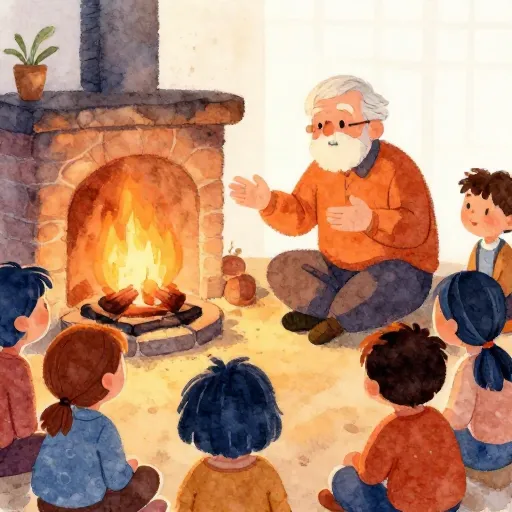
For thousands of years, history in many African cultures was kept entirely through speech and memory. Griots could recite the names and deeds of kings going back dozens of generations without ever checking a book!
The Continent of Many Voices
When we talk about African mythology, we have to remember that Africa is a massive continent, not a single country. It is home to thousands of different ethnic groups, each with its own language and its own way of seeing the world. There isn't just one 'African' myth, just like there isn't just one 'European' myth.
From the Yoruba people of Nigeria to the Zulu of South Africa and the Dogon of Mali, every group has a different answer to the big questions. Who made the stars? Why do humans have to die? Why is the spider so clever and the elephant so proud?

Finn says:
"What if the reason we have so many different stories is that the world is too big for just one person to understand everything?"
Despite these differences, many of these cultures share a deep respect for Animism. This is the belief that everything in nature: trees, rivers, stones, and animals: has a spirit or a soul. To an ancient storyteller, a mountain wasn't just a pile of dirt. It was a witness to history.
The Great Weaver: How the World Began
Many African creation stories start with a god who is a master craftsman. For the Dogon people of Mali, the creator god is named Amma. They say he created the world out of clay, spinning the stars and planets like a potter spins a bowl.
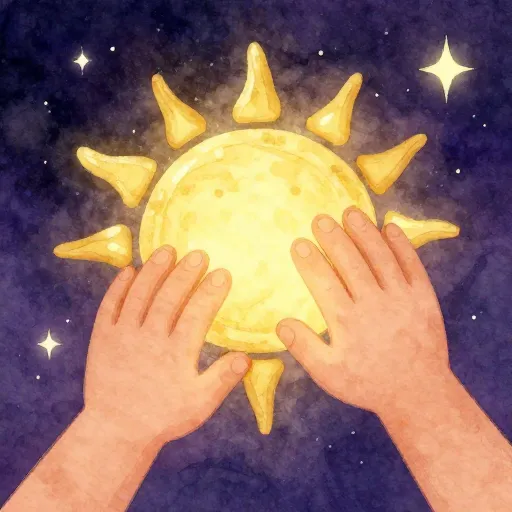
Imagine a god named Amma who looked at the empty space of the universe and saw it as a piece of pottery. He didn't use a hammer or a saw. He used his hands to shape the sun like a hot bowl of copper and the moon like a cool bowl of brass.
In Yoruba tradition, the world was once just a watery waste until a god named Obatala came down from the sky on a long gold chain. He carried a snail shell full of sand, a five-toed chicken, and a black cat. He poured the sand on the water, and the chicken scratched it until it became the dry land we walk on today.
Until the lions have their own historians, the history of the hunt will always glorify the hunter.
These stories suggest that the world didn't just happen by accident. It was made with intention, but it was also made with a bit of messiness. In the Yoruba story, Obatala got a bit tired and made some mistakes while molding humans out of clay. This helps people understand why the world isn't perfect: even the gods have 'off' days.
The Spirits Around Us
In many African religions, the high creator god is often seen as being very far away. He or she finished the job of creation and then went to rest in the highest part of the sky. To get things done on Earth, humans talk to smaller gods or spirits.
For the Yoruba, these spirits are called Orishas. There are hundreds of them, and each one represents a different part of human life or nature. Shango is the god of thunder and lightning, while Yemoja is the mother of the oceans.
Think of an object in your room: maybe a lamp or a favorite toy. If that object had a spirit (like in Animism), what would its personality be like? Is it grumpy when you turn it off? Does it feel happy when it's being used? Write down three things your 'spirit object' might say if it could speak.
These spirits are very much like humans. They can be kind, angry, jealous, or helpful. They don't want to be worshipped from a distance: they want to be part of the community. People often offer them food, music, or dance to keep the relationship strong.

Mira says:
"It's like the Orishas are the personality of the world. The ocean isn't just water: it's Yemoja's mood."
The Power of the Ancestors
There is a famous proverb that says: 'The dead are not dead.' In many African mythologies, when a person dies, they don't just disappear. They become Ancestors, spirits who continue to watch over their families.
Think of it like having a team of wise great-great-grandparents who are always in the room with you. You can't see them, but you can feel their influence. People often consult their ancestors before making big decisions, like moving to a new house or getting married.
Ancestors are like guardians who help and protect us from the spirit world.
Ancestors are like teachers who remind us of the mistakes and successes of our family history.
This connection to the past creates a sense of Ubuntu. This is a South African philosophy that means 'I am because we are.' It reminds us that we aren't just individuals: we are a single point on a long line of people stretching back to the beginning of time.
The Trickster: Why We Need Trouble
If you have ever heard a story about Anansi the Spider, you have met the Trickster. Tricksters are characters who love to break rules, play jokes, and outsmart those who are bigger and stronger than them.
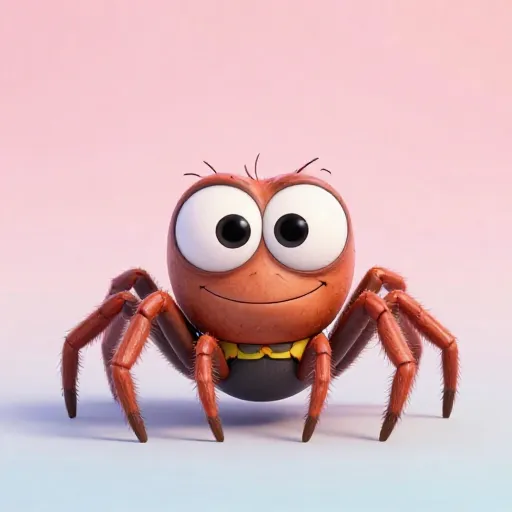
Anansi is the spirit of all rebellion: the one who says 'no' when the world says 'yes'.
Why would a religion or a mythology include a character who lies and cheats? Because tricksters represent the unexpected. They remind us that life is unpredictable and that sometimes the only way to solve a problem is to think outside the box.
The Dogon people of Mali have a myth about a star called Sirius B. For hundreds of years, they described it as a heavy, tiny star that was invisible to the eye. Modern scientists only discovered Sirius B with powerful telescopes in the 1800s, proving it was exactly as the Dogon said!
In West Africa, the trickster god Eshu is the one who stands at the crossroads. He is the messenger between gods and humans. He often causes a little bit of chaos just to see how people will react. He teaches us that change, even when it is annoying or scary, is how we grow.
Mira says:
"If the ancestors are always watching, then history isn't just something that happened in a book. It's happening right now."
Through the Ages
African mythology didn't stay in one place. It has traveled across oceans and changed over thousands of years. Even when people were taken from Africa against their will during the time of slavery, they carried these stories in their hearts.
The Journey of the Stories
Today, you can see the influence of these myths everywhere. They are in the superhero movies we watch, the books we read, and the music we hear. Characters like Black Panther or the stories in American Gods draw directly from the rich well of African tradition.
The Living Story
Unlike some ancient mythologies that feel like they belong in a museum, African mythology is still very much alive. It changes as the world changes. New stories are being told every day that blend ancient spirits with modern technology.
The gods are not just myths; they are the many faces of the human experience.
We might not live in a world where we think a spider is literally talking to us, but we still live in a world where we need to be clever. We still live in a world where we need to respect our elders and take care of the nature around us. That is the magic of these 'Big Ideas': they never really grow old.
Something to Think About
If you were a trickster like Anansi, what is one rule in the world you would want to change just to see what happens?
There are no right or wrong answers here. Tricksters remind us that sometimes the world needs a little shaking up to stay interesting.
Questions About Religion
Is African mythology the same as a religion?
Why are so many African myths about animals?
How do we know these stories if they weren't written down?
The Story Continues With You
African mythology teaches us that the world is a giant, breathing network of connections. Whether it's the trickster making us laugh or the ancestors giving us strength, these stories remind us that we are never truly alone. The next time you see a spider in its web or hear the rumble of thunder, think about the ancient names people gave them. Perhaps the world is still trying to tell you a story.
