Have you ever looked up at the night sky and wondered if something or someone made all of this, only to realize you didn't have a clue how to find out for sure?
This feeling of standing before a giant mystery is the heart of agnosticism, a way of thinking that says we simply do not know the answer to life's biggest questions. It is a philosophy built on honesty, curiosity, and the courage to say those three difficult words: I don't know.
Imagine you are in London in the year 1869. The air is thick with the smell of coal smoke and the sound of horse-drawn carriages clicking over cobblestones. Inside a grand, wood-paneled room, some of the smartest people in the world are having a heated argument.
There are scientists, priests, and poets all sitting around a long table. Some are shouting that they are certain God exists. Others are shouting that they are certain God does not exist. In the middle of this sits a man named Thomas Henry Huxley, and he feels very out of place.
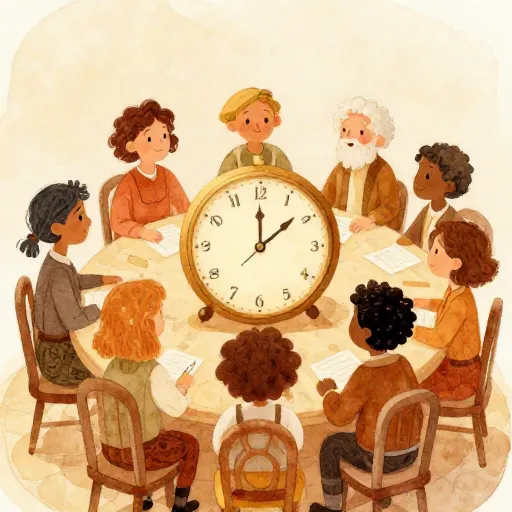
Imagine a dinner party where the world's most famous thinkers are arguing. One side says the world is a clock made by a giant clockmaker. The other side says the clock made itself. You are the only person at the table who says, 'Wait, we haven't even opened the back of the clock yet! How can we be so sure?'
Huxley was a brilliant biologist who loved evidence. He looked at his friends and realized they all had something he didn't: they all had a label for what they believed. They called themselves 'theists' or 'atheists' or 'pantheists.'
Huxley felt like a person without a team. He didn't want to guess, and he didn't want to pretend he was sure when he wasn't. He decided he needed a brand-new word for his own way of thinking.
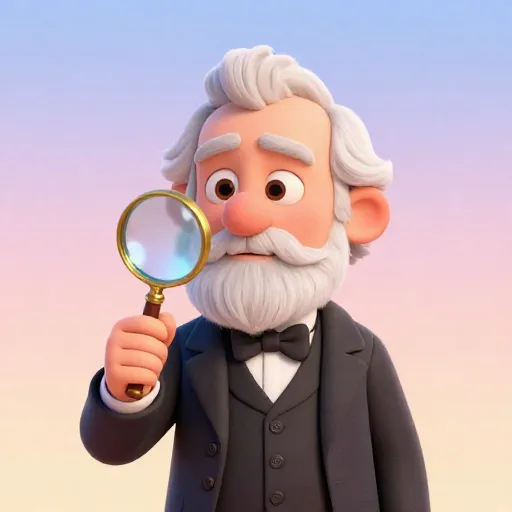
It is wrong for a man to say that he is certain of the objective truth of any proposition unless he can produce evidence which logically justifies that certainty.
He took the Greek word gnosis, which means 'knowledge.' Then he added the letter 'a' to the front, which in Greek means 'without.' And just like that, agnosticism was born.
To Huxley, being an agnostic wasn't about being lazy or bored. It was about being a good scientist. He believed that if you cannot prove something using reason or observation, the most honest thing you can do is admit it is a mystery.

Finn says:
"What if the answer to the universe is so big that our brains literally aren't big enough to hold it? Like trying to download the whole internet onto a calculator!"
While the word was new in 1869, the feeling was very old. If we travel back much further, across the ocean and through thousands of years, we find people asking the same questions in ancient India.
About 3,000 years ago, poets wrote the Rig Veda, one of the oldest sacred texts in the world. In a section called the Nasadiya Sukta, they didn't write about certainty. Instead, they wrote about the existence of the universe and wondered if even the gods knew where it all came from.
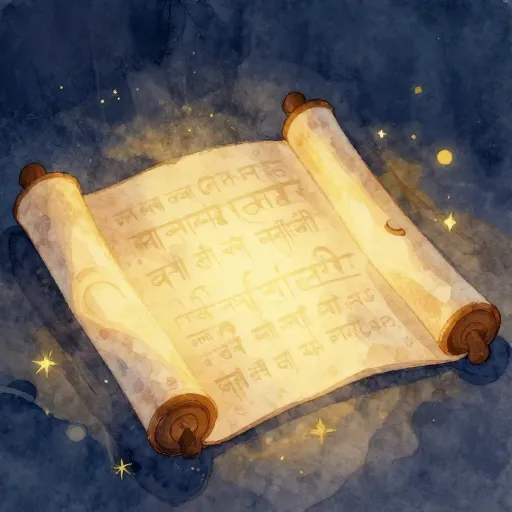
The Rig Veda, written over 3,000 years ago, ends its creation story by saying: 'Perhaps it formed itself, or perhaps it did not. The one who looks down on it, in the highest heaven, only he knows - or maybe he does not know.' Even the ancients left room for doubt!
This ancient poem suggests that perhaps the creator knows how it all started, or perhaps even the creator does not. It is one of the earliest examples of humans being comfortable with a giant question mark at the center of the world.
Not long after that, in Ancient Greece, a philosopher named Protagoras was thinking about the same thing. He was a man who lived in the sunshine of Abdera, surrounded by people who built white marble temples to gods like Zeus and Athena.
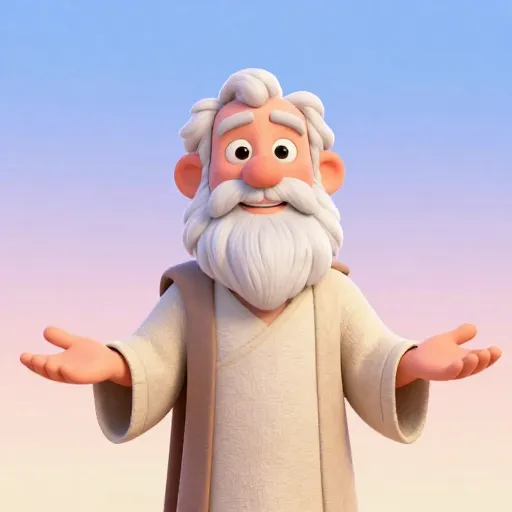
Concerning the gods, I have no means of knowing whether they exist or not, nor of what sort they may be.
Protagoras wasn't saying the gods weren't there. He was saying that the human condition is limited. We are like ants trying to understand how a smartphone works: we might see the screen glow, but we don't have the tools to understand the software inside.
Find a 'Mystery Box' (or ask a friend to put a secret object in a box). Without opening it, try to figure out what it is. You can shake it, weigh it, and listen to it. You might have a great theory, but notice the difference between your 'guess' and actually 'knowing' what is inside. That space in between is where agnosticism lives.
This brings us to a big question: how do we know anything at all? Philosophers call this epistemology. It is the study of how we gather knowledge through our eyes, our ears, and our logical brains.
Agnostics argue that our five senses are great for finding out if it is raining or if a lemon is sour. However, those same senses might not be enough to find something unseen or something that exists outside of time and space.

Mira says:
"It's like looking at the wind. I can see the leaves moving and feel the cold on my cheeks, but I can't actually see the wind itself. I know it's doing something, but I can't point to its shape."
Think about a wrapped gift sitting on a table. You can look at the paper, shake the box to hear a rattle, and smell the cardboard. You can make a very good guess about what is inside, but until the box is opened, you do not truly 'know.'
For an agnostic, the universe is like that box. We can study the stars and the atoms, which is the metaphysical wrapping paper. But the answer to 'Why is there something rather than nothing?' remains inside the box, and the box is taped shut.
The only way to live a meaningful life is to pick a side and have faith in what you cannot see. Doubt just keeps you stuck.
It is more noble to stay in the middle than to pretend to know something you don't. Doubt is what keeps us searching and honest.
Some people find this idea frustrating. They want a 'yes' or a 'no' answer because it helps them feel safe. But agnostics find a different kind of safety: the safety of not having to be right all the time.
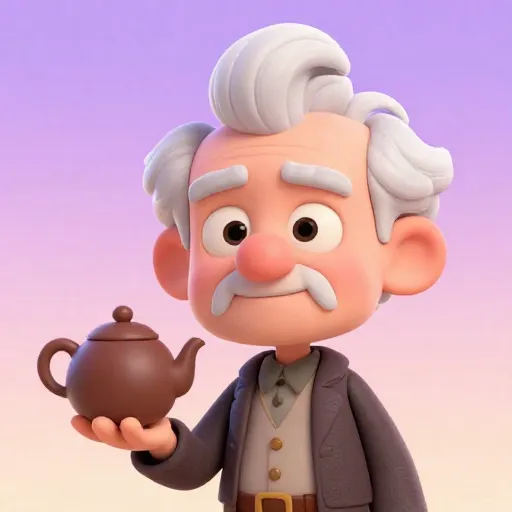
The whole problem with the world is that fools and fanatics are always so certain of themselves, and wiser people so full of doubts.
Bertrand Russell, a famous thinker from the 1900s, used a funny story to explain this. He asked people to imagine there was a tiny china teapot orbiting the sun between Earth and Mars. It was too small for any telescope to see.
If someone told you the teapot was definitely there, you would ask for proof. If they couldn't show it to you, you wouldn't necessarily say it's impossible, but you wouldn't believe it either. You would stay in the middle, waiting for better telescopes.
Through the Ages
Through the years, agnosticism has changed. In the past, it was sometimes dangerous to say you didn't know the answers to religious questions. People could be kicked out of their towns or even put in jail for not following the local certainty.
Today, many people identify as 'agnostic seekers.' These are people who don't have a specific religion, but they still think the universe is a spiritual, amazing place. They enjoy the search more than the destination.
Finn says:
"I like the idea that we're all still explorers. If we already had all the answers, there wouldn't be anything left to go find, would there?"
There is also a difference between an agnostic and an atheist. An atheist generally believes there is no God. A theist generally believes there is a God. An agnostic looks at both and says, 'I don't think we have enough evidence to pick a side yet.'
It is like being a judge in a courtroom. A judge doesn't decide who is guilty before the trial starts. They wait, they listen, and sometimes, they decide that there just isn't enough proof to make a final call.
There is a specific type of agnostic called an 'Agnostic Theist.' This is someone who believes in a higher power but admits they have no proof and can't really explain what that power is like. They have faith, but they also have a lot of questions!
This way of thinking can be applied to many things, not just religion. It can be used in science, when we don't yet know what dark matter is. It can be used in history, when we aren't sure why a civilization disappeared.
Being agnostic is an invitation to keep looking. It means the world is still full of surprises and that no one has the 'final' map of everything. It allows us to wonder at the stars without needing to own them.
Something to Think About
If you could ask the universe one question, knowing you'd get a totally honest 'I don't know' as an answer, would that make the mystery feel more or less exciting?
There are no right or wrong answers here. Some people love a mystery that never ends, and some people find it a little bit spooky. How does it feel to you?
Questions About Religion
Is being agnostic the same as being an atheist?
Can you be religious and agnostic at the same time?
Does being agnostic mean you don't care about the truth?
The Beauty of the Question Mark
Agnosticism isn't a wall that stops us from thinking, it is a door that stays open. It reminds us that the universe is vast, deep, and full of secrets that we are still learning how to uncover. Whether you eventually find an answer or decide to stay an explorer of the unknown, your curiosity is the most powerful tool you have.
