If you were walking through the Egyptian desert four thousand years ago, you might see a pair of pointed ears silhouetted against the rising moon.
This was the shape of Anubis, one of the oldest and most mysterious gods of Ancient Egypt. He wasn't a monster to be feared, but a guide who walked between the world we know and the afterlife, ensuring that every person found their way home.
Imagine the desert at night. The sand is cool, the stars are impossibly bright, and the only sound is the wind whistling through the limestone cliffs. To the people of the Old Kingdom, this was the realm of the jackal.
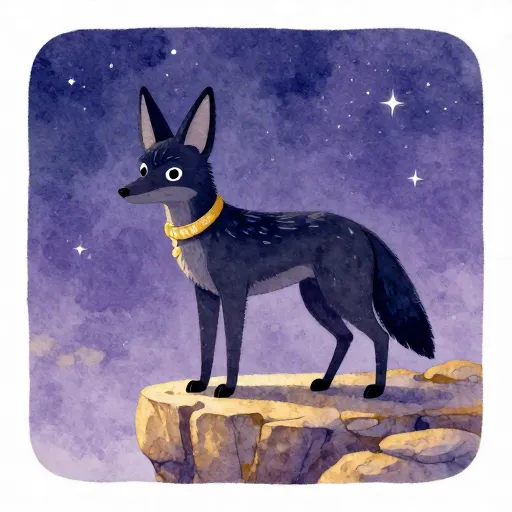
Imagine you are standing on the edge of the Sahara Desert at dusk. The sky is turning a deep violet. Suddenly, you see a flash of gold. It is the collar of a sleek, black hound standing perfectly still on a cliff above you. He isn't barking or growling, he is simply watching. He is waiting for the stars to come out so he can start his night shift.
Jackals are clever, wild dogs that roam the edges of the desert. Because they were often seen near cemeteries, the Egyptians didn't just see them as scavengers. They saw them as guardians who knew the secret paths through the dunes.
The Watchman of the West
Anubis is almost always shown as a man with the head of a black jackal or as a full jackal resting on a golden shrine. In the Egyptian mind, the West was the place of the dead because that is where the sun sets every evening.

Finn says:
"If the sun dies every night when it sets in the West, does that mean Anubis has to help the sun find its way back to the East every morning?"
He was called the Lord of the Sacred Land because his job was to protect the places where people were buried. He made sure that no one disturbed the peace of those who had finished their life on Earth.
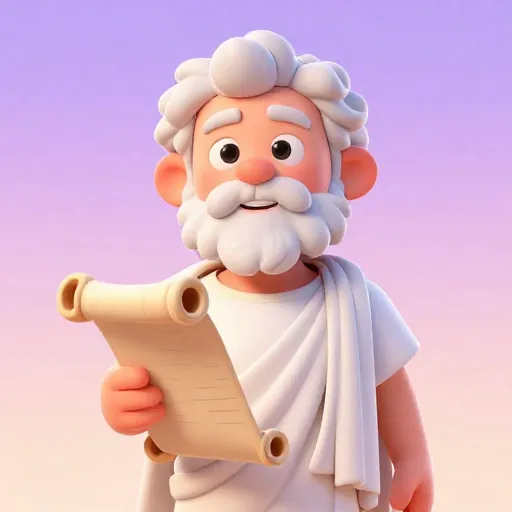
The jackal-god is the most vigilant of all, for he keeps watch by night as well as by day.
Before the great god Osiris became famous, Anubis was the primary ruler of the underworld. He was the one families prayed to when they wanted to make sure their grandmothers and grandfathers were safe in the dark.
The Master of Secrets
Anubis was also the god of mummification. This was the complex process of preserving a body so it would last forever. The Egyptians believed that the soul needed a home to return to, and Anubis was the first person to ever perform this sacred task.

The Egyptians used a special salt called natron to dry out bodies during mummification. Anubis was often called 'He Who is in the Place of Embalming' because he was the inventor of the recipes involving oils, resins, and salts that kept mummies intact for thousands of years!
When priests prepared a body for burial, the lead priest would often wear a heavy, painted mask of a jackal. By putting on the mask, he was stepping into the role of Anubis, using the god's steady hands to wrap the linen bandages.

Mira says:
"It's like how we keep old photos or a favorite teddy bear. The Egyptians were just doing that on a much bigger scale to keep their memories alive."
This process wasn't meant to be scary. It was an act of deep love and care. It was the way the living told the dead, "We will not let you be forgotten."
The Weighing of the Heart
Perhaps the most famous story about Anubis happens in the Hall of Truth. This is where every person's soul would go after they died to see if they had lived a good and kind life.
Take a piece of paper and draw a simple balance scale. On one side, write 'My Heart.' On the other side, write 'The Feather.' Now, think of three kind things you did this week. Each time you think of one, imagine the 'Heart' side of your scale getting lighter and lighter. How does it feel to carry a heart that is light?
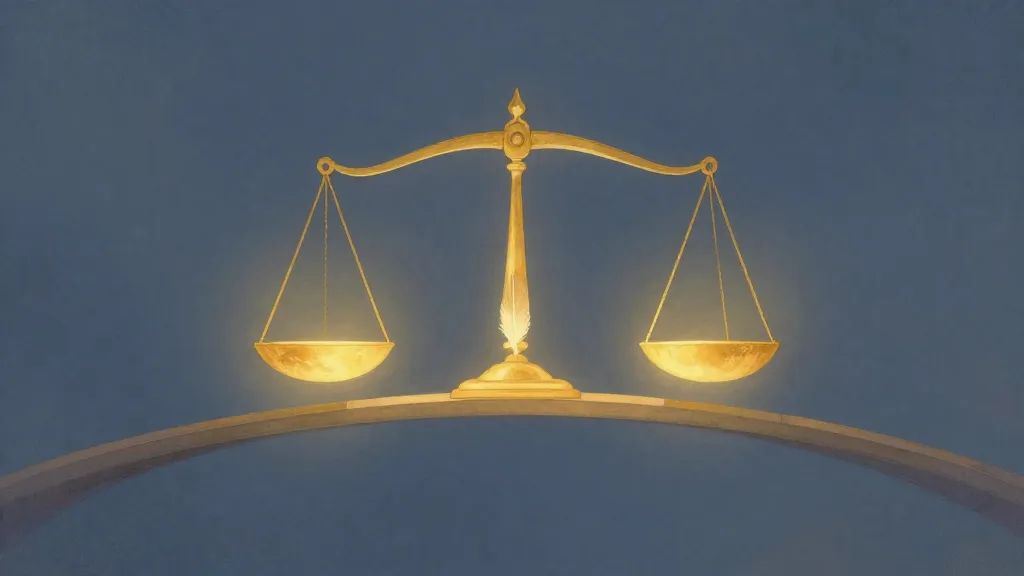
Anubis would lead the person by the hand toward a giant set of golden scales. On one side, he would place the person's heart. On the other side, he placed the Feather of Ma'at, which represented truth, balance, and cosmic order.
May Anubis set me on my feet. May he give me my heart and my tongue in the place where they belong.
If the heart was as light as the feather, it meant the person had been honest and fair. Anubis would then lead them to meet the other gods and live in the Field of Reeds, a place of eternal sunshine and emerald green grass.
The Color of Life
Usually, we think of the color black as representing darkness or sadness. But for the Egyptians, Anubis being black was a sign of hope. They didn't see it as the color of a shadow, but as the color of the Nile's soil.
In the earliest days of Egypt, Anubis was the most powerful god of the underworld. He was the king of the dead, and everyone answered to him.
Later in history, Anubis became more like a helpful younger brother or a specialized doctor. He let Osiris be the King while he focused on the 'science' of mummification and guiding people.
Every year, the Nile River flooded and left behind thick, black silt. This dirt was full of nutrients that allowed crops to grow. Because of this, black was the color of rebirth and new life.
Finn says:
"So, Anubis is kind of like a gardener of people? He takes care of them in the black soil so they can bloom into something else in the Field of Reeds?"
Anubis was black because he was the one who helped life start over again in a new way. He was the bridge between the end of one story and the beginning of another.
Anubis Through the Ages
A Changing Story
History is a long conversation, and the way people thought about Anubis changed over thousands of years. Early on, he was the king of the dead. Later, when stories of Osiris became more popular, Anubis took on a different, perhaps more intimate role.
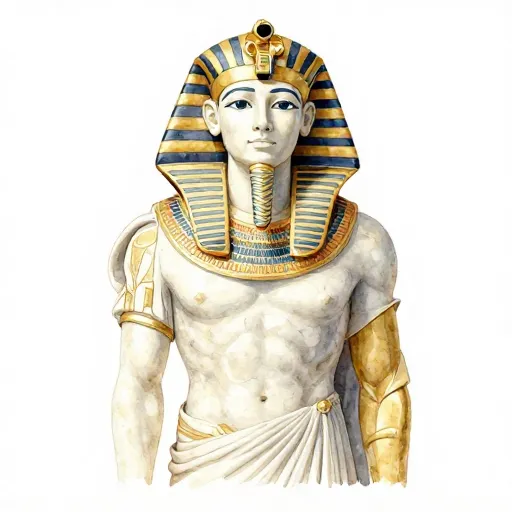
Anubis was so popular that even when the Romans took over Egypt, they didn't stop worshipping him. They combined him with their god Mercury to create a new god called Hermanubis who carried a herald's wand and had a dog's head!
He became the Psychopomp, a word that comes from the Greek language meaning a "guide of souls." He was the one who stood at the threshold, the place between two worlds, making sure no one felt lost or alone.

Anubis is the god who knows the way when the map is blank.
This is why Anubis remains one of the most beloved figures in history. He represents the part of us that isn't afraid of the dark because we have a lantern and a friend to walk with us.
Something to Think About
If you had to choose an animal to represent your most important traits, what would it be?
The Egyptians chose the jackal for Anubis because they saw something special in how that animal lived. There are no right or wrong answers, only interesting connections between our world and the world of stories.
Questions About Religion
Was Anubis a bad guy or a villain?
Why does Anubis have a dog's head?
Is Anubis the same as the Greek god Hades?
The Silent Friend
Anubis reminds us that even the parts of life that seem dark or mysterious can have a guardian. He wasn't a god of endings, but a god of transitions. Whether we are starting a new school, moving to a new house, or just wondering about the stars, we can think of the jackal god: the one who knows the way when the map is blank.