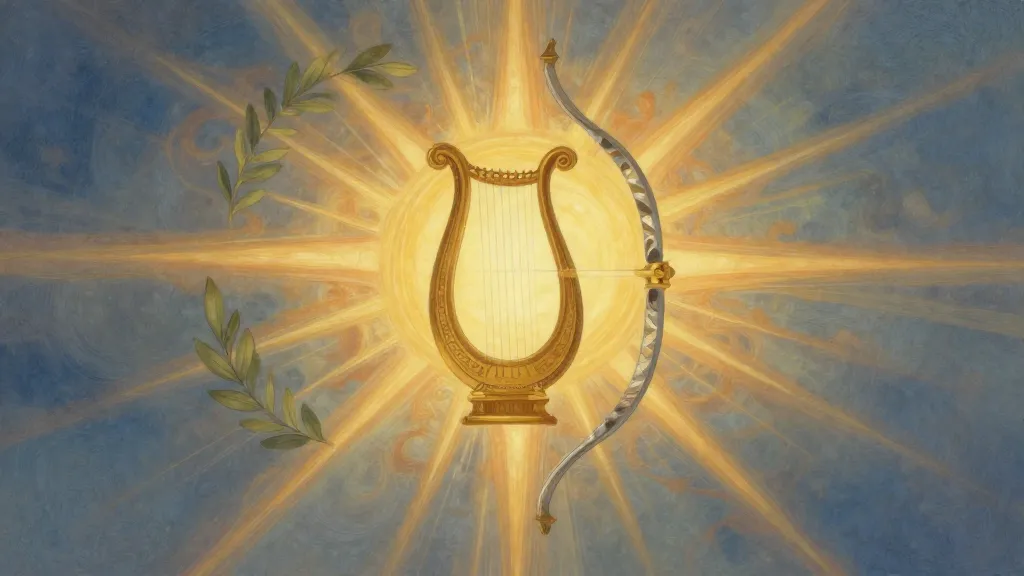
Have you ever wondered why we feel the need to make things perfect, whether it's a drawing, a song, or even a messy bedroom?
In the world of Ancient Greece, this urge for order and beauty was personified by the god Apollo. He was an Olympian who held the keys to music, truth, and the light of the sun, making him one of the most complex figures in history.
Imagine standing on a dusty, sun-drenched hill in Greece nearly three thousand years ago. The air smells of wild thyme and salty sea spray, and the sound of a distant lyre drifts through the olive trees.
To the people living then, the world was alive with invisible forces. They didn't see the sun as just a giant ball of burning gas, but as a sign of a mind that could see everything and bring clarity to the dark.
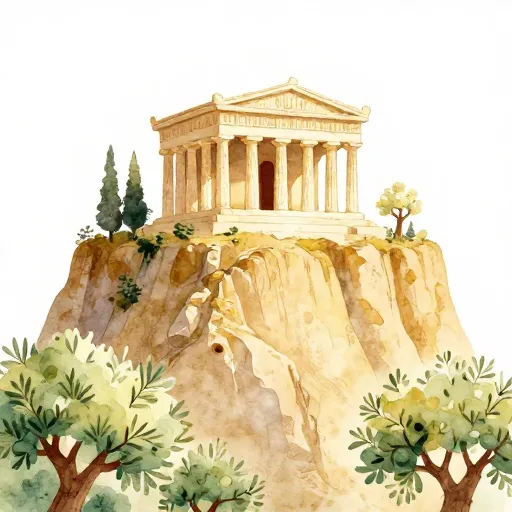
Imagine a temple perched on a cliffside so high the clouds drift through the pillars. Below you, a valley of a million silver-green olive trees stretches to the sea. This was Delphi, the 'center of the world,' where people believed the voice of a god could actually be heard in the whistling wind.
Apollo was born on the tiny, rocky island of Delos. His mother, Leto, had been chased across the world by a jealous queen, find no place to rest until this floating island offered her shelter.
When Apollo was born, it was said the island turned to gold. He didn't grow up slowly like a human baby: he tasted nectar and ambrosia, the food of the gods, and immediately stood up, demanding a bow and a harp.
I shall remember and not be unmindful of Apollo who strikes from afar. As he goes through the house of Zeus, the gods tremble before him.
From that very first day, Apollo represented a bridge between two worlds. He was a master of the bow, which could bring sudden death or protect a city, and a master of the strings, which could heal a broken heart.
He showed the Greeks that the same energy used for fighting could be turned into art. This was a revolutionary idea: that strength isn't just about muscles, but about the control and precision of a musician.

Mira says:
"It's funny how he's the god of the bow AND the god of the harp. One shoots arrows away, and the other pulls strings toward you. Maybe balance is about knowing when to let go and when to hold on?"
Apollo was often called 'Phoebus,' which means bright or pure. He wasn't just the god of light that you see with your eyes, but the god of the light that happens inside your head when you finally understand a difficult math problem.
He loved things that were clear, balanced, and logical. In a world that often felt chaotic and scary, Apollo was the promise that there was a hidden order to everything if you looked closely enough.
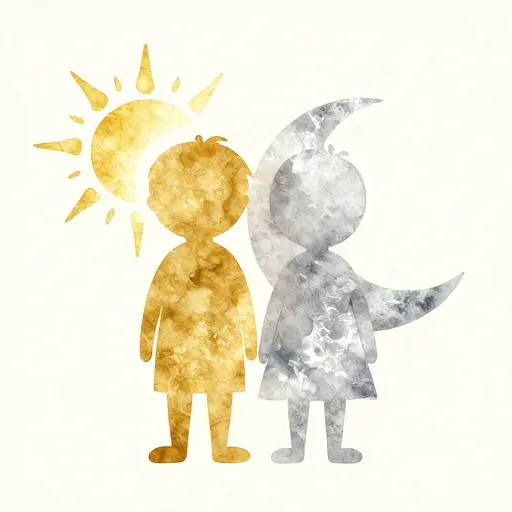
Apollo wasn't born alone! He had a twin sister, Artemis, the goddess of the hunt and the moon. While Apollo represented the sun and the city, Artemis represented the moon and the wild forests. They were the perfect pair of opposites.
One of his most famous symbols was the laurel wreath. He wore it to remember Daphne, a nymph who chose to turn into a tree rather than be captured by him, a story that reminded even the gods that they couldn't control everything.
This is one of the most interesting things about Apollo: even though he was the god of truth, he often struggled with his own feelings. He was powerful, yet he often felt the sting of loneliness or the frustration of being misunderstood.
The world should be orderly, logical, and beautiful. We should use our minds to create rules, practice our music, and keep our emotions under control. This is the 'Apollonian' way.
Life is meant to be wild, messy, and loud! Sometimes we need to stop thinking and just dance, shout, and let our feelings take over. This is the 'Dionysian' way (named after the god Dionysus).
Because he could see everything through his light, Apollo became the god of prophecy. He knew what was going to happen before it happened, but he didn't always tell people in a way that was easy to hear.
His most famous home was at Delphi, a temple built on the side of a steep mountain. People would travel for months from all over the Mediterranean just to ask him a single question through his priestess, the Pythia.

The Lord whose oracle is at Delphi neither speaks nor conceals, but gives a sign.
The answers given at Delphi were famous for being riddles. If a king asked if he would win a war, the Oracle might say: 'A great empire will fall.' The king would go to war, lose, and realize the empire that fell was his own.
Apollo didn't lie, but he expected people to use their own brains to figure out the truth. He believed that the journey of thinking was just as important as the answer itself.

Finn says:
"If I went to the Oracle and she gave me a riddle, I think I'd be frustrated! But maybe the riddle is like a mirror? It just shows you what you're already thinking."
Inside the temple at Delphi, there were two famous phrases carved into the stone. The first was Know Thyself, and the second was Nothing in Excess.
These two ideas were the heartbeat of Apollo's philosophy. He believed that if you understood your own mind and didn't do things to the extreme, you could live a life of perfect harmony.
- Know Thyself: Understand your strengths and your mistakes.
- Nothing in Excess: Don't eat too much, work too much, or even play too much.
- Seek Harmony: Find the middle ground between being too loud and too quiet.
Can you find the 'Golden Mean' today? Try to find the middle point between two extremes. For example: if you are drawing, find the spot between 'too messy' and 'too stiff.' If you are talking, find the volume between 'whispering' and 'shouting.' How does it feel to be right in the middle?
Apollo was also the leader of the Muses, nine sisters who looked after different types of creativity, like dance, history, and astronomy. He was like the conductor of a giant, cosmic orchestra.
Because he led the Muses, the word music actually comes from this group. For Apollo, music wasn't just something to listen to: it was a form of medicine that could calm a worried mind or help a sick person get better.
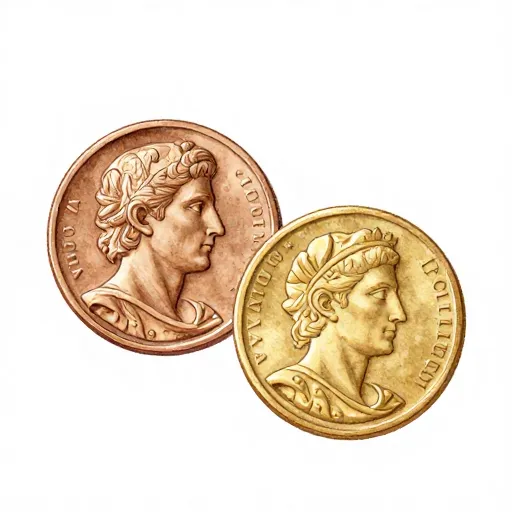
Apollo was the only major Greek god whose name stayed exactly the same when the Romans adopted the Greek religion. Most others changed: Zeus became Jupiter, and Aphrodite became Venus. But Apollo was simply too 'himself' to be renamed!
As the centuries passed, the way people saw Apollo changed. When the Romans took over, they loved Apollo so much that they didn't even change his name, which was very rare for them.
They saw him as a symbol of the Emperor's power: bright, unstoppable, and civilized. He became the face of the 'Golden Age,' a time when people believed that human reason could solve any problem.
Apollo Through the Ages
Even in the modern world, Apollo hasn't really left us. When NASA wanted to send the first humans to the moon in the 1960s, they didn't name the program after a god of travel or a god of the moon.
They chose Apollo. They chose him because the mission required the highest level of precision, math, and 'light' in the form of human knowledge, exactly the things Apollo stood for.
Mira says:
"The NASA scientists used Apollo's name to land on the moon, which belongs to his sister Artemis. It's like the two of them are still working together to help us explore the dark."
It is interesting to think about how Apollo's 'light' compares to the 'darkness' of other gods like Dionysus. While Apollo is about rules and logic, life also needs a bit of the wild and the unpredictable.
Perhaps the most important lesson Apollo teaches us is that the search for truth is never finished. Like a song that keeps developing new melodies, the way we understand the world is always changing.
Apollo, as the god of all shaping energies, is also the fortune-telling god. He, who is the 'shining one,' the deity of light, is also ruling over the beautiful appearance of the inner world of fantasy.
If you look up at the sun today, or if you practice a musical instrument, you are stepping into a tradition that is thousands of years old. You are practicing the art of bringing order to the world.
Apollo reminds us that being 'bright' isn't just about how much you know. It is about how much you are willing to look at the truth, even when the truth is a riddle that takes a lifetime to solve.
Something to Think About
If you could ask a question that has no easy answer, what would it be?
Apollo didn't give simple answers because he wanted people to think for themselves. There is no 'right' answer to this question, only the one that makes you curious.
Questions About Religion
Why is Apollo the god of so many different things?
Was Apollo a 'good' god?
Is Apollo the same as the Sun?
Keeping the Light On
Apollo represents the part of us that wants to learn, to create, and to understand the truth. Whether you are gazing at the stars or humming a new tune, you are carrying a little bit of that ancient golden light with you. Keep asking questions, keep practicing your 'lyre,' and always remember to know yourself.