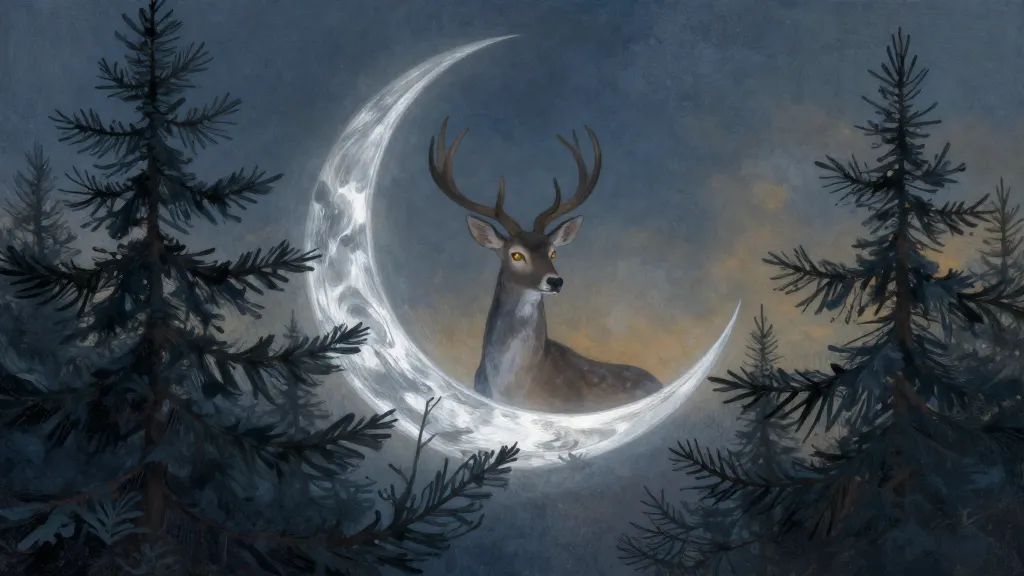
Have you ever stood at the very edge of a forest just as the sun was going down?
For the people of Ancient Greece, that flickering moment between day and night belonged to a specific power. They called her Artemis, the goddess who lived where the sidewalks ended and the shadows began.
Imagine a world without streetlights, where the night was truly dark and the woods were full of sounds you couldn't explain. This was the world of the Greeks nearly 3,000 years ago.
To them, the wilderness was not just a bunch of trees, it was a sacred space that required a guide. Artemis was that guide, a goddess who chose the mountains and the silver light of the moon over the golden palaces of Mount Olympus.

Imagine you are walking through a thick forest at midnight. The air is chilly, and the only light comes from the moon filtering through the leaves, turning everything silver. You hear a twig snap. You aren't scared, but you feel like you are being watched by something very old and very wise. That feeling of 'mountain-quiet' is what the Greeks called Artemis.
She was one of the twelve Olympians, the primary gods who ruled the Greek universe. While her father, Zeus, ruled the sky, Artemis looked after the places that felt "untouched" by human hands.

Finn says:
"If Artemis was a goddess, why didn't she want to live in a big fancy palace with everyone else? It seems like being alone in the woods would get a bit lonely after a while."
The Twin and the Light
Artemis was not alone in the world; she was the twin sister of Apollo, the god of the sun, music, and logic. They were born on the tiny island of Delos to a mother named Leto, who had to run away from a jealous queen to find a safe place to give birth.
Legend says that Artemis was born first and immediately helped her mother deliver her brother. This story made her a protector of mothers and young children, even though she was also the goddess of the hunt.

Artemis is the goddess of the outside, the goddess of the border, the goddess of the wild.
She and Apollo represented a perfect balance of light. While Apollo was the bright, clear sun that helps us see everything clearly, Artemis was the cool, silver moon that shows us things differently.
Apollo was the god of the city and civilization, but Artemis was the goddess of the "outside." She reminded the Greeks that no matter how many cities they built, the wild world would always be there.
Apollo represents the 'Logos' or logic. He is about music with structure, laws that are written down, and the clear light of the sun that reveals every detail.
Artemis represents the 'Wild.' She is about the things we can't fully explain, the rhythm of the seasons, and the soft light of the moon that leaves some things in shadow.
The Mistress of Animals
One of her oldest titles was Potnia Theron, which means "Mistress of Animals." This sounds like she was a zookeeper, but it was actually much more complicated and interesting than that.
Artemis was the protector of baby animals and the goddess of the hunt at the same time. To a modern mind, this might seem like a contradiction, but to the Greeks, it made perfect sense.

Mira says:
"I think Artemis is like the 'edge' of a map. She's the part where the rules of the city stop and the rules of nature start. It's not lonely if you feel like the trees are your friends."
In the wild, life and death are constantly dancing together. A lioness protects her cubs but must hunt to feed them; Artemis was the spirit of that necessary, natural cycle.
She didn't hunt for sport or for fun, but for survival and sacred ritual. She taught that if you take something from nature, you must respect it and never take more than you need.

Artemis had a favorite animal: the deer. Specifically, she was associated with the Ceryneian Hind, a massive female deer with golden antlers and hooves of bronze. It was said to be so fast it could outrun an arrow!
The Tools of a Goddess
When you see a statue of Artemis today, she is almost always carrying her signature weapon: a silver bow. Her arrows were said to be like moonbeams, striking silently and with perfect aim.
Give me to keep my maidenhood, Father, forever... and give me all the mountains.
She also wore a short hunting tunic, which was quite different from the long, flowing dresses other goddesses wore. This outfit allowed her to run, climb, and move through the brush without getting stuck.
She was often followed by a pack of hunting dogs and a group of Nymphs, who were nature spirits. Together, they formed a community that lived completely apart from the rules and expectations of human society.
Artemis was the goddess of focus. Try this: go outside and pick one small thing, like a leaf or a bug. Stare at it for 60 seconds without looking away. Notice every tiny line and color. This kind of 'hunter's focus' is exactly the kind of quiet attention Artemis was known for.
The Temple of Wonders
Artemis was so important that the people of Ephesus built a massive temple for her in what is now modern-day Turkey. This wasn't just any building; it was one of the Seven Wonders of the Ancient World.
It was four times larger than the famous Parthenon in Athens. People traveled for months just to see the 127 giant columns that reached toward the sky like a stone forest.
Finn says:
"A stone forest! I wonder if the people inside the temple felt like they were still outside. Maybe that was the whole point of making it so big."
Inside, the statue of Artemis looked very different from the athletic hunter we see in other art. She was covered in symbols of fertility and power, showing that she was the source of all life in the natural world.
This temple was a place of asylum, which meant that if someone was in trouble or being treated unfairly, they could find safety inside the temple's walls. Artemis protected the vulnerable, whether they were baby deer or people in need.
Through the Ages
Boundaries and Respect
One of the most famous (and sometimes scary) things about Artemis was how she protected her privacy and the boundaries of the wild. There is a story about a hunter named Actaeon who accidentally stumbled upon Artemis while she was bathing in a hidden pool.
Instead of apologizing, he stood and stared. In the world of Greek myths, this was a huge mistake because it showed a lack of respect for the goddess's space.

The moon is a cold mother. She has a giant silence.
Artemis turned him into a stag (a male deer), and he was chased away by his own hunting dogs. This story wasn't just meant to be a ghost story; it was a lesson about sanctity.
It taught the Greeks that some places are not meant for humans to control. It suggested that we should always ask permission before entering the "sacred groves" of the world and that some things should remain private and wild.
In the city of Ephesus, Artemis was linked to bees! The priests at her temple were called 'drones,' and the coins from the city had a picture of a bee on one side and a stag on the other. This showed she was the queen of the hive of nature.
The Modern Moon
Even though people stopped worshipping the Olympian gods a long time ago, the idea of Artemis is still very much alive. We still look at the moon and feel a sense of mystery, and we still feel a need to protect the wilderness.
When NASA decided to send the first woman to the moon in the 21st century, they didn't name the mission after Apollo again. They named it the Artemis Program.
It is a fitting name for a new age of exploration. Artemis reminds us to be brave, to stay focused on our goals, and to never lose our connection to the beautiful, wild world that exists just beyond our doorstep.
Something to Think About
If you could have a 'wild' place that belonged only to you, what would it look like?
Artemis reminds us that everyone needs a place where they can be themselves without anyone else watching or judging. There is no right or wrong way for your wild place to look: it might be a snowy mountain, a messy garden, or even just a quiet corner of your room.
Questions About Religion
Is Artemis a good or bad goddess?
Why is she associated with the moon?
Did Artemis ever get married?
The Call of the Wild
Artemis is a reminder that we all have a little bit of 'wild' inside us. She invites us to look at the moon, to respect the boundaries of nature, and to find strength in our own independence. The next time you see a silver light in the night sky, remember the goddess who chose the mountains over the palace.